On every one of them

“I found rest in remembering the hands laid on every one of us, not one of us overlooked, and the hands laid upon us are wounded hands.” (Amy Carmichael)

Rate this:

An encouraging meditation from Amy Carmichael:

Luke 4:40 He laid His hands on every one of them, and healed them.

This verse took life for me one day lately.  I was reading in the Revised Version and looked up the Authorized, to see if I was reading something new, for it felt new.  But no, I must have read it hundreds of times before.
     On every one of them.  It comforted me to know that He does not look upon us as a mass, but as separate needy souls.  I remembered the terrific attack that is always on the love that should hold us together, and I read over and over again John 15.9-17.  I know well that the devil hates and fears strong love.  If he can weaken us there, all goes.  For us, to weaken means to perish.  I found rest in remembering the hands laid on every one of us, not one of us overlooked, and the hands laid upon us are wounded hands.

He heals the lame

The heart of God in the words of God

The Hand that holds the seven churches also is laid upon each one of us individually.

Rate this:

One of the things Amy Carmichael has taught me to do is to pay more attention to things like what verse follows a verse, or to the little words in scripture, like “but”.  Here’s an example of a verse following upon a verse:

In the Bible we have ‘the heart of God in the words of God’, as someone said hundreds of years ago; and now here is something for you from the heart of God in the words of God:

                    In His right hand were seven stars.  Rev. 1.16
                   But He laid His right hand upon me, saying, “Fear not.”  Rev. 1.17

Did you ever fear a little as you thought of difficulties ahead?  Did you ever think, ‘The Lord Jesus has so many to take care of, how will He have time to think of me”?  We have the answer to such thoughts here.  It is the Hand that holds the seven stars (the seven churches, all the worlds and the Heaven of heavens), it is that Hand that is laid upon each one of us, and to each one the word is the same, ‘Fear not’.”
     This does not mean that there will not be difficulties and hard fights, and (if we are real soldiers) battle-wounds.  Look at the next ‘Fear not’. ‘Do not fear what you are about to suffer’ (Rev. 2.10).  In the day when those words were written, the things that true Christians were about to suffer were terrific.  But even though we have not to go through torture of the body, we shall all have to endure something which is really suffering, and which God knows is suffering; and so we have the glorious word at the outset, ‘Fear none of these things . . .; be faithful unto death, and I will give you the crown of life.’

And nothing shall hurt you (2)

Sometimes we do not feel in the least like treading down scorpions and serpents and all the power of the enemy.

Rate this:

Here are the rest of Amy Carmichael’s thoughts on Luke 10:19:

     Sometimes we do not feel in the least like treading down scorpions and serpents and all the power of the enemy.  Perhaps we are allowed to feel our nothingness, so that we may in the depths of our heart understand these other words “Without Me you can do nothing” (John 15.5).  I think there was something of this in our Lord Jesus’ mind, when He told the story of one who had nothing to set before his friend–not a crumb–and it was midnight.  [Cf. Luke 11.5-8] When we do not feel victorious and have nothing to give to others, it is in truth “midnight” in our soul, “the dark night of the soul”, old writers called it.
     But we have  God to Whom we can go at any minute, the weakest minute, the darkest minute, “at midnight”.  “Be Thou my strong habitation, whereunto I may continually resort: Thou hast given commandment to save me; for Thou art my Rock and my Fortress” (Ps 71.3).  And if it be victory over the power of the enemy in our own hearts that we need, He will give us not just crumbs, but loaves–“He will rise and give him as many as he needs” (Luke 11.8).

[For a related link, see “When you feel like you have nothing left to give . . . “]

And nothing shall hurt you (1)

Today and tomorrow I’d like to share a couple reflections from Amy Carmichael (Edges of His Ways).  (Can you tell that I love her writings?)  They both have to do with this passage: “Behold, I have given you authority to tread upon serpents and scorpions, and over all the power of hte enemy; and nothing shall hurt you” (Luke 10:19)

     Our Lord Jesus said this to the seventy: and yet we know that all downthe ages His servants have been hurt in a thousand ways.  So the words must mean, and we know they do mean, something that goes far deeper than bodily hurt, deeper even than disappointment–that hardest hurt the mind can be asked to bear.
     It must mean that our spirits shall tread on serpents and scorpions, and have power over all the enemy.  Nothing shall be able to sting our spirit, poison it, or paralyse it.  It is one of the magnificent promises of the Bible.  We cannot take it too literally.  There is no need to be overcome, whatever happens. “O my soul, thou hast trodden down strength” (Judges 5.21).

Never be afraid of singing too much

An excellent way to put the Enemy to flight is by singing.

Rate this:

Another thought about those Philistines (from yesterday’s post).  One of the things I do sometimes when I’m under attack is to sing–especially small songs, little ditties I’ve learned over the years like “I will sing of the mercies of the Lord forever” or “I am my Beloved’s and His is mine, His banner over me is love” or “I love you, Lord, and I lift my voice”.   It helps us to forget the Enemy and that is a very effective strategy against him.  As Amy Carmichael says:

The reason why singing is such a splendid shield against the fiery darts of the devil is that it greatly helps us to forget him, and he cannot endure being forgotten.  He likes us to be occupied with him, what he is doing (our temptations), with his victories (our falls), with anything but our glorious Lord.  So sing.  Never be afraid of singing too much.  We are much more likely to sing too little.

But what if you can’t even think of something to sing or your soul is too heavy?  Not to worry.  Your grief, your sorrow, your heaviness can become a song to Him, a sacred lament.  Sing to Him of it.  “Then David and the people who were with him raised their voices and wept, until they had no more strength to weep. (1 Sam. 30:4)  And what if you feel that you can’t even do that?  Take heart. Just turn to your Beloved and ask His Holy Spirit to sing through you, for you are His song, you know.

It takes all the sting out of a disappointment . . .

Can we receive all as coming from the hand of Christ?

Rate this:

This is a follow-up on “God is the One at the end of the line” (posted 7/5/09).   This quote from Amy Carmichael caused a paradigm shift in my thinking when I first read it, and I continue to come back to it periodically.  She’s commenting on how St. Paul called himself a “prisoner for the Lord” numerous times.  “Do not be ashamed of testifying to our Lord, nor of me his prisoner” (2 Tim 1:8) :

It takes all the sting out of a disappointment if we see it as Paul did.  Isn’t it interesting that never once does he call himself Nero’s prisoner, though he was chained by Nero’s chain and in Nero’s cell?  This has been a great comfort to me.  We don’t admit the domination of Nero–no, not for an hour.  We have to do only with the sovereignship of Christ.

And that brought to mind this same orientation from St. Paul of the Cross, this time in reference to Jesus.  “[Jesus] said to Peter, as Peter was wielding his sword against the soldiers who had come to take Jesus, ‘Put your sword into its scabbard.  Am I not to drink the cup the Father has given me?’ (Jn 18:11)”

It is significant that Jesus did not say, “Am I not to drink the cup that these soldiers are giving me?” or “the cup that Annas or Pilate is giving me?” Jesus saw everything as coming from the hand of his Father and did not take the cup from those whom St. Paul of the Cross calls “intermediaries”.  Jesus took it directly from the hand of his Father.

Can we say the same about the difficulties in our own lives?

Cloud and Fire (2)

Gold is gold before it goes through the fire.

Rate this:

Well, as I think about it, I realize that the Lord leads me by fire also–not the kind of brilliant, clear fire ahead of me–or by Fourth of July fireworks either–but by a purifying internal fire, a fire that purges and causes great longing for Him and Him alone.   It’s not a fire that makes one “feel good” necessarily, but, nonetheless, it is a fire that leads, and leads us to places that we cannot go on our own.  It is the very fire of  His Holy Spirit making us ready to see Him as He is.

And that reminds me of something a good friend of mine, Cecilia, told me years ago when I was going through the fire: “Gold is gold before it goes through the fire.”  A good thing for us all to remember–we are already gold.  Amy Carmichael illustrates this point somewhere in her writings where she tells the story of a goldsmith who keeps pulling his work out of the fire and checking it.  When asked what he was doing, he replied that he was waiting for it to be pure enough to see his face in it.  So also does Christ want to see His face reflected in us, and that is the beautiful purpose of the fire in our lives.

Cloud and Fire (1)

God is just as much in the cloud as in the fire.

Rate this:

“The Lord went before them . . . in cloud and fire.” (Exodus 13.21)

I don’t know about you but most of my prayer times seem to be in the cloud rather than the fire.  It’s comforting to know that God leads by a cloud as well as by a pillar of fire.   And it’s also strengthening to remember that God spoke to Moses out of the cloud.

From Amy Carmichael:
When Moses went up, a cloud enfolded him.  In that cool darkness he heard words which afterwards he spoke to the people in the heat and glaring light of the plain.  So, day by day, as we look forward into the hours which seem to rush upon us, we see not clearness but a cloud.  Then a Voice that we know calls softly, Come up to Me, and be here; the Cloud of the Unknown becomes for us then the very over-shadowing of the wings of the Lord; we sit down under His shadow with great delight, and His fruit is sweet to our taste [Song of Songs 2.3].  And this fruit, tasted first in the dark alone with Him, will be ours for others.  “What I tell you in darkness,” He says to us still, “speak that in the light.” [Matt. 10.27]

Figures of the True

Everything in God’s creation points to Him if only we have the eyes to see.

Rate this:

Amy Carmichael has a slim book called Figures of the True.  It is a collection of meditations on some photos that someone sent her in her illness.  Each picture, she says, is a “Figures of the True”: “For surely they are not only lovely pictures of fragments of a lovely creation, they are patterns of things we all know if we have ever really lived: they are Figures of the True.”  Everything in God’s creation points to Him if only we have the eyes to see.

Fairy Door
Fairy Door

Today I am going over to our “baby house” to help our little girls, Anna and Renee, make some fairy doors.  Ann Arbor has a set of these around town, delightful little doors through which one can peek and see the little world of fairies.  I’ve always loved looking through them.  The girls recently took a tour of them and want to make their own.  I started thinking about how they, too, are a Figure of the True.  Most of these doors around town require one to stoop down to look through them. It’s only then that you can see into the little room created behind the door.  In the spiritual life, humility is often referred to as the low door through which one must enter the kingdom of heaven.  And the world one enters through that door is far more delightful and beautiful than that behind any fairy door . . .  Let’s not hesitate to stoop and enter by the door of humility as it presents itself daily in our lives. 

P.S. I’ll post pictures of the little girls’ doors soon. (See “More Figures of the True.”)

But she came and worshipped him

This, by Amy Carmichael, has made me reflect on my own response to what I would consider “undeserved” remarks.  (I put “undeserved” in quotation marks because if I really reflect on my true state, I realize how I deserve even more. 🙂  Amy is reflecting on the story of the Canaanite woman who came to Jesus begging healing for her daughter.  If you remember, the disciples wanted to send her away, and Jesus cryptically replied: “I was sent only to the lost sheep of the house of Israel.” 
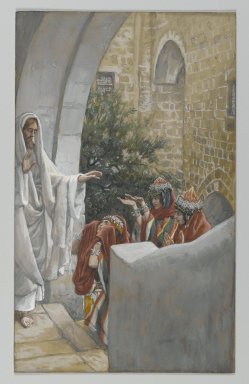
The Canaanite woman (James Tissot)Mt. 15:25  But she came and worshipped Him.

Her prayer had met first silence, and then a perplexing answer, for she must have heard our Lord Jesus’ words to His disciples, and she would know what they meant.  It was all perplexity then, and disappointment.  But she came and worshipped. . . .
     These words spoke to my heart today.  Sometimes our prayer does not at once meet with the response we expected, and the temptation then is to discouragement. “But she came and worshipped.”
     May the Lord work in us both to will and to do, so that conquering the natural inclination of our weak hearts, we shall turn our disappointments to causes and occasions for worship.  Worship may lead to renewed intercession, as it did in this blessed story, but first let there be worship, the adoration of the lover, the quietness of faith.    (Edges of His Ways)

And that brought to mind the incredible response of Job after he lost his servants, sheep, ox, asses, camels, and his sons and daughters (certainly a greater trial than a few hard words): Then Job arose, and rent his robe, and shaved his head, and fell upon the ground and worshipped (Job 1:20). 

May it be the same with us.

[Note: for an excellent exposition of the story of the Canaanite woman–one that I’ve struggled to understand for years–read Erasmo Leiva-Merikakis’s Fire of Mercy, Heart of the Word, Meditations on the Gospel of Matthew, Vol. 1, “Dog in Search of Master.” ]