A walk along the river

Yesterday I was talking a walk around Gallup Park along the Huron River.  When I turned one corner, I was struck by the brightness of the sun being reflected off a portion of the river.  I started thinking about how that brightness was the result of the sun being reflected of many individual drops of water.  We are like those drops of water.  Many days we can wonder whether our life counts for anything.  We’re just living our ordinary daily lives, trying to love God and love His people.  Who even knows about us?  Yet, we are part of a people, the people of God. And when His light shines on us, we do reflect it.

In order for light to reflect off of something, the object must be pure, and that requires purification –the purification that happens right there in the ordinariness of our lives. This reminds me of a story told by Amy Carmichael.

One day in India, she took her children to see a goldsmith refine gold in the ancient manner of the East.  He was sitting at his little charcoal fire.  Amid the glow of the flames he place a common curved roof tile.  Another tile was used to cover it as a lid, and this became his simple, homemade crucible.  Into the crucible the refiner placed ingredients: salt, tamarind fruit, and burned brick dust.  Embedded within these ingredients was a gold nugget.  The fire worked on the gold nugget, ‘eating it,’ as the refiner put it.  From time to time, he would lift the told out with the tongs, let it cool, then rub it between his fingers.  Then he would return it to the crucible and blow the fire hotter than it was before.  ‘It could not bear it so hot at first, but it can bear it now,’ he explained to the children. ‘What would have destroyed it then helps it now.’  Finally Amy asked, ‘How do you know when the gold is purified?’ The refiner answered, ‘When I can see my face in it, then I know it is pure.'(Robert J. Morgan, The Promise: God Works Everything Together for Your Good, pp. 91-92)

The Hill Mizar

Did you ever wonder about Mizar in Ps 42–where it was and what was its significance?  (Maybe you didn’t, but have I piqued your curiosity?)  Here’s Amy Carmichael’s take on it:

Ps 42.6  The Hill Mizar

Did you ever feel that you had nothing great enough to be called a trouble, and yet you very much needed help?  I have been finding much encouragement in the hill Mizar.  For Mizar means littleness–the little hill.  The land of Jordan was a place where great floods (the swelling of Jordan) might terrify the soul, and the land of the Hermonites was a place of lions and leopards [FYI: these are the places mentioned in this verse]; but Mizar was only a little hill: and yet the word is, I will “remember You from . . .  the hill Mizar”, from the little hill.

So just where we are, from the place of our little trial, little pain, little difficulty, little temptation (if temptation can ever be little), let us remember our God.  Relief will surely come, and victory and peace; for “the Lord will command His lovingkindness” (v. 8), even to us in our little hill.

Look out your window

I really don’t feel inspired this morning  . . . so, when in doubt, turn to Amy Carmichael!

Dan 6.10 His windows being open in his chamber toward Jerusalem.

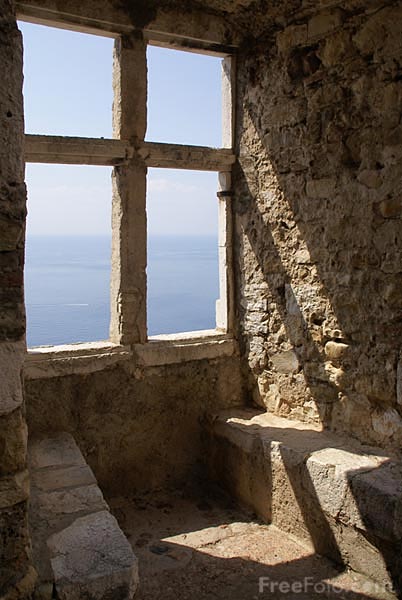
Daniel had only to kneel down upon his knees beside one of those windows, and at once he had access to the Father.  Daniel’s windows almost certainly were very small, set in a thick wall.  We often feel that the windows of are chamber are very small–we see so little, know so little of our Heavenly Jerusalem–but a bird can fly through a very small window out into the wide blue air, and if our windows be open toward Jerusalem, we shall in heart and mind thither ascend.

Leaning upon your Beloved

From Amy Carmichael:

I want to give you a word that helped me all yesterday and will help me today.  It is the “through” of Psalm 84.6 [“As they go through the bitter valley, they make it a place of springs”] and of Isaiah 43.2 [“When you pass through the waters I will be with you; and through the rivers, they shall not overwhelm you”], taken with Song of Songs 8.5 [“Who is that coming up from the wilderness, leaning upon her beloved?”].

We are never staying in the valley or the rough waters; we are always only passing through them, just as the bride in the Song of Songs is seen coming up from the wilderness leaning upon her Beloved.

So whatever the valley is, or however rough the waters are, we won’t fear.  Leaning upon our Beloved we shall come up from the wilderness and, as Psalm 84.6 says, even use the valley as a well, make it a well.  We shall find the living waters there and drink of them.

One’s little pot of oinment

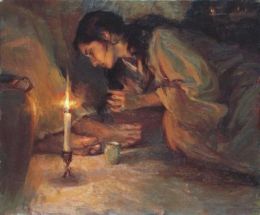
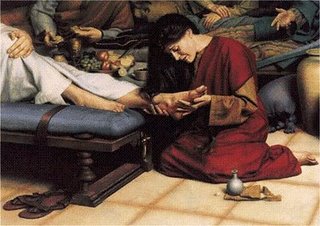
Today’s Gospel as we begin Holy Week is the story of Mary of Bethany anointing Jesus’ feet.  A meditation from Amy Carmichael to ponder when we think we have broken our “little pot of ointment” in vain.

Things to remember quietly when one’s little pot of ointment seems to have been broken in vain.  Of Thine own have we given Thee, for love is of God.  The love, then, was His, and to Him first of all it was offered–to the human dear one not first but second.  No pot of ointment was ever broken at His feet wihtout given Him some little quick sense of pleasure. So it was not all in vain.  Then if it seemed to miss what we meant it to do for the one we love down here, it may be only for the moment.  The remembrance may return and be very sweet, like a fragrance.

The more loving the heart is, the more it looks forward to giving a pleasure to the one it loves, the keener therefore the pang of disappointment when it fails, and the fiercer the inrush of depression.  The heart is grieved and cannot rise to be glad.  At such times it does help to know that love cannot be as water spilt on the ground.  For it is of God.  The fragrance of the ointment will yet fill the house.  The one to whom we wanted to bring comfort will in the end find that which we brought.  But the sweet and immediate comfort is-–‘Of Thine own have we given Thee.’  Dear Lord, did it comfort Thee?

Quiet time

We were talking this morning at breakfast about how busy this Lent has been for some of us.  What happened to Lent being a “retreat”?  For many of us it’s been a time of providing more spiritual help for others–Sr. Ann has been out of town a lot doing retreats, I’ve had some unexpected spiritual direction meetings, etc.  Nonetheless, it is so important to guard our times of personal prayer–especially during this season.  Here’s a word about this from Amy Carmichael, commenting on Ps 28.9:

Ps 28.9: Save . . . bless . . . feed . . .  lift up . . .

What an inclusive prayer!  nothing is left out.  The word that speaks to me specially is “feed”.
I do not think there is anything from the beginning of our Christian life to the end, that is so keenly attacked as our quiet with God, for it is in quietness that we are fed.  Sometimes it is not possible to get long uninterrupted quiet, but even if it be only ten minutes, “hem it in with quietness.”  Enclose it in quietness; do not spend the time in thinking how little time you have.  Be quiet.  If you are interrupted, as soon as the interruption ceases, sink back into quietness again without fuss or worry of spirit.  Those who know this secret and practise it, are lifted up.  They go out from that time with their Lord, be it long or short, so refreshed, so peaceful, that wherever they go they unconsciously say to others, who are perhaps cast down and weary, There is a lifting up.

Passing through the midst of them

In last Sunday’s gospel, Luke recounts the story of Jesus escaping those who were furious enough with him to want to throw him headlong off the brow of a hill.  Luke simply states: “But Jesus passed through the midst of them and went away (Lk 4.30)”.  An astonishing thing.  Amy Carmichael applies this verse to our own lives:

Our new month will bring us joys, for the Lord of joy is with us; it will also bring us sorrows, for sorrows are part of life.  It may bring things which would “throw us down” if they could.  But they need not ever do that, for it is possible for us to do just what our Master did when, passing through the midst of them, He went His way.
As, by His grace, we go on in quietness, we shall find those words we know so well come true: “My Presence will go with you, and I will give you rest” (Ex 33.14).  (Edges of His Ways, p. 18)

Little words (7)

In October I did a series of posts on “little words” in Scripture that are really “big” words.  I wanted to share another with you today.  

Psalm 73.26: But God

These words have been like strong hands lifting up, bearing up, countless thousands of souls. “My flesh and my heart faileth: but God is the strength of my heart and my portion for ever.”  Many who will read this note are well and strong and joyful in their work, thank God for that.  Sooner or later, however, to most who follow the Crucified, there comes a time when flesh and heart fail, and if it were not for that “But God”, we should go under. . . .   (Amy Carmichael, Edges of His Ways, p. 12)

It’s evident to me what it means to have your flesh fail, but I have been pondering what it may mean to have your heart fail: sorrow, doubts, hopelessness, discouragement, etc.  It comforts me to hear those words: but God even in the midst of those failings.  He will be for us all times–another very important little word.  🙂

(For the other “little words” posts, go to the first one here and move on from there.)

John must have wondered . . .

I have a number of “lighted coals” in my life.  One of them is Amy Carmichael whom I have quoted quite often in this blog.  She never fails to “rekindle” me.   And one of my favorite things is to introduce my good friends to one another.  Here is another gem from her:

I have been reading Luke 1.  “With God nothing shall be impossible” [Luke 1.37].   Then I read Acts 12.  James was killed in prison; Peter was set free.  God, with whom nothing is impossible, did not answer the prayers of those who loved James in the same way as He answered prayers of those who loved Peter.  He could have done so, but He did not.  “And blessed is he who takes no offense at Me” [Luke 7.43].  The words seem to me to be written across Acts 12.  John must have wondered why the angel was not sent to James, or at least have been tempted to wonder.  Again and again in Acts the Lord Jesus seems to say those words under His breath, as it were.  Let us turn all our puzzles, all our temptations to wonder why, into opportunities to receive the blessing of the unoffended.
     And now all the grief of those days has been utterly forgotten by those who loved James; they have all been together with him in the Presence of the Lord for 1900 years, and the one thing that matters now is how they lived through those days when their faith was tried to the uttermost.
     So it will be with any who are longing to see the answer to their prayers for those who are in affliction, or any other adversity.  In a few years–how few we do not know, but few at most–we shall all be together in joy.  So with us, too, all that matters is how we live through these days while we are trusted to trust.   (Thou Givest . . . They Gather, p. 76)

The same day that my good friend, Deb, was in her bad car accident, I heard of another person who spun out on the expressway, hit a truck, ended up facing the right direction, and was able to drive off without injury.  I, too, have wondered, but I also know only too well: “Blessed is he who takes no offense at Me.”

“If he had leaned on Jonathan . . .”

Continuing from yesterday. . .  In this meditation, Amy writes about the importance of our not leaning so much on our friends for support to the point that we don’t lean on the Lord–especially in those times when our friends can’t be there for us.  David is in serious trouble–not just a slight emotional blip on the screen–and Jonathan is not there for him.

Next time we read of David being in serious trouble he had no Jonathan to strengthen his hands.  “And David was greatly distressed; for the people spoke of stoning him . . . .But David encouraged himself in the Lord his God.” [1 Samuel 30.6]  Long afterwards when he was delivered from Saul he sang one of his songs, “It is God who girded me with strength . . . You have girded me with strength . . . . The Lord lives.” [Ps 18.32, 39, 46]  (His dear Jonathan was dead, but he does not even speak of him, all that matters is, “The Lord lives; and blessed be my Rock.”.)
     If he had leaned on Jonathan, if Jonathan had made himself necessary to David, he would not have leaned on his Rock and proved the glorious strength of his Rock; his whole life would have been lived on a lower level, and who can tell how many of his songs would have been left unwritten, with great loss to the glory of God and to the Church of all ages?
     So let us not weaken those whom we love be weak sympathy, but let us love them enough to detach them from ourselves and strengthen their hands in God.

God knows what and whom we need in our distress, and first and foremost, He will gird us with strength and be our Rock.