Pneuma
The wind breathes where it wishes
blows where it flows
The eye of your storm
sees from the wild height
Your air augments the world
tearing away dead wood
testing, toughening all trees
spreading all seeds
sifting the sand
carving the rock
the water
in the end
moving the mountain.~Luci Shaw
Category: Poetry

And That Will Be Heaven
A Sunday-poem for you:
And That Will Be Heaven
and that will be heaven
and that will be heaven
at last the first unclouded
seeingto stand like the sunflower
turned full face to the sun drenched
in light in the still centre
held while the circling planets
hum with an utter joy
seeing and knowing
at last in every particle
seen and known and not turning
away
never turning away
again~Evangeline Patterson
“Not all gold”
A beautiful poem for this Sunday from a fellow blogger: “Not all gold”
My heart, where have you gone?
A poem for this feast of Our Lady of Sorrows:
Christ and His Mother at the Cross
Christ:
Mother, take my broken heart
For your own to share apart.
John, beloved as you are
Shall be to you a son.
John, my mother here behold;
Take her tenderly and hold
her in your love. For she is cold,
her heart has come undone.Mary:
Son, your spirit has gone forth.
Son of all surpassing worth.
My eyes are in their vision dark
And dying is my heart.Hear me, Son, so innocent,
Son of light magnificent
Spending and now spent,
and only darkness for my part.
Son of whiteness and of rose,
Son unrivaled as the snows,
Son my bosom held so close,
My heart, where have you gone?John, disciple whom he loved,
your brother must be dead,
for I feel the sword through me
as prophesied.Jacopone da Todi

The fire of Your love
Eternal Trinity,
Godhead,
mystery deep as the sea,
you could give me no greater gift
then the gift of
yourself.
For you are a fire ever burning and never consumed,
which itself consumes all the selfish love
that fills my being.Yes, you are a fire that takes away the coldness,
illuminates the mind with its light,
and causes me to know your
truth.And I know that
you are beauty and wisdom itself.The food of angels,
you gave yourself to man
in the fire of your
love.~St. Catherine of Siena

“O what it must have cost the angels”
Today we celebrate the birth of Mary. I have to say that this morning when I woke up, I felt like breaking into a little song to her, at least “Happy birthday to you . . .”–which sounds so trite–but I knew in my heart that that would be dear to her . . . because she is that kind of Mother.
I want to share the first verse of a poem by Rilke because I think it conveys the sense of joy in the heavens at the birth of this great gift of God to us.
Birth of Mary
O what must it have cost the angels
not suddenly to burst into song, as one bursts into tears,
since indeed they knew: on this night the mother is being
born to the boy, the One, who shall soon appear.(Rainer Maria Rilke, translated from the German by M.D. Herter Norton)

“He Who Would Be Great Among You”
I felt like dipping into Luci Shaw this morning.
He Who Would Be Great Among You
You, whose birth broke all
the social and biological rules–
son of the poor who accepted
the worship due a king–
child prodigy debating
with the Temple Th. D.s–you
were the kind who used a new math
to multiply bread, fish, faith.
You practiced a radical sociology:
rehabilitated con men &
call girls. You valued women,
aliens, & other minority groups.
A general practitioner,
you specialized in heart surgery.
Creator, healer, innovator,
shepherd, story-spinner,
weather-maker, botanist,
alchemist, exorcist, iconoclast,
seeker, seer, motive-sifter,
you were always beyond us,
ahead of your own time, & ours.And we would like to be
like you. Bold as the James and John,
the Boanerges brothers,
we hear ourselves demand,
“Admit us to your avant-garde.
Grant us degrees in all
the liberal arts of heaven.”
Why our belligerence? Why
does this whiff of fame and greatness
smell so sweet?
Why do we always compete
to be first? Have we forgotten
how you took, gently & simply,
cool water, & a towel for our feet?~Luci Shaw
Even there
Written by a missionary in Communist China in the early 1950’s, with only 15 cents left in his pocket, a terrible toothache, no fuel and a tiny daughter with scarlet fever. The beginning reference is to Acts 27:27-32.
In Adria’s tempest-tossed wastes,
My barque through the dark deeps is driv’n;
The canvas all torn from my masts,
My timbers by stormy waves riv’n.
Yet there faith’s assurance rings clear,
E’en there will I trust, EVEN THERE.All hope for deliverance had gone,
Despair’s chilly gloom shrouded all;
No sun’s ray through threat’ning cloud shone
To brighten the future’s dark pall.
Yet there should my heart quake with fear,
E’en there will I trust, EVEN THERE.My brook’s daily waters had dried,
All replenishing springs scorched bare;
Resourceless in sore need I cried
To a God who seemed not to care.
Though trembling, triumphant I bow
E’en now will I trust, EVEN NOW.The barrel of meal empties fast,
The tempter crowds close with his lies;
“Can God?” Ah! He’s failed you at last,
“In wilderness find fresh supplies.”
Perish doubts! Though I know not how,
E’en now will I trust, EVEN NOW.~Arthur Mathews
The pass of suffering
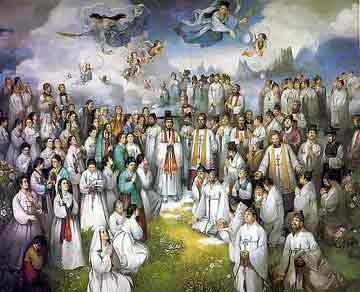
In reading the book by Richard Wurmbrand this past week, it is hard not to think of all those who have gone before us to Christ by the path of martyrdom and the many who tread that path today. This poem by Emily Dickenson succinctly sums up their secret and is an encouragement to all of us.
Through the straight pass of suffering
The martyrs even trod,
Their feet upon temptation
Their faces upon God.
“Do Thou For Me”
Amy Carmichael’s note on this poem of hers: “Ps 109.21. A prayer that may be unfathomable comfort to the ill and tired: ‘Do Thou for them, for him, for her, O God the Lord.’ When one cannot pray minutely or powerfully, this prayer suffices. We need not tell Love what to do; Love knows.” God knows better than we what is best for those we love. Here Amy is simply encouraging us to trust Him who knows how to love best.
Do Thou For Me
Do Thou for me, O God the Lord,
Do Thou for me.
I need not toil to find the word
That carefully
Unfolds my prayer and offers it,
My God, to Thee.
It is enough that Thou wilt do,
And wilt not tire,
Wilt lead by cloud, all the night through
By light of fire,
Till Thou has perfected in me
Thy heart’s desire.
For my beloved I will not fear,
Love knows to do
For him, for her, from year to year,
As hitherto.
Whom my heart cherishes are dear
To Thy heart too.
O blessèd be the love that bears
The burden now,
The love that frames our very prayers,
Well knowing how
To coin our gold. O God the Lord,
Do Thou, Do Thou.

