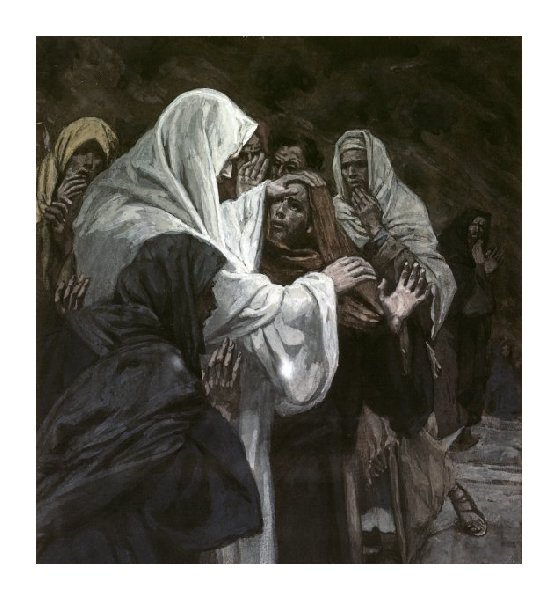
It’s still the time, the season, of remembering Christ’s appearances to those He loved. Let us not move too quickly back into ordinary time. (Is there ever an “ordinary” time with Christ in our lives?) Luci Shaw captures this need to learn to recognized Him in this Sunday-poem. We, too, need to “get beyond the way he looks” in our everyday lives:
He who has seen Me has seen the Father (James Tissot)
“. . . for they shall see God”
Matthew 5.8
Christ risen was rarely
recognized by sight.
They had to get beyond the way he looked.
Evidence strong than his voice and face and footstep
waited to grow in them, to guide
their groping from despair,
their stretching beyond belief.
We are as blind as they
until the opening of our deeper eyes
shows us the hands that bless
and break our bread,
until we finger
wounds that tell our healing,
or witness a miracle of fish
dawn-caught after our long night
of empty nets. Handling
his Word, we feel his flesh,
his bones, and hear his voice
calling our early-morning name.
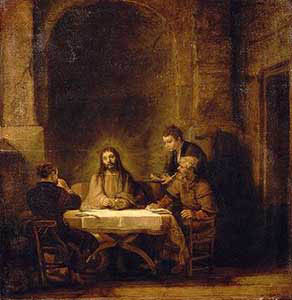
The poem for this Sunday describes the experience of the two disciples on the road to Emmaus:
Companion
When first He joined us, coming, it seemed from nowhere,
and yet, somehow, as if he had followed us a long, long time,
immediately, He was one of us, no stranger, but
a close companion, speaking softly, familiar with our lives,
these days, the answers to our doubts.
And when we moved Him to at least partake of food,
he stood there at the table, not as guest, but host,
and broke the bread to portions, one for each,
then poured the wine, His dark-marked hands
blessing the wine and us. Was it that act,
His broken hands raised up against the wooden walls,
the prayer-bowed head, the gently spoken word
or some reflection trembling in the wine,
a thickening of air, a luminosity not of wavering light,
that pierced our hearts with joy,
that filled our mouths with praise? O praise!
O joy! Then suddenly the light withdrawn,
no longer form and lifted hands above the bread.
Stumbling, we found the road to town,
knowing that never, never would we walk alone again.
Doubt padlocked one door and
Memory put her back to the other.
Still the damp draught seeped in, though
Fear chinked all the cracks and
Blindness boarded up the window.
In the darkness that was left
Defeat crouched, shivering,
In his cold corner.
Then Jesus came
(all the doors being shut)
and stood among them.
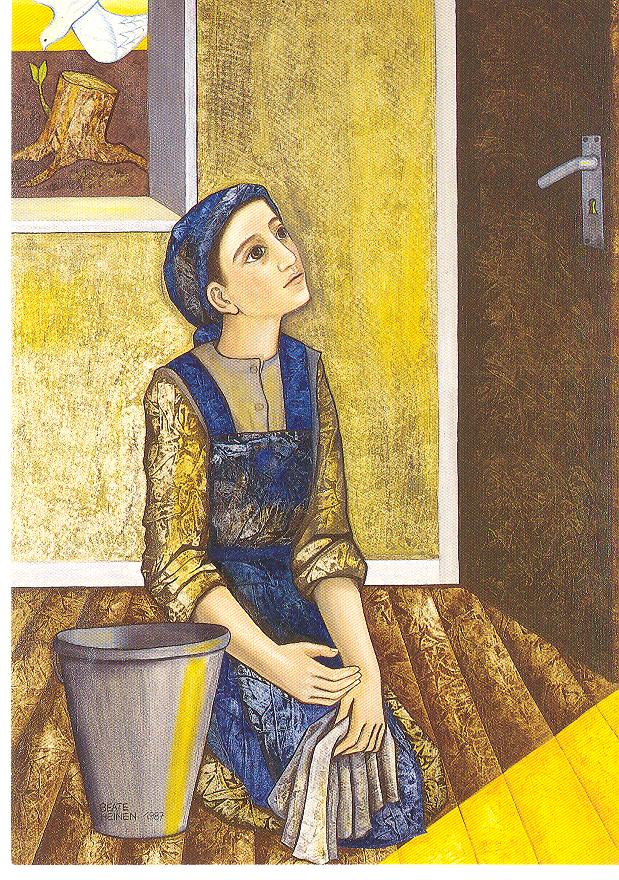
There are so many artistic depictions of the Annunciation, but one of my all-time favorites is one that a good friend of mine gave me a few years ago. You can see it below. Not too long afterward I came across a poem by Luci Shaw that seemed to have been written for it. I share that with you as well. Thank you, Mary, for your earth-changing yes. . .
Virgin
As if until that moment
nothing real
had happened since Creation
As if outside the world were empty
so that she and he were all
there was–he mover, she moved upon
As if her submission were the most
dynamic of all works; as if
no one had ever said Yes like that
As if that day the sun had no place
in all the universe to pour its gold
but her small room
Bare-soled he waits,
bowed bare-headed, stripped to the heart,
eyes narrowing, hands to his face
against the heat,
watching.
Hissing, the dust-dry leaves
and cobwebs shrivel
baring the curved thorns
woven with gold,
and the black-elbowed branches
wrapped in a web of flame.
Wondering, he waits
in the hot shadow of the smoking voice–
observes no quivering flake of ash
blown down-draft from the holy blaze,
no embers glowing on the ground.
Flinching, himself, before the blast
he sees the unshrinking thorny stems
alive, seared but still strong,
uncharred, piercing the fire.
Enveloped now in burning, ardent speech
he feels the hot sparks touching his
tinder soul, to turn him into flame.
A wonderful poem about the joy of the angels when any of us repents of our sin:
Choreography for Angels
I say to you, that there is joy among the angels in heaven upon one sinner doing penance . . . (Luke 15.10)
Who spun these Angels into dance
When wars are needing artillery
Of spirits’ cannonading. Armistice
Wants first the over-powering wings, and they
Are occupied with pirouettes! Who did this?
Gone penitent, I caused it. I confess it.
Who tilted flames of Seraphim
In arabesques of pure delightedness?
Is not the cosmic crisis begging fire
For full destruction of hate’s hazarding?
Why Seraphs swirling flames on floors of heaven?
I lit the heavens, when I bent my head.
Who lined mystic corps-de-ballet
Of Cherubim? Who set in pas-de-deux
This Power with this Principality?
Why these Archangels not on mission sent
Today, but waltzing on stars, and singing?
I am the one who did this. I confess it.
I smote my errant heart, and Angels danced.
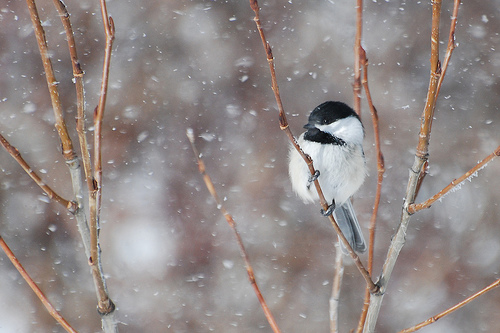
A beautiful snow last night and this morning a bird singing outside my window. This brings to mind a poem by Jessica Powers about a chickadee in a snow storm. There is always something to be learned from God’s creatures if we just take the time to look and ask Him to help us to really see.
Look at the Chickadee
I take my lesson from the chickadee
who in the storm
receives a special fire to keep him warm,
who in the dearth of a December day
can make the seed of a dead weed his stay,
so simple and so small,
and yet the hardiest hunter of them all.
The world is winter now and I who go
loving no venture half so much as snow,
in this white blinding desert have been sent
a most concise and charming argument.
To those who seek to flout austerity,
who have a doubt of God’s solicitude
for even the most trivial of His brood,
to those whose minds are chilled with misery
I have this brief audacious word to say:
look at the chickadee,
that small perennial singer of the earth,
who makes the week of a December day
the pivot of his mirth.
There are some things that should be as they are:
plain, unadorned, common, and all-complete;
things not in a clutter, not in a clump,
unmuddled and unmeddled with;
the straight, the smooth, the salt, the sour, the sweet.
For all that’s timeless, untutored, untailored, and untooled;
for innocence unschooled,
for unplowed prairies, primal snow and sod,
water unmuddied, wind unruled,
for these, thank God . . .




 Witnesses to Hope