Loving Love and Beauty seeing

A beautiful poem on beauty by one of our sisters, Sr. Stacy Whitfield:

                       Beauty

I love your wild extravagance,
          mountain flower and autumn leaves
Endowed with lovely lavishness,
          making much of what none sees.

Yet surely you would not adorn
          with greater glory grassy hills
Than sons and daughters made for joy
           and destined for more beauty still.

Oh give me hope to lift my soul
           to beauties that yet lie unseen,
That wait beyond the shimm’ring veil,
           awaiting Dawn’s eternity.

The wondrous views of heaven’s scope
           from which earth’s grand reflection springs,
The beauty that is fairer still
           than all your earthly artistry.

Oh give me faith and love to long
           to see all beauty’s heavenly source,
From which all loveliness is flowing,
           river-like upon its course.

The fullness of all beauty there
          on which to gaze to soul’s delight,
A heart all pure, a form all fair,
          the fountainhead of love, of light.

I shall abide in blissful rest,
          loving Love and Beauty seeing,
Taking in your loveliness
          with opened eyes, with transformed being.

                                          ©Sr. Stacy Whitfield (revised February 3, 1991)
We praise Thee, O God

This Sunday’s poem is by T.S. Eliot:

We praise Thee, O God, for Thy glory displayed in all the creatures of the earth,
In the snow, in the rain, in the wind, in the storm; in all of Thy creatures, both the hunters and the hunted.
For all things exist only as seen by Thee, only as known by Thee, all things exist
Only in Thy light, and Thy glory is declared even in that which denies Thee; the darkness declares the glory of light.
Those who deny Thee could not deny, if Thou didst not exist; and their denial is never complete, for if it were so, they would not exist.
They affirm Thee in living; all things affirm Thee in living; the bird in the air, both the hawk and the finch: the beast on the earth, both the wolf and the lamb; the worm in the soil and the worm in the belly.
Therefore, man, whom THou hast made to be conscious of Thee, must consciously praise Thee, in thought and in word, and in deed.
Even with the hand to the broom, the back bent in laying the fire, the knee bent in cleaning the hearth, we, the scrubbers and sweepers of Canterbury,
The back bent under toil, the knee bent under sin, the hands to the face under fear, the head bent under grief,
Even in us the voices of seasons, the snuffle of winter, the song of spring, the drone of summer, the voices of beasts and of birds, praise Thee.
We thank Thee for the mercies of blood, for Thy redemption by blood.  For the blood of Thy martyrs and saings
Shall enrich the earth, shall create holy places.
For wherever a saint has dwelt, wherever a martyr has given his blood for the blood of Christ,
There is holy ground, and the sanctity shall not depart from it
Though armies trample over it, though sightseers come with guidebooks looking over it;
From where the western seas gnaw at the coast of Iona,
To the death in the desert, the prayer in forgotten places, by the broken imperial column,
From such ground springs that which forever renews the earth
Though it is forever denied.  Therefore, O God, we thank Thee
Who has given such blessing in Canterbury.

                                                      – T.S. Eliot

Invitatory for a Wedding Anniversary

Yesterday one of our sisters, Sr. Katie, made her Final Profession of Vows.  It was a wonderful day for all of us.  Today another sister, Sr. Christina, is celebrating her first anniversary of Final Vows, and tomorrow on one of our major feasts, the Triumph of the Cross, three other sisters are celebrating anniversaries.  This poem, by Mother Mary Francis, seems so appropriate:

Invitatory for a Wedding Anniversary

“We recount your marvelous deeds” (Psalm 75)

Come, let us marvel at God confecting dawn
Out of a pastelled fluff of fancy, then
Unbfolding night from velvet bolt of mystery, arranging
Moons halved, then quartered, then plumped full
To serve our recreation.

          But marvel more that He has brided me.

Here is tall marvel: twirled by hand Divine
All birds’ propellers dancing circled grace
Down boulevarded space and all trees waving
For such performance, fans of jubilation.
Sun stoked and skies spread and clouds lit
With virgin light or pregnant with the rain
Are marvels that demand high recounting.

          But marvel more that He has brided me.

Come, let us kneel before th Lord devising
Day from the night and marshalling the stars,
Flattering peaches pink, and then gone off surprising
Carrots to gold with glance Divine
And us to exaltation.

          But marvel more that He has brided me.

All the long aeons God has lightly laid
Across our history call: Marvel! and
We gladly tell it, call for cosmic chorus to proclaim it:
God great, God mighty, God beyond
Our power small to marvel.

          But marvel more that He has brided me. 

DSC_2001

The Little Black Sheep

A wonderful poem by Paul Lawrence Dunbar (best read aloud . . .):

     The Little Black Sheep

Po’ lil’ brack sheep dat strayed away,
     Done los’ in de win’ an’ de rain–
An’ de Shepherd He say, “O, hirelin’,
     Go fin’ my sheep again.”
An’ de hirelin’ say, “O, Shepherd,
     Dat sheep am brack an’ bad.”
But de Shepherd He smile, like dat lil’ brack sheep
     Wuz de onliest lamb He had.

An’ de Shepherd go out in de darkness
     Where de night wuz col’ and’ bleak,
An’ dat lil’ brack sheep, He fin’ it
     An’ lay it agains’ His cheek.
An’ de hirelin frown, “O, Shepherd,
     Don’ bring dat sheep to me!”
But de Shepherd He smile, an’ He hol’ it close.
     An’–dat lil’ brack sheep–wuz–me!


Will not the end explain

“Will not the end explain the crossed endeavor?” (Amy Carmichael)

Rate this:

Will not the end explain
The crossed endeavor, earnest purpose foiled,
The strange bewilderment of good work spoiled,
The clinging weariness, the inward strain,
Will not the end explain?

Meanwhile He comforteth
Them that are losing patience. ‘Tis His way:
But none can write the words they hear Him say
For men to read, only they know He saith
Sweet words and comforteth.

Not that He doth explain
The mystery that baffleth; but a sense
Husheth the quiet heart, that far, far hence
Lieth a field set thick with golden grain,
Wetted in seedling days by many a rain:
The end–it will explain.

                   ~Amy Carmichael

Of consolation

The poem this Sunday is another by Luci Shaw:

Of consolation

It is down
makes
up seem
taller
black
sharpens white
flight
firms earth
underfoot
labor
blesses birth
with
later sleep

After silence
each sound
sings
dull clay
shines the
bright coin
in the pot
lemon
honeys
its sweet sequel
and my dark
distress
shows comfort
to be doubly
heaven-sent.

The Garments of God

“The Garments of God”, a poem by Jessica Powers.

Rate this:

The poem I have to share with you this Sunday is another by Jessica Powers:

The Garments of God

God sits on a chair of darkness in my soul.
He is God alone, supreme in His majesty.
I sit at His feet, a child in the dark beside Him;
my joy is aware of His glance and my sorrow is tempted
to nest on the thought that His face is turned from me.
He is clothed in the robes of His mercy, voluminous garments–
not velvet or silk and affable to the touch,
but fabric strong for a frantic hand to clutch,
and I hold to it fast with the fingers of my will.
Here is my cry of faith, my deep avowal
to the Divinity that I am but dust.
Here is the loud profession of my trust.
I need not go abroad
to the hills of speech or the hinterlands of music
for a crier to walk in my soul where all is still.
I have this potent prayer through good or ill:
here in the dark I clutch the garments of God.

Mary Magdalene

A Jessica Powers’ poem on Mary Magdalen.

Rate this:

I’ve done a lot of meditating over the years on today’s gospel.  For many long seasons of my life, I have felt that I have been with Mary weeping outside the tomb, Jesus calling my name, but I keep failing to recognize Him.  Learning to trust Him when I think He’s gone and I can’t recognize Him. (See “While it was still dark”)

Two paintings here of Mary before and after her conversion:

The Magdalene before her conversion (Tissot)
The Magdalene before her conversion (James Tissot)
The repentant Mary Magdalen (James Tissot)


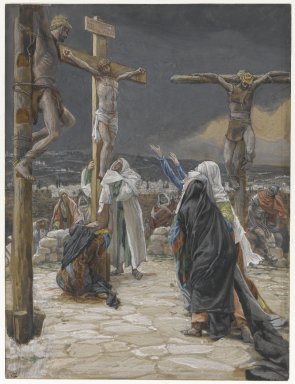
On another note, this poem by Jessica Powers came to mind today.  In this poem, she writes about Mary’s encounter with Christ on the Cross and then her later life, where she lived as a contemplative hermit:

The death of Jesus (James Tissot)

The Blood’s Mystic

Grace guards that moment when the spirit halts
to watch the Magdalen
in the mad turbulence that was her love.
Light hallows those who think about her when
she broke through crowds to the Master’s feet
or ran on Easter morning,
her hair wind-tumbled and cloak awry.
What to her need were the restrictions of
earth’s vain formalities?
She sought, as love so often seeks and finds,
a Radiance that died or seemed to die.

One can surmise she went to Calvary
distraught and weeping, and with loud lament
clung to the cross and beat upon its wood
till Christ’s torn veins spread a soft covering
over her hair and face and colored gown.
She took her First Communion in His Blood.

O the tumultuous Magdalen!  But those
who come upon her in the hush of love
claim the last graces.  A wild parakeet
ceded its being to a mourning dove,
as Bethany had prophesied.  We give
to Old Provence that solitude’s location
where her love brooded, too contemplative
to lift the brief distraction of a wing.
There she became a living consecration
to one remembering.
Magdalen, first to drink the fountained Christ
Whose crimson-signing stills our creature stir,
is the Blood’s mystic.  Was it not the weight
of the warm Blood that slowed and silenced her?

Reluctant prophet

Luci Shaw’s poem, “Reluctant Prophet.”

Rate this:

Continuing in my share-a-poem-with-you-on-Sunday tradition, here’s another one by Luci Shaw:

Reluctant Prophet

Both were dwellers
in deep places
(one in the dark
bowels of ships
and great fish
and wounded pride.
The other–
in the silvery belly
of the seas).

Both heard God saying
“Go!”
but the whale
did as he was told.