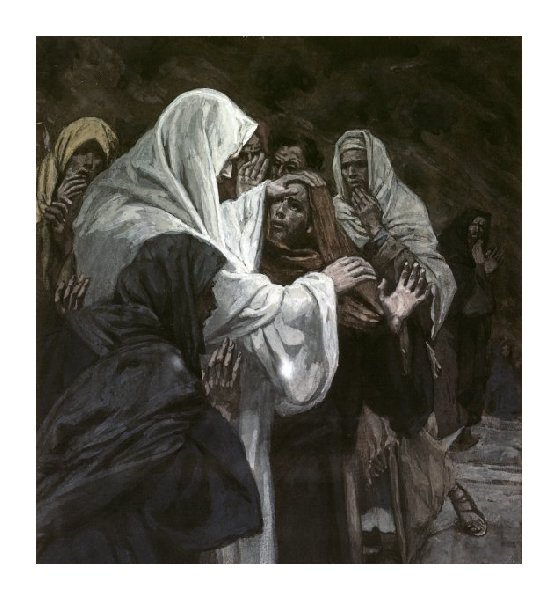
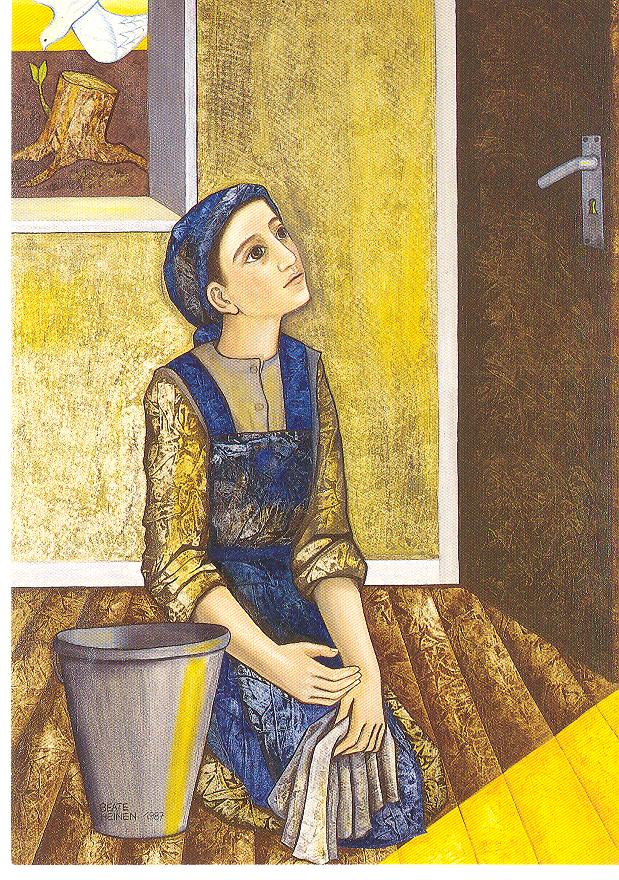
“He Who Would Be Great Among You”

I felt like dipping into Luci Shaw this morning.

He Who Would Be Great Among You

You, whose birth broke all
the social and biological rules–
son of the poor who accepted
the worship due a king–
child prodigy debating
with the Temple Th. D.s–you
were the kind who used a new math
to multiply bread, fish, faith.
You practiced a radical sociology:
rehabilitated con men &
call girls.  You valued women,
aliens, & other minority groups.
A general practitioner,
you specialized in heart surgery.
Creator, healer, innovator,
shepherd, story-spinner,
weather-maker, botanist,
alchemist, exorcist, iconoclast,
seeker, seer, motive-sifter,
you were always beyond us,
ahead of your own time, & ours.

And we would like to be
like you.  Bold as the James and John,
the Boanerges brothers,
we hear ourselves demand,
“Admit us to your avant-garde.
Grant us degrees in all
the liberal arts of heaven.”
Why our belligerence?  Why
does this whiff of fame and greatness
smell so sweet?
Why do we always compete
to be first?  Have we forgotten
how you took, gently & simply,
cool water, & a towel for our feet?

~Luci Shaw

May 20: Very Early Morning

It’s Sunday and time for me to share a poem.  I love this poem by Luci Shaw.  I think it’s one of the first I ever read of hers and always comes back to mind this time of year.   I hope you enjoy it as much as I do.  I think it’s one that benefits greatly from being read aloud.  (There are shades of Hopkins in this poem.)

May 20: Very Early Morning

All the field praises him/all
dandelions are his glory/gold
and silver all trilliums unfold
white flames above their trinities
of leaves all wild strawberries
and massed wood violets   reflect his skies–
clean blue and white
all brambles/all oxeyes
all stalks and stems lift to this light
all young windflower bells
tremble on hair
springs for his air’s
carillon touch/last year’s yarrow (raising
brittle star skeletons) tells
age is not past praising
all small low unknown
unnamed weeds show his impossible greens
all grasses sing
tone on clear tone
all mosses spread a spring–
soft velvet for his feet
and by all means
all leaves/buds/all flowers cup
jewels of fire and ice
holding up
to his kind morning heat
a silver sacrifice

now
make of our hearts a field
to raise your praise

~Luci Shaw

“. . . for they shall see God”

It’s still the time, the season, of remembering Christ’s appearances to those He loved.  Let us not move too quickly back into ordinary time.  (Is there ever an “ordinary” time with Christ in our lives?)  Luci Shaw captures this need to learn to recognized Him in this Sunday-poem.  We, too, need to “get beyond the way he looks” in our everyday lives:

He who has seen Me has seen the Father (James Tissot)

“. . . for they shall see God”

Matthew 5.8

Christ risen was rarely
recognized by sight.
They had to get beyond the way he looked.
Evidence strong than his voice and face and footstep
waited to grow in them, to guide
their groping from despair,
their stretching beyond belief.

We are as blind as they
until the opening of our deeper eyes
shows us the hands that bless
and break our bread,
until we finger
wounds that tell our healing,
or witness a miracle of fish
dawn-caught after our long night
of empty nets.  Handling
his Word, we feel his flesh,
his bones, and hear his voice
calling our early-morning name.

~Luci Shaw

All the doors being shut

A Sunday-poem along yesterday’s lines:

Open

Doubt padlocked one door and
Memory put her back to the other.
Still the damp draught seeped in, though
Fear chinked all the cracks and
Blindness boarded up the window.
In the darkness that was left
Defeat crouched, shivering,
In his cold corner.

Then Jesus came
(all the doors being shut)
and stood among them.

~Luci Shaw

A golden moment

There are so many artistic depictions of the Annunciation, but one of my all-time favorites is one that a good friend of mine gave me a few years ago.  You can see it below.  Not too long afterward I came across a poem by Luci Shaw that seemed to have been written for it.  I share that with you as well.  Thank you, Mary, for your earth-changing yes. . .

Annunciation (golden) 001Virgin

As if until that moment
nothing real
had happened since Creation

As if outside the world were empty
so that she and he were all
there was–he mover, she moved upon

As if her submission were the most
dynamic of all works; as if
no one had ever said Yes like that

As if that day the sun had no place
in all the universe to pour its gold
but her small room

(Luci Shaw)

Royalty

Today’s Sunday-poem is by Luci Shaw:

Royalty

He was a plain man
and learned no latin.

Having left all gold behind
he dealt out peace
to all us wild ones
and the weather.

He ate fish, bread,
country wine and God’s will.

Dust sandaled his feet.

He wore purple only once
and that was an irony.

Moses Reclothed

This Sunday’s poem is by Luci Shaw:

Moses Reclothed

Bare-soled he waits,
bowed bare-headed, stripped to the heart,
eyes narrowing, hands to his face
against the heat,
watching.

Hissing, the dust-dry leaves
and cobwebs shrivel
baring the curved thorns
woven with gold,
and the black-elbowed branches
wrapped in a web of flame.

Wondering, he waits
in the hot shadow of the smoking voice–
observes no quivering flake of ash
blown down-draft from the holy blaze,
no embers glowing on the ground.
Flinching, himself, before the blast
he sees the unshrinking thorny stems
alive, seared but still strong,
uncharred, piercing the fire.

Enveloped now in burning, ardent speech
he feels the hot sparks touching his
tinder soul, to turn him into flame.

A Song for Simplicity

Today’s poem-for-Sunday is another by Luci Shaw:

A Song for Simplicity

There are some things that should be as they are:
plain, unadorned, common, and all-complete;
things not in a clutter, not in a clump,
unmuddled and unmeddled with;
the straight, the smooth, the salt, the sour, the sweet.
For all that’s timeless, untutored, untailored, and untooled;
for innocence unschooled,
for unplowed prairies, primal snow and sod,
water unmuddied, wind unruled,
for these, thank God . . .

~Luci Shaw

Wrestling

This Sunday’s poem is one by Luci Shaw.  There is always risk in wrestling with God.

     With Jacob

Inexorably I cry
as I wrestle
for the blessing,
thirsty, straining
for the joining
till my desert throat
runs dry.
I must risk
the shrunken sinew
and the laming of
his naming
till I find
my final quenching
in the hollow
of his thigh.

I have more than I prayed for

The poem I chose for this Sunday could more accurately be termed “poetic prose.”  It’s a piece by Catherine Doherty, and I’m not sure of its source.  Her perspective on God’s work in our souls during dark times gives great food for thought.  It is obvious, at least to me, that the place at which she arrives is absolutely a work of grace–but one which God can do for each of us.  It is one of the great paradoxes of the spiritual life, one which Luci Shaw addressed in her poem, “Of Consolation” which starts: “It is down/makes/up seem/taller . . .” 

   I prayed to God for songs and laughter.  He gave me tears instead.  I prayed for life in valleys green, full of harvest rich.  He led me through deserts arid and heights where snow alone could feel at home.

   I prayed for sun, lots of dancing, and sparkling rivers to sail upon.  He gave me night, quite dark, starless, and thirst to guide me through its waste.

   But now I know that I was foolish, for I have more than I prayed for.

   I have the Son for bridegroom.  The music of his voice is a valley green, and river sparkling on which I sail.  My soul is dancing, dancing with endless joy in the dark night he shares with me.

An unknown Puritan many years before had written something similar in a poem entitled, “The Valley of Vision”, which includes this line: “Let me learn by paradox/that the way down/is the way up . . .”  The poem ends:

Lord, in the daytime stars can
     be seen from deepest wells,
          and the deeper the wells
               the brighter thy stars shine;
Let me find thy light in my darkness,
               thy life in my death,
               thy joy in my sorrow,
               thy grace in my sin,
               thy riches in my poverty,
               thy glory in my valley.

May you find His light in your darkness. . .