I have more than I prayed for

The poem I chose for this Sunday could more accurately be termed “poetic prose.”  It’s a piece by Catherine Doherty, and I’m not sure of its source.  Her perspective on God’s work in our souls during dark times gives great food for thought.  It is obvious, at least to me, that the place at which she arrives is absolutely a work of grace–but one which God can do for each of us.  It is one of the great paradoxes of the spiritual life, one which Luci Shaw addressed in her poem, “Of Consolation” which starts: “It is down/makes/up seem/taller . . .” 

   I prayed to God for songs and laughter.  He gave me tears instead.  I prayed for life in valleys green, full of harvest rich.  He led me through deserts arid and heights where snow alone could feel at home.

   I prayed for sun, lots of dancing, and sparkling rivers to sail upon.  He gave me night, quite dark, starless, and thirst to guide me through its waste.

   But now I know that I was foolish, for I have more than I prayed for.

   I have the Son for bridegroom.  The music of his voice is a valley green, and river sparkling on which I sail.  My soul is dancing, dancing with endless joy in the dark night he shares with me.

An unknown Puritan many years before had written something similar in a poem entitled, “The Valley of Vision”, which includes this line: “Let me learn by paradox/that the way down/is the way up . . .”  The poem ends:

Lord, in the daytime stars can
     be seen from deepest wells,
          and the deeper the wells
               the brighter thy stars shine;
Let me find thy light in my darkness,
               thy life in my death,
               thy joy in my sorrow,
               thy grace in my sin,
               thy riches in my poverty,
               thy glory in my valley.

May you find His light in your darkness. . .
Open

This is a powerful Easter poem by Luci Shaw.  I know it’s not the Easter season, but I think it’s at times like these–as we’re moving into the physically darker seasons of fall and winter, and sometimes simultaneously darker emotional seasons for some of us–that we need to remember that we are always an Easter people.      

                  Open
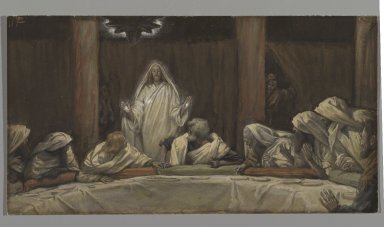
             John 20:19, 26

Doubt padlocked one door and
Memory put her back to the other.
Still the damp draught seeped in, though
Fear chinked all the cracks and
Blindness boarded up the window.
In the darkness that was left
Defeat crouched, shivering,
In his cold corner.

Then Jesus came
(all the doors being shut)
and stood among them.

                              Luci Shaw

The Appearance of Christ at the Cenacle
The Appearance of Christ at the Cenacle (James Tissot)

Of consolation

The poem this Sunday is another by Luci Shaw:

Of consolation

It is down
makes
up seem
taller
black
sharpens white
flight
firms earth
underfoot
labor
blesses birth
with
later sleep

After silence
each sound
sings
dull clay
shines the
bright coin
in the pot
lemon
honeys
its sweet sequel
and my dark
distress
shows comfort
to be doubly
heaven-sent.

Reluctant prophet

Luci Shaw’s poem, “Reluctant Prophet.”

Rate this:

Continuing in my share-a-poem-with-you-on-Sunday tradition, here’s another one by Luci Shaw:

Reluctant Prophet

Both were dwellers
in deep places
(one in the dark
bowels of ships
and great fish
and wounded pride.
The other–
in the silvery belly
of the seas).

Both heard God saying
“Go!”
but the whale
did as he was told.