God’s need

A few years ago I read something to this effect: if God had a need–which He doesn’t because He is God–but if He did have a need, it would be to love.  That statement made me stop to consider how much–or how little–I let Him actually love me.  How often did I consider myself unworthy of His love and consequently not open myself to His love?  How often did I put limits on how much He could possibly love me?  How often did I turn away from Him because I was dissatisfied/distressed/upset with the events He was allowing in my life?  How often did I just want to give up on my relationship with Him?  Sounds like an examination of conscience, doesn’t it?  In fact, it is, and it’s worth doing.

The Catechism, when describing the effects of original sin, lists “lack of trust in his goodness” as one of the primary effects (cf. CCC 396).  God went after Adam and Eve when they sinned.  The first thing God says to them after they sinned was “Where are you?”, the words of a God who desires to love, who wants relationship with us, who doesn’t want us hiding from Him.  The Father thirsts and hungers to love us, to love you.  He “needs” to love you.

Patient waiting

The sisters in my house had an exercise in patient waiting this weekend.  We lost power on Thursday night due to a strong thunderstorm.  The projected time for restoration of power was this Tuesday night.  When we lose power, we lose everything including water.  We do have a generator–thanks to a very generous donor last year, but, of course, we can’t plug everything into it . . . and the water pump is one of those things.  This means a lot of water hauling, manual flushing of toilets, heating water on the stove.  (Like the good old days, heh?)  The good news is that everyone pitched in and maintained a good attitude.  The other good news is that the power came on last night at midnight–two days before the estimated time!!!

“Be patient, therefore, brethren, until the coming of the Lord. . . . You also must be patient.  Establish your hearts for the coming of the Lord is at hand.  Do not grumble . . . .” (James 5.7a, 8-9a)

Bowing down before the Lord

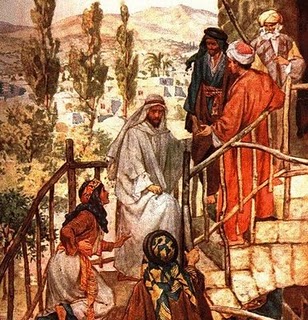
The whole story of the Canaanite woman who implored Jesus to heal her daughter (cf. Mt. 15.21 ff) is absolutely fascinating to me.  Jesus seems to rebuff her more than once, yet she tenaciously perseveres in her request.  What particularly moves me is her response after 1) he first seemingly ignores her and 2) says that His mission is to the lost sheep of the House of Israel (of which she is not a part).  She responds by coming to Him, kneeling at His feet and worshiping (15.25).

Worship is an act of bowing before the Lordship of God and completely surrendering to His will.  How often is our response one of worship when we experience silence and non-answers from the Lord?  May the Spirit of the Lord prompt us to turn our disappointments into occasions of worship of our God who is only and always Love.

The Red Sea Rules

I just finished a book I wanted to recommend to you all: The Red Sea Rules by Robert J. Morgan.  It’s a short book (just over 100 pages) based on Exodus 14–when God leads the Israelites to the Red Sea and they are chased by Pharaoh’s army.  Pastor Morgan draws out 10 “rules” based on this episode in the life of God’s chosen people.  He illustrates each rule with real-life stories.  And, lest you wonder if this is an easy, fix-it-quick book, in his preface he writes: “These aren’t ten quick-and-easy steps to instant solutions, In my case, it took quite a while to work through the anguish and achieve a positive result.”

The subtitle of the book is: The Same God who Led You In Will Lead You Out. Rule #1 is “Realise that God means for you to be where you are.”  An excerpt from that chapter:

Some circumstances are beyond our control, and something as simple as the ringing of a phone, a card in the mail, or a knock on the door can push us off the wire.  We fall into a world of worry.  Someone defined worry as a small trickle of fear that meanders through the mind, cutting a channel into which all other thoughts flow.

The preacher John R. Rice said, “Worry is putting question marks where God has put periods.”

Bishop Fulton J. Sheen called worry “a form of atheism, for it betrays a lack of faith and trust in God.”

But for some of us, worry seems as inherent as breathing.

Sound familiar?  Morgan ends this section with this:

In the story of the Red Sea, the Israelites followed the pillar of cloud and fire as carefully as possible, thrilled with their new freedom, full of excitement about the future.  Yet as they followed Him, God deliberately led them into a cul-de-sac between hostile hills, to the edge of a sea too deep to be forded and too wide to be crossed.

The unmistakable implication of Exodus 14:1-2 is that the Lord took responsibility for leading them into peril.  He gave them specific, step-by-step instructions, leading them down a route to apparent ruin: Turn and camp.  Camp there. There, before the entrapping sea.  Yes, right there in that impossible place.

The Lord occasionally does the same with us, testing our faith, leading us into hardship, teaching us wisdom, showing us His ways.  Our first reaction may be a surge of panic and a sense of alarm, but we must learn to consult the Scriptures for guidance.

So, take a deep breath and recall this deeper secret of the Christian life: when you are in a difficult place, realize that the Lord either placed you there or allowed you to be there, for reasons perhaps known for now only to Himself.

The same God who led you in will lead you out.

The voice of Pharaoh

Following on yesterday’s post (and Tesa’s excellent comment!), I thought I would share another reflection by Amy Carmichael on the same topic: listening–or rather the importance of not listening–to the voice of the Enemy.

Exodus 14.3  Pharaoh will say . . . They are entangled in the land; the wilderness has shut them in.

Sometimes when problems come up and we see no way through, or when souls we love seem entangled, we are tempted to think of what Pharaoh will say.  There can be no entanglement, the wilderness cannot possibly shut in anyone whom God is leading Home.  It has been said, “What we see as problems, God sees as solutions”; and what we have to do through the age-long minute* before we see is to wait in peace and refuse to be hustled.  “Fear not, stand still,” and sooner or later, you shall “see the salvation of the Lord” (v. 13).  There will be no entanglement.

And is it not comforting that the Lord Jesus knows beforehand what Pharaoh will say? So we need not pay the slightest attention to him, even if he does make discouraging remarks.  The last word is never with Pharaoh.  What is he but a “noise” (Jer 46.17)?  So let us trust and not be afraid.

(Edges of His Ways, p. 40)

*Amy is referring here to the “age-long minute” between when the storm on the sea began for the disciples and when Jesus came to them walking on the water and calmed the sea.

What others say about us

Have you ever found yourself getting down or discouraged because of what someone else has said or even because of what you yourself are saying inside your own head?  Here’s a little perspective from Amy Carmichael:

Ps 3.2 Many are saying of me, there is no help from God.

Have you ever been discouraged and distressed because of something people said, or the voices inside you said?  Such people and such voices talk most when one is in trouble about something.  “Many are saying of me, there is no help from God.”  That was what the many said who were round about poor King David in a dark hour.  But he turned to his God and told Him just what they were saying, and then he affirmed his faith, “But thou, O Lord, art a shield about me, my glory, and the lifter of my head.” (v. 3)

We cannot use these words if we are pleasing ourselves in anything, and doing our own will, not our Lord’s.  In that case what the many say is only too true.  There is no help for us in God while we are walking in any way of our own choice.  But when all is clear between us and our Father, even if like David we are in trouble because of something we have done wrong in the past, then those words are not true.  There is help for us in God.  He is our shield, our glory, and the lifter up of our head, and we need not be afraid of ten thousands of people [v.6]–ten thousands of voices–for the Lord our God is our very present Help.

Twice in Psalms 3 and 4 we find David taking the unkind words of others and putting them into a prayer.  It was the wisest thing he could have done with them.  The alternative would have been either to brood over them, or to talk to others of them; but no, he turns like a child to his father, “Many are saying of me, there is no help for him in God.” “Many say, How can we experience good?” [Ps 4.6]

This last “many say” will come home to some of us, I think.  It was spoken, as the first was, in a difficult time, and it was a hopelessly discouraging word: Who will show us any good?  How can we experience good?  Everything is going wrong.  There is no comfort anywhere.  This is how those voices speak.

But David is not confounded.  He refuses to be cast down, let the many say what they will.  “Lord, lift up the light of Thy countenance upon us” [Ps4.6].  If only we can look up and meet His ungrieved countenance, what does anything matter?  And we shall experience good.  “The Lord is my light and my salvation; whom shall I fear?  The Lord is the stronghold of my life; of whom shall I be afraid?” [Ps 27.1]

The Hill Mizar

Did you ever wonder about Mizar in Ps 42–where it was and what was its significance?  (Maybe you didn’t, but have I piqued your curiosity?)  Here’s Amy Carmichael’s take on it:

Ps 42.6  The Hill Mizar

Did you ever feel that you had nothing great enough to be called a trouble, and yet you very much needed help?  I have been finding much encouragement in the hill Mizar.  For Mizar means littleness–the little hill.  The land of Jordan was a place where great floods (the swelling of Jordan) might terrify the soul, and the land of the Hermonites was a place of lions and leopards [FYI: these are the places mentioned in this verse]; but Mizar was only a little hill: and yet the word is, I will “remember You from . . .  the hill Mizar”, from the little hill.

So just where we are, from the place of our little trial, little pain, little difficulty, little temptation (if temptation can ever be little), let us remember our God.  Relief will surely come, and victory and peace; for “the Lord will command His lovingkindness” (v. 8), even to us in our little hill.

One sentence

Sometimes one sentence can say it all.  From Hans urs Von Balthasar:

What is uniquely Christian begins and ends with the revelation that the infinite God loves the individual man infinitely.

Speaking of one sentences, I came across this attempt by a protestant woman to summarize each of the books of the Bible in one sentence, actually by one verse from the book (a little more challenging to do).  If you’re interested, you can peruse her attempt here.

That breakfast on the beach

Browsing through my journal, I came across a quote from five years ago that is a wonderful reflection on last Sunday’s gospel:

“Feed my sheep,” Jesus said to Peter as the first rays of the sun went fanning out across the sky, but, before that, he said something else.  The six other men had beached the boat by then and had come up to the charcoal fire knowing that it was Jesus who was standing there and yet not quite knowing, not quite brave enough to ask him if he was the one they were all but certain he was.  He told them to bring him some of the fish they had just hauled in, and then he said something that, if I had to guess, was what brought tears to their eyes if anything did.  The Lamb of God.  The Prince of Peace.  The Dayspring from on High.  Instead of all the extraordinary words we might imagine on his lips, what he said was, “Come and have breakfast.”

I believe he says it to all of us: feed my sheep, his lambs, to be sure, but first to let him feed us–to let him feed us with something of himself.

Look out your window

I really don’t feel inspired this morning  . . . so, when in doubt, turn to Amy Carmichael!

Dan 6.10 His windows being open in his chamber toward Jerusalem.

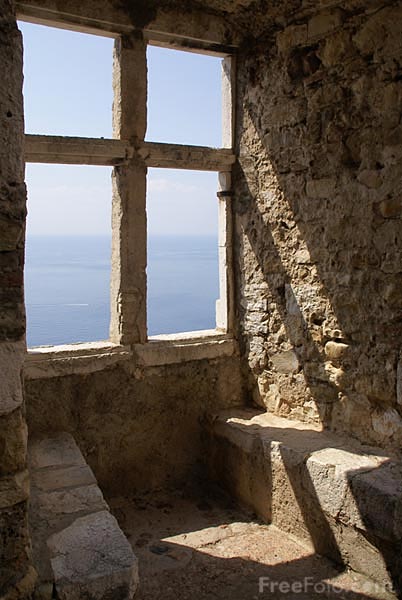
Daniel had only to kneel down upon his knees beside one of those windows, and at once he had access to the Father.  Daniel’s windows almost certainly were very small, set in a thick wall.  We often feel that the windows of are chamber are very small–we see so little, know so little of our Heavenly Jerusalem–but a bird can fly through a very small window out into the wide blue air, and if our windows be open toward Jerusalem, we shall in heart and mind thither ascend.