“He was one of us, no stranger . . .”

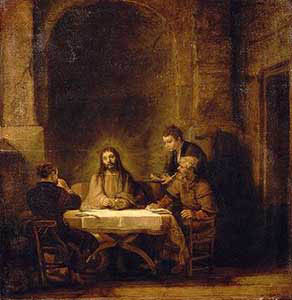
The poem for this Sunday describes the experience of the two disciples on the road to Emmaus:

Companion

When first He joined us, coming, it seemed from nowhere,
and yet, somehow, as if he had followed us a long, long time,
immediately, He was one of us, no stranger, but
a close companion, speaking softly, familiar with our lives,
these days, the answers to our doubts.

And when we moved Him to at least partake of food,
he stood there at the table, not as guest, but host,
and broke the bread to portions, one for each,
then poured the wine, His dark-marked hands
blessing the wine and us.  Was it that act,

His broken hands raised up against the wooden walls,
the prayer-bowed head, the gently spoken word
or some reflection trembling in the wine,
a thickening of air, a luminosity not of wavering light,
that pierced our hearts with joy,

that filled our mouths with praise?  O praise!
O joy!  Then suddenly the light withdrawn,
no longer form and lifted hands above the bread.
Stumbling, we found the road to town,
knowing that never, never would we walk alone again.

~Marie J. Post (all rights reserved)

Leaning upon your Beloved

From Amy Carmichael:

I want to give you a word that helped me all yesterday and will help me today.  It is the “through” of Psalm 84.6 [“As they go through the bitter valley, they make it a place of springs”] and of Isaiah 43.2 [“When you pass through the waters I will be with you; and through the rivers, they shall not overwhelm you”], taken with Song of Songs 8.5 [“Who is that coming up from the wilderness, leaning upon her beloved?”].

We are never staying in the valley or the rough waters; we are always only passing through them, just as the bride in the Song of Songs is seen coming up from the wilderness leaning upon her Beloved.

So whatever the valley is, or however rough the waters are, we won’t fear.  Leaning upon our Beloved we shall come up from the wilderness and, as Psalm 84.6 says, even use the valley as a well, make it a well.  We shall find the living waters there and drink of them.

Locked doors

I always find this kind of reflection on the Easter appearances full of great hope for folks like me: “Jesus moves among men and women–even if it means passing through doors locked from within” (Jn 20.19-23). (Fr. William M. Joensen)  Many of us frequently–or continually–bolt the doors of our hearts from within, yet we long for Christ to come to us.  We can have great hope . . . for He is the One who can enter “through doors locked from within.”

With the eyes of faith

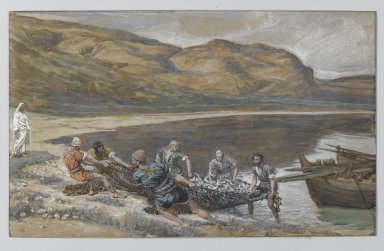
I love pondering the post-Resurrection appearances of Christ.  I guess I feel in good company when those who had spent three solid years with Christ failed to recognize Him.  It’s always a reminder to me of the need to sharpen our eyes of faith, to look for Him in His many disguises.  In today’s Gospel, we see Jesus showing a sense of humor (in my opinion).  He repeats advice that He had given them when He first met them: put the net down on the other side.  How many times does that happen to us, that God comes to us in a familiar way?  Let’s not miss His appearances to us in our every day life.

While it is still dark

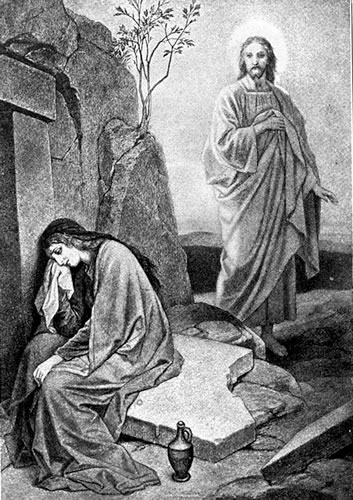
Some of us can wake up on Easter morning or Easter Monday or any other morning, for that matter, and wonder where the risen Christ is.  For one reason or another, we may feel like Mary Magdalene weeping outside the tomb wondering where they have taken Him.  I wrote this a few years back on Easter morning and thought I might share it with you:

“Now on the first day of the week Mary Magdalene came to the tomb early, while it was still dark . . . “ (Jn 20:1)

While it was still dark she came. She did not wait at home. She did not wait for Him or for others to come to her. And she expected to find what? Surely the stone still blocking her from Him. And yet she came. In the darkness. In her grief. She sought Him out even if only to lean her head and heart upon that stone that separated Him from her. In the darkness, in her grief she came.

And what did she find? The stone rolled away—but He was not there. He was not there. “I sought him, but found him not. I called him, but he gave no answer” (Song of Songs 5:6b). “Where have they laid him? They have taken away my Lord, and I do not know where they have laid him” (Jn 20:13b).

Her sorrow is now greater, yet she does not return home. She stands there weeping. And seeking. While it was still dark.

And no one else can solace her. Not angels. Not gardeners . . . She still seeks Him. While it is still dark. And that seeking, that longing of her soul, that anguish at His absence is the latch Christ uses to open her heart when He says her name: “Mary.” While it was still dark.

So go to Him. While it is still dark. While you are still weeping. Even when you cannot find Him. Stand there weeping and seeking Him. And listen for your name. Even now He is saying it.

While it is still dark.

“Blessed are those who have not seen and yet believe.”

Quiet time

We were talking this morning at breakfast about how busy this Lent has been for some of us.  What happened to Lent being a “retreat”?  For many of us it’s been a time of providing more spiritual help for others–Sr. Ann has been out of town a lot doing retreats, I’ve had some unexpected spiritual direction meetings, etc.  Nonetheless, it is so important to guard our times of personal prayer–especially during this season.  Here’s a word about this from Amy Carmichael, commenting on Ps 28.9:

Ps 28.9: Save . . . bless . . . feed . . .  lift up . . .

What an inclusive prayer!  nothing is left out.  The word that speaks to me specially is “feed”.
I do not think there is anything from the beginning of our Christian life to the end, that is so keenly attacked as our quiet with God, for it is in quietness that we are fed.  Sometimes it is not possible to get long uninterrupted quiet, but even if it be only ten minutes, “hem it in with quietness.”  Enclose it in quietness; do not spend the time in thinking how little time you have.  Be quiet.  If you are interrupted, as soon as the interruption ceases, sink back into quietness again without fuss or worry of spirit.  Those who know this secret and practise it, are lifted up.  They go out from that time with their Lord, be it long or short, so refreshed, so peaceful, that wherever they go they unconsciously say to others, who are perhaps cast down and weary, There is a lifting up.

What is your address?

Tomorrow’s Gospel is about Jesus being led into the wilderness.  I am borrowing an article from Madonna House again today.  (One of the reasons that I love Madonna House articles is that they are so down to earth.)  This one is about looking at Jesus while we’re in the wilderness with Him and not at the desert.

What Is Your Address?

by Fr. Denis Lemieux.

Here is a composite of a series of conversations I’ve had recently:

Ring, ring… (Standard corporate North America telephone routine begins.)… push one-push two, working my way through the voice-mail maze… music, waiting… “Your call is important to us”… more music…

Finally, a friendly, human, non-electronic voice: “Hello, customer service. How may I help you?”

“Hello, I’m phoning to inform you of a change of address for my (bank statement/credit card bill/subscription to your magazine).”

“Would you give me your name and current mailing address.”

“My name is Fr. Denis Lemieux, and my current address is…”

I go blank. What is my address? Where am I? Which of eight possible addresses does this particular corporation have me at?

I yell down the hall at the parish secretary. “Martha, what’s the address here?” She gives it to me. I try it out on the friendly, non-electronic, customer-service lady. No. That’s not the one she has.

I try my previous address. This one works. I give my new address, thank her for her friendly manner. Just before hanging up, I say, “My life has been kind of unsettled lately.” “Sounds like it,” she replies.

In the last five years, I have moved fourteen times—four moves back and forth between the seminary and Madonna House (for the summer), four short-term assignments to MH field-houses, and (after ordination a year and a half ago) two short-term parish assignments.

That’s a lot of packing, unpacking, shunting around of boxes, names to learn, household routines and layouts to orient to, plane, train, and automobile trips.

So, perhaps I can be excused for the occasional memory lapse.

But that’s all behind me now, as I return to Madonna House in Combermere (move number fifteen!) to begin my (God-willing) looooong-term assignment to the training center here. It is good to be home, and even better to be able to put my suitcases into storage, at least for a while.

Starting over. New life. Beginning again. The phrases all have a nice ring for me at the moment.

Now that I’m back where I started from before “the moving years” began, it’s time to catch my breath, take stock, pull up my socks in any areas of life that need that particular wardrobe adjustment, and generally put my house in order, externally and internally.

It’s something we all need to do once in a while—start over. We even say it at times, especially when things have gone wrong. When life has become hard, relationships have failed, some situation or other has blown up in our faces. “I wish I could start from scratch…. I just want to go back to square one.”

I recall a line from a recent movie. One of the lead characters has made a mess of her life, and at a moment of crisis, cries out in despair, “I want to be a baby again. I want to be new.”

Lent is all about this poignant desire, all about this experience of wanting to start over, of wanting to be new. Every year the Church issues us an invitation, in its liturgical cycle, to catch our breath, to take stock, to put our houses into order. To start over.

On the First Sunday of Lent this year, we hear of Jesus going into the desert to fast, pray, and confront evil. In this year’s cycle we hear Mark’s telling of the story. Like most of Mark it is short, direct, and to the point.

The Spirit drove Jesus out into the desert, and he remained in the desert for forty days, tempted by Satan. He was among wild beasts, and the angels ministered to him (Mark 1:12-13).

The end. Two sentences, thirty-one words. It is such a short passage compared to Matthew and Luke’s detailed accounts that we can miss the depths it contains.

Jesus in the desert, according to Mark, is starting over again on behalf of the whole human race. Jesus is returning us, in himself, to our original human condition in the Garden.

He is not going into a garden, though, but into a desert, for sin has made the world such. But in this desert, like Adam and Eve, he exists in perfect harmony with the lower creation, the wild beasts, and with the higher creation, the angels.

In this desert, he is tempted like Adam and Eve were. And in this desert, he remains, in obscurity, in hiddenness, in silence, in the Spirit, for forty days.

Back to how it all began, back to “being a baby, being new,” back to humanity in its youth and innocence, yet living this newness and restored innocence in an environment that mirrors the inner spiritual environment of humanity marred by sin.

Lent is here, and the Church is summoning us to one more change of address, one more move. Out to the desert we are to go, out to spend a season with Jesus as he confronts (our) sin and evil in order to bring us to repentance and conversion.

Out to the desert to allow him to restore us to harmony with the lower creation, in this case, the lower part of ourselves. This is what fasting is about. We deny ourselves so that our disordered passions and desires may be tempered and brought into submission to the Holy Spirit dwelling in us.

Out to the desert we go, to be restored also to harmony with the higher creation. To pray, to set our minds more perfectly on God and the things of God. In this is included works of mercy, works of love, because we cannot touch God unless we reach out to our neighbour, to serve him in his need.

We do not go out to the desert, that is, we do not take on the Church’s Lenten project of prayer, fasting, and almsgiving, so as to renew ourselves, or to return ourselves to our lost innocence.

Any attempt at self-renewal, any attempt to make the desert into a garden by our own efforts and through our own abilities, is doomed to utter failure.

Out to the desert we are to go, ultimately because Jesus is there, and he is our only real “fixed address.” And it is in him, and through him, and with him, that we begin again. That we become new as babies, that we receive his gift of a new heaven and a new earth, a new humanity, an ever-new life.

If we look at the desert, look at our sins, look at the hard work of repentance—fasting, prayer, and all that—it is a dismal season. Just one more move in an unsettled life, and won’t it be great to move on to the next place!

But if we look at the One who calls us to the desert, especially if we look into his eyes, then we are home, and all is well. Then the eternal newness of Easter will run through our Lenten days like an underground stream, bringing us life and freshness.

Passing through the midst of them

In last Sunday’s gospel, Luke recounts the story of Jesus escaping those who were furious enough with him to want to throw him headlong off the brow of a hill.  Luke simply states: “But Jesus passed through the midst of them and went away (Lk 4.30)”.  An astonishing thing.  Amy Carmichael applies this verse to our own lives:

Our new month will bring us joys, for the Lord of joy is with us; it will also bring us sorrows, for sorrows are part of life.  It may bring things which would “throw us down” if they could.  But they need not ever do that, for it is possible for us to do just what our Master did when, passing through the midst of them, He went His way.
As, by His grace, we go on in quietness, we shall find those words we know so well come true: “My Presence will go with you, and I will give you rest” (Ex 33.14).  (Edges of His Ways, p. 18)

God saw that it was beautiful

When God created the world, Genesis says He “saw that it was good” which also means “beautiful.”

Rate this:

I’m back pondering “beauty”–partly because I’m reading an excellent article, “Tolkien and St. Thomas on Beauty” from the current issue of StAR.  Lots to ponder there.  Then this morning I stumbled on this post from Conversion Diary about music and beauty.  Seems to be a theme for my day today.  Actually, the upshot of my pondering this morning was to ask God for more of His eyes, to be able to see the beauty in every soul I encounter today (including my own).  When God created the world, Genesis says He “saw that it was good” which also means “beautiful.”  This is how God sees us:

The Creator, like a divine poet, in bringing the world into being out of nothingness, composed his “Symphony in Six Days,” the Hexameron. After each one of his creative acts, he “saw that it was beautiful.”  The Greek text of the biblical story uses the word kalon–beautiful–and not agathon–good; the Hebrew word carries both meanings at the same time.  (Paul Evdokimov, The Art of the Icon: a Theology of Beauty, p. 2)

Little words (7)

In October I did a series of posts on “little words” in Scripture that are really “big” words.  I wanted to share another with you today.  

Psalm 73.26: But God

These words have been like strong hands lifting up, bearing up, countless thousands of souls. “My flesh and my heart faileth: but God is the strength of my heart and my portion for ever.”  Many who will read this note are well and strong and joyful in their work, thank God for that.  Sooner or later, however, to most who follow the Crucified, there comes a time when flesh and heart fail, and if it were not for that “But God”, we should go under. . . .   (Amy Carmichael, Edges of His Ways, p. 12)

It’s evident to me what it means to have your flesh fail, but I have been pondering what it may mean to have your heart fail: sorrow, doubts, hopelessness, discouragement, etc.  It comforts me to hear those words: but God even in the midst of those failings.  He will be for us all times–another very important little word.  🙂

(For the other “little words” posts, go to the first one here and move on from there.)