2 Cor 2.15 For we are the aroma of Christ to God . . .
Literally, “Christ’s fragrance am I, unto God.” (Conybeare) Paul is speaking of the fragrance of the incense carried in the Triumph of a Roman Emperor, to illustrate God’s triumph over His enemies. We are as captives following in Christ’s triumphal procession, yet at the same time His incense-bearers, those who are unto God a sweet savour of Christ.
Whatever we have to offer owes everything to that which causes it to be (without Me you can do nothing); yet God counts it as something. he even thinks of us as fragrance; ” Christ’s fragrance am I, unto God.” I think it is very wonderful.
I have just recently been paying more attention to the subtitles of the psalm, and this one caught my eye today regarding Psalm 142: “A Maskil of David, when he was in the cave. A prayer.” When he was in the cave. I feel that way often–do any of you as well? That you’re in some kind of cave? So I took some time to read Derek Kidner’s commentary on this psalm. I can’t go into all of what he had to say in this brief post, but there are a few things I’d like to pass on. But, first, the psalm:
Psalm 142 [141]
A Maskil of David, when he was in the cave. A Prayer. 1 I cry with my voice to the LORD, with my voice I make supplication to the LORD, 2 I pour out my complaint before him, I tell my trouble before him. 3 When my spirit is faint, thou knowest my way! In the path where I walk they have hidden a trap for me. 4 I look to the right and watch, * but there is none who takes notice of me; no refuge remains to me, no man cares for me. 5 I cry to thee, O LORD; I say, Thou art my refuge, my portion in the land of the living. 6 Give heed to my cry; for I am brought very low! Deliver me from my persecutors; for they are too strong for me! 7 Bring me out of prison, that I may give thanks to thy name! The righteous will surround me; for thou wilt deal bountifully with me.
What I gleaned from Kidner’s comments:
Ps 57 is also a psalm David wrote while in a cave. That one is more “bold and animated, almost enjoying the situation for the certainty of its triumphant outcome. In the present psalm the strain of being hated and hunted is almost too much, and faith is at full stretch. But this faith is undefeated, and in the final words it is at last joined by hope.”
v. 1: with my voice has the sense of “aloud”. Made me consider the importance–and “okay-ness”–of calling out loud to the Lord in our distress. “David, Like Bartimaeus in the gospels, knows the value of refusing to lapse into silence. That way lies despair.” That way, lies despair. Even if all we can do is cry out loud to the Lord, that will save us from despair . . .
v. 2: my complaint can be translated “my troubled thoughts” Kidner also points out about this verse David’s frankness, indicated by the words pour out and tell.
One last comment on v. 3: The TEV translates When my spirit is faint as “When I am ready to give up.” But Kidner also points out, there is almost a double emphasis on the word Thou–and, here we find the first of three “modest summits” in the psalm: “Thou knowest my way.” And doesn’t that–the fact that God knows your way–make all the difference? Can you find the other two summits in the psalm?
Have you ever been in a funk–one of those times when you’ve been walking along fine, experiencing great hope in the Lord about something, but all of a sudden that hope just disappears? (Rhetorical question) Your thoughts just swirl around you. You’re not able to concentrate on the truth. Your thinking at the moment is not helpful, to say the least?
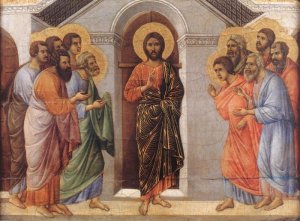
Christ Appears to the Apostles Behind Closed Doors (Duccio)
Often our thoughts are like a crowd of people talking together in a room whose doors are shut, and because of the setting of some hope that had a bright sunrise, it is a sorrowful time.
There may be love, understanding love, all around us, and yet we may be needing some word of life in our own soul, something that would do what only the Divine can do. “Lord, to whom shall we go? You have the words of eternal life” (Jn 6.68).
One day lately, when feeling like this, I took my New Testament, and it opened of itself at John 20, and the first words I read were these: “The same day at evening . . . when the doors were shut . . . Jesus came and stood in their midst, and said . . . Peace be with you. And when He had said this, he showed them His hands and His side.” It is all there–the shut doors (for we cannot say aloud all that fills our mind), the dreary evening, then the risen Lord, and peace. (Amy Carmichael, Edges of His Ways, pp. 131-2)
My prayer for you today is that the Lord may enter through any of your shut doors . . .
Today I want to point out what is undoubtedly the most important little word that I have circled in my Bible. To do that, I need to go back to the scripture I referred to in “Little words (4)”:
“Behold, I go forward, but he is not there;
and backward, but I cannot perceive him;
on the left hand I seek him, but I cannot behold him;
I turn to the right hand, but I cannot see him.
But he knows the way that I take:
when he has tried me, I shall come forth as gold.”
(Job 23:9-10)
As you can see, the word I’m referring to is “he”. The fact that he knows the way I take–even though I cannot seem to find him or perceive him–makes all the difference.
Three little words today: “But if not . . .” And once again, it was Amy Carmichael who brought these to my attention. The context is Daniel 3:16-18. The three young men are threatened with the fiery furnace if they will not bow down the false god. Nebuchadnezzar asks them: If I do this, who will snatch you from my hands? Their reply is: “O Nebuchadnezzar, we have no need to answer you in this matter. If it be so, our God whom we serve is able to deliver us from the burning fiery furnace; and he will deliver us out of your hand, O king. But if not, be it known to you, O king, that we will not serve your gods or worship the golden image which you have set up.”
Amy refers to this passage in this selection from her book, Thou Givest . . . They Gather:
Some years ago we were caught in the turmoil of Law Court trouble [Note: Amy rescued Indian children from temple prostitution]; it lasted for many months, and utterly exhausted those of us who were submerged in it. During that time a friend came for a visit, and his (as it seemed to me) light faith was a trial, not a help. Of course, we should win, he said–“Power over all the power of the enemy”–was not that our Lord’s own word? What need for anxiety? Everything would be all right. I remember thanking God for the Psalms with their cries of depth. This shallow sureness got me nowhere. I could not forget “But if not . . .”
I do not think we should ever forget that “must” of our Lord Jesus, spoken just after the shining word about His coming: “So shall also the Son of Man be in His day. but first He must suffer many things” (Lk 17.24-5). They followed a suffering Savior, the warrior souls and heroes of faith all down the ages . . ..
Of course, this brings to mind that powerful eleventh chapter in Hebrews wherein is recounted all those who “by faith” “did not receive what was promised, since God had foreseen something better for us, that apart form us they should not be made perfect.”
May God give us the grace to be able always to say: “But if not . . .”
I’d like to point out another significant use of the little word, “but”, that I have circled in my bible: Job 23:8-10.
“Behold, I go forward, but he is not there;
and backward, but I cannot perceive him;
on the left hand I seek him, but I cannot behold him;
I turn to the right hand, but I cannot see him. But he knows the way that I take:
when he has tried me, I shall come forth as gold.”
Where would we be if we only had those first two verses and not the third beginning with that little word? It makes all the difference.
Today’s little word from those circled in my bible comes from Ps 102, verse 12: “but”. The previous verses are a litany of personal suffering. As Derek Kidner describes it: “The cry of one whose sufferings are unexplained.” When one’s suffering is unexplained, it makes the suffering even more intense. The psalmist pours forth his woe: “My heart is smitten like grass, and withered; I forget to eat my bread. Because of my loud groaning, my bones cleave to my flesh. . . I lie awake, I am like a lonely bird on the housetop . . . for you have taken me up and thrown me away.” These are dire cries from a forsaken soul.
Yet, out of this heartfelt suffering rises the little word, “but”–and that word makes all the difference: “BUT you, O Lord, are enthroned forever; your name endures to all generations. You will arise and have pity on Zion.” Etc. An incredible act of trust and courage. This is indeed heroic hope. A hope and trust placed not in one’s circumstances but in Someone who can be trusted because of Who He is and Whose word never fails.
May this little word encourage each of us. May we pray for the grace to use it in the midst of our own litanies, that we, too, may say: “BUT you, O Lord, are the lover of my soul. Your steadfast love endures forever. Your mercies are new every morning. Great is your faithfulness.”
A follow-up on yesterday’s post about the little word “all”. After reading Amy’s reflection on “all” meaning all, I found myself noticing that little word more. For instance, Ps 25.16: “All the paths of the Lord are steadfast love and faithfulness.” “All” means all, not some. So wherever the Lord leads my steps are full of His steadfast love and faithfulness. No matter how it looks or feels.
Or take Ps 145. I have eleven “alls” circled in my Bible in that psalm. For example, vv. 17-18: “The Lord is just in all his ways, and kind in all his doings. The Lord is near to all who call upon him . . .” Take some time to find the rest of them yourself. . . and better yet, meditate on what that little word means for you. “All” means all.
I’d like to start a mini-series of posts today–about little words in the Bible. I have quite a few circled in mine. What started me noticing them–and their significance–was a meditation I read years ago by Amy Carmichael. Here it is:
Eph 6.16 Above all taking the shield of faith, with which you can quench all the flaming darts of the evil one.
The word used for shield signifies a great oblong shield which covers the whole body, and the dart mentioned here is the kind which when it strikes a hard object catches fire. The promise is that when the dart strikes the great shield of faith, though it is set on fire, it is quenched. It cannot pierce the shield. It cannot burn the one who is behind the shield. The promise covers all manner of darts. The kind of dart hurled against us makes no difference to the promise. “All” means all. Do we expect “all” to mean all? Is there a secret fear in our hearts about a certain kind of temptation which perhaps we shall not be able to overcome? Away with this fear! It is of the devil. The shield of faith is ready to be taken up and used. If we take it up and use it, not a single dart of any sort will pierce it. All means all.
Think about the power of that little word: “all”–and look for it in other places in Scripture.
I guess it’s obvious if you look at my “Category Cloud”–scroll down the sidebar on the right–that Amy Carmichael is indeed a present and favorite author of mine. She has been consistently present in my life for many years. When I pause to consider why, the reason is simply because reading her has always fostered great hope in me. She helps me to be a witness to hope. And so I quote her often in my blog in the hopes that she will also foster hope in you.
Rom 15:13 says: May the God of hope fill you with all joy and peace in believing, so that by the power of the Holy Spirit you may abound in hope.
Amy begins her reflections on this verse first by looking at some other verses in Scripture, verses that seem contradictory and surprising: In Lk 22.28, Jesus says: You are those who have continued with me in my trials. Yet, just a few hours later, he says: Could you not watch with me one hour? And then (Mt 26.56): Then all the disciples forsook him and fled. Another set of conflicting verses: In Jn 17.6, Jesus says to His Father: They have kept Your word. Yet we know differently–as is so evident in Lk 22.24, describing their activity right after the institution of the Eucharist (!) (but who am I to judge?!): A dispute arose among them, which of them was to be regarded as the greatest. And so Amy wonders: How could Jesus say: They have kept Your word.
How could He say it? What does it mean to us? Just this: Our Lord of Love, our blessed Lord Jesus, looks upon us with such loving eyes that He sees us as we are in our deepest, lowliest, holiest moments, in those hours when, like John, we lean upon His bosom, and He speaks to us, and we all but see His face.
He knows, as no one else can know, how far we fall. “Not as though I had already attained”–He knows that; but “I press on”–He knows that, too.
The love of the Father has the same golden quality of hope. “The God of Hope” hopes for us, even for us. He never loses hope. He accepted the word of His beloved Son: “They have kept [intently observed] Thy word”, in spite of times when they had seemed most grievously to disregard it–when for example at our Lord’s own table they strove about the dreadful matter of pre-eminence. The God of Hope saw what they wished to be, what they yet would be. And He looks at us like that. Is there not something in this that touches us to the quick? How grieve a love like that? And is there not encouragement, too, for the strengthening of our souls?
(Edges of His Ways, p. 145)

 Witnesses to Hope