God is all for you alone

Earlier this week, a good friend of mine read out loud to me excerpts from one of my favorite books (and now hers), Impact of God, by Fr. Iain Matthew.  I don’t think I’ve ever shared anything from that book with all of you.  The book’s purpose is to introduce the reader to St. John of the Cross, but even more importantly, I think, to gain a deeper understanding of God’s desire for relationship with us, especially when prayer is dark and dry.  Here’s a little taste from one of the first chapters of the book:

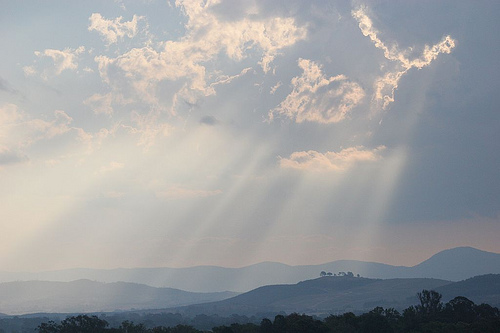
[God] does not give in a general way only, like rays of sunlight shining above a mountain, but leaving me-in-particular shadowed in the valley.  John’s God enters to confront the other person as if there were no other.  It seems to her that God has no other concern, ‘but that he is all for her alone.’  God comes in strength, capable of reconciling opposites, ‘giving life for death’s distress.’  His embrace is as wide as Good Friday to Sunday, and nothing in the person is too much for him.  He finds in the soul, not a burden, or a disappointment, but a cause for ‘glad celebration.’  John dares to place on the lips of his God the words:

‘I am yours, and for you, and I am pleased to be as I am that I may be yours and give myself to you.’
Ponder that.

More to come . . .
“Give God that nothing”

I am re-reading a slim volume on Mother Teresa, titled I Loved Jesus in the Night.  This book increases my hope whenever I pick it up.  Today while reading, I was reminded of something I wish I would remember  more often–and that is that nothing in our life need be wasted.  We can offer whatever we suffer, however small or insignificant it may seem, to God for the sake of others.  Whenever I do remember this truth, it makes such a world of difference for me.  It lifts me out of my small world of seemingly petty sufferings–mostly of my own making–into God who holds all things in His massive Heart.

If at the time of prayer or meditation it seems to you that not only have you been distracted in your prayer, but that you have done nothing at all, never leave that time or that place of prayer angry or bitter with yourself.  First–turn to God and give God that nothing.  (Mother Teresa)

P.S. I am continually struck by how much Mother Teresa was influence by her namesake, St. Thérèse, who wrote in one of her early letters: “If I felt that I had nothing to offer to Jesus, I would offer Him that nothing.” (LT 76)

The silence of God

“The Silence of God.”  That’s the name of a song on Michael Card’s CD, The Hidden Face of God.  After my talk last Monday night, one woman mentioned to me that the part of my talk that gave her the most hope was when I talked about the “door” that I experienced at one point coming down between me and God.  She hoped that I would talk more about that sometime, and I promised her that I would.  I have recently been reading the book Michael Card wrote, of the same name as his album.  In one chapter, he writes about Jesus facing the silence of God–during His agony in the garden.  Christ calls out in anguish to His Father.

But where is the response of God?  None of the Gospels record a single word.  The answer to the most impassioned plea of the Son of God was the silence of God.
God spoke audibly at least three times int he life of Jesus: at the baptism (Matthew 3.16-17), at the “coming of the Greeks” (John 12.28), and at the Transfiguration (Matthew 17.5).  In both instances in Matthew God says, “This is my Son.”  The words are addressed to the witnesses, not directly to Jesus.  . . . In John, at the coming of the Greeks, in response to Jesus’ prayer “Father, glorify your name,” God says, “I have glorified it, and will glorify it again.”  But Jesus’ explanation of the Father’s words to the crowd hint that perhaps, even here, God was not talking to Him. “This voice was for you, not for my sake,” Jesus says.
These incidents hint at something that is extremely sad and also wonderfully encouraging at the same time.  Perhaps Jesus, even Jesus, lived His life, as we all do, within the context of the silence of God.
We usually imagine Jesus’ prayer sessions as “sweet communion.”  But perhaps more often they were like the time of bloody sweat in the Garden of Gethsemane.  Perhaps this garden prayer was more representative of His entire prayer life.  I must say that this thought brings a certain sadness, to think that still another part of Jesus’ suffering for me was that in His Incarnation, He chose to be silently cut off from God in the same way that you and I are cut off.  And yet at the same time, it fills me with a hope that is beyond words, that Jesus, even Jesus, in experiencing every part of humanity (except for sin) knew what it was like to call out to the Father and hear only the silence of God in response!  If this is true, you and I are not–and cannot be–alone in this frustrating experience ever again.  It means that every time we suffer the silence of God, it is an occasion to be brought closer to Jesus.  It means that He has chosen to join us in that silence and fill it with His understanding Presence.  (Michael Card, The Hidden Face of God, pp. 152-3)

Distracted Prayer (2)

A little more on distracted prayer.  One of the most helpful things I ever learned about dealing with distractions in prayer was that it’s not something you necessarily need to repent of and it’s not an indication of “good” or “bad” prayer.  Distractions will come; it’s impossible (and not healthy) to turn our minds completely off.  The important thing is what we do with them.  If we peacefully resist them, we do not sin.  I stress “peacefully”, because if we get agitated about them, it can allow the devil an entrance.  St. Francis de Sales once wisely said: “Our very care not to have distractions often serves as a very great distraction.”  The best thing to do is peacefully turn from them when we become aware of them.  Fr. Thomas Green, author of When the Well Runs Dry, advises relating to them as you would to noisy children who are trying to interrupt a conversation you are having with another adult: reprimand them as needed, but sometimes you just need to relate to them as background noise and ignore them, doing your best to stay focussed on the One you’re talking to. You moms out there surely have a lot of experience at doing that!

Distracted prayer

Early last fall I was speaking with my spiritual director about my experience of the prayer for the last long while.  I told him that I felt that all I did was fight distraction after distraction.  He replied by describing Cardinal John Henry Newman’s response when asked how long he had prayed: “About a minute . . . and it took me an hour to get there.”   Don’t you love it?

And from Dom Columba Marmion: “It is above all on days of weariness, sickness, impatience, temptation, spiritual dryness, and trials, curing hours of sometimes terrible anguish which press upon the soul, that holy abandonment is most pleasing to God.”

The musician

A story from St. Francis de Sales that I call to mind when prayer gets “tough”:

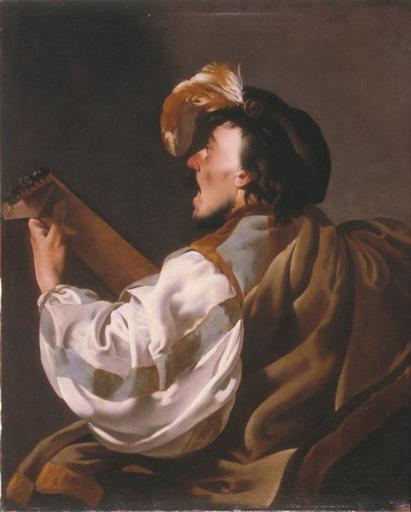
One of the world’s finest musicians, who played the lute to perfection, in a brief time became so extremely deaf that he completely lost the use of his hearing.  However, in spite of that he did not give up singing and playing the lute, doing so with marvelous delicacy by reason of his great skill which his deafness had not taken away.  he had no pleasure either in singing or in the sound of the lute, since after his loss of hearing he could not perceive their sweetness and beauty.  Hence he no longer sang or played except to entertain a prince whose native subject he was and whom he had a great inclination as well as an infinite obligation to please since he had been brought up from his youth in the prince’s court.  For this reason he had the very greatest pleasure in pleasing the prince and he was overjoyed when the prince showed that he enjoyed his music.  Sometimes it happened that to test this loving musician’s love, the prince would command him to sing and immediately leave him there in the room and go out hunting.  The singer’s desire to fulfill his master’s wishes made him continue his song just as attentively as if the prince were present, although in fact he himself took no pleasure out of singing.  He had neither pleasure in the melody, for his deafness deprived him of that, nor that of pleasing the prince, since the prince was absent and hence could not enjoy the sweetness of the beautiful airs he sang. (On the Love of God, Book 9, Chapter 9)

The Lord comes to our wilderness

The Lord will manifest His glory in the wilderness.

Rate this:

I always find great hope in this first paragraph of the second reading from this past Sunday’s Office of Readings.  The reason I find it so hopeful is because in it Eusebius proclaims that the glory of the Lord will appear in the wilderness, not in Jerusalem.  Because most of my prayer these days consists in loving Christ in the darkness and the wilderness of my own life, it is a great consolation to know that that is exactly where Christ will manifest His glory.  Be heartened if you, too, experience a wilderness, a trackless waste, somewhere in your life.  “It is there that the glory of the Lord is to appear.”

The voice of one crying in the wilderness: Prepare the way of the Lord, make straight the paths of our God.  The prophecy makes clear that it is to be fulfilled, not in Jerusalem but in the wilderness: it is there that the glory of the Lord is to appear, and God’s salvation made known to all mankind.  (Eusebius of Caesarea)

I have more than I prayed for

The poem I chose for this Sunday could more accurately be termed “poetic prose.”  It’s a piece by Catherine Doherty, and I’m not sure of its source.  Her perspective on God’s work in our souls during dark times gives great food for thought.  It is obvious, at least to me, that the place at which she arrives is absolutely a work of grace–but one which God can do for each of us.  It is one of the great paradoxes of the spiritual life, one which Luci Shaw addressed in her poem, “Of Consolation” which starts: “It is down/makes/up seem/taller . . .” 

   I prayed to God for songs and laughter.  He gave me tears instead.  I prayed for life in valleys green, full of harvest rich.  He led me through deserts arid and heights where snow alone could feel at home.

   I prayed for sun, lots of dancing, and sparkling rivers to sail upon.  He gave me night, quite dark, starless, and thirst to guide me through its waste.

   But now I know that I was foolish, for I have more than I prayed for.

   I have the Son for bridegroom.  The music of his voice is a valley green, and river sparkling on which I sail.  My soul is dancing, dancing with endless joy in the dark night he shares with me.

An unknown Puritan many years before had written something similar in a poem entitled, “The Valley of Vision”, which includes this line: “Let me learn by paradox/that the way down/is the way up . . .”  The poem ends:

Lord, in the daytime stars can
     be seen from deepest wells,
          and the deeper the wells
               the brighter thy stars shine;
Let me find thy light in my darkness,
               thy life in my death,
               thy joy in my sorrow,
               thy grace in my sin,
               thy riches in my poverty,
               thy glory in my valley.

May you find His light in your darkness. . .

Thousands of stars

Seeing the stars at night requires deep darkness.

Rate this:

I can across this piece by Fr. Garrigou-Lagrange when I was going through a very dark time of prayer.  What he has to say applies also, of course, to any times of darkness in our lives–times when we can’t see the ending, wondering if it will be good or bad.  (Of course, God works everything for the good, but sometimes it’s hard to even see that, isn’t it?)  Fr. Garrigou-Lagrange writes: “If we are saddened at the approach of twilight, God could well answer us by saying: How can I otherwise reveal to you all those thousands of stars which can only be seen at night?”  Isn’t that the truth–we can only see stars if there is darkness–and a deep darkness at that.  And we can only see certain spiritual things (of just as much beauty as the stars on a clear, clear night) if we walk through certain darknesses that God allows.  “To You I lift up my eyes, O You who are enthroned in the heavens!” (Ps 123.1)  Lift up your eyes!

Stars at night

Cloud and Fire (1)

God is just as much in the cloud as in the fire.

Rate this:

“The Lord went before them . . . in cloud and fire.” (Exodus 13.21)

I don’t know about you but most of my prayer times seem to be in the cloud rather than the fire.  It’s comforting to know that God leads by a cloud as well as by a pillar of fire.   And it’s also strengthening to remember that God spoke to Moses out of the cloud.

From Amy Carmichael:
When Moses went up, a cloud enfolded him.  In that cool darkness he heard words which afterwards he spoke to the people in the heat and glaring light of the plain.  So, day by day, as we look forward into the hours which seem to rush upon us, we see not clearness but a cloud.  Then a Voice that we know calls softly, Come up to Me, and be here; the Cloud of the Unknown becomes for us then the very over-shadowing of the wings of the Lord; we sit down under His shadow with great delight, and His fruit is sweet to our taste [Song of Songs 2.3].  And this fruit, tasted first in the dark alone with Him, will be ours for others.  “What I tell you in darkness,” He says to us still, “speak that in the light.” [Matt. 10.27]