I send my angel before you


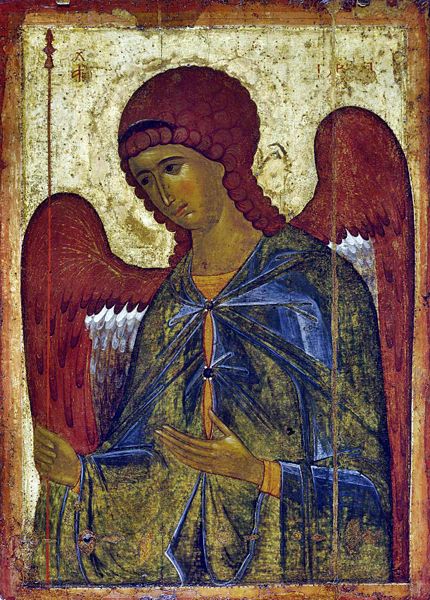
How often do I forget the astounding gift of a guardian angel, an angel given just to me, to help me along my journey home, to protect and prod me.  “Behold, I send my angel before you.” (Ex 32.34) May God open the eyes of our hearts to perceive His great goodness through this wonderful gift.  May we be ever more attentive to their inspirations and help!

You must not tremble

From a letter by Father John, a Russian monk, written to a lay person (1947):

I received your cordial note.  I was happy with your last words: ‘I am not troubled at all, but peaceful’.  According to the Holy Fathers, that is how it should be: if you falter in some virtue, you must not tremble; if you fall–get up; if you fall again, get up again; and so on till the final hour of death.  O Lord, glory to thy mercy.  Great is thy goodness, that Thou has given repentance to us sinners, for Thou didst come to earth not for the righteous, but for us sinner.

You did draw up pure water, but a toad had unexpectedly got into the well.  Throw it away and the life-giving water will still be pure.

What should I give up for Lent?

I have the answer for you!  I’d like to share a short article I wrote for The Catholic Times last year:

“So . . . what are you giving up for Lent?”  The best all-time answer I’ve ever heard to that question comes from Fr. John Peter Cameron, editor of Magnificat: “Here’s what to give up for Lent: the doubt that goes, ‘I can never get closer to God because I’m too sinful, too flawed, too weak.’”  Lent really is not about giving up, but about receiving. Fr. John goes on to say: “Lent is not about lamenting our inadequacy.  Rather, it is a graced moment to receive from God what he is eager to give us so that we can live the friendship with him that he desires. . . .”

This approach requires a major change of attitude on most of our parts.  We are so geared up for what we should do for God, when what is uppermost in the Lord’s mind is his desire to draw near to us, to give himself to us.  If what we decide to give up would, in fact, encourage greater friendship with him, that would be one thing, but for many of us, we fall too readily into the following two categories. Either we succeed in doing what we’ve set out to do and just grow stronger in our pride and self-sufficiency, and in a real sense, further from God.  Or we fail and  grow less confident in God’s mercy.  “How could I expect him to show me mercy after I fail to do one simple thing like giving up chocolate for Lent? I mean, how hard is that?”

Of course, I’m not saying that self-discipline isn’t important or that chocolate in someone’s life may not indeed be a stumbling block in his relationship with God, but for so many of us, the main obstacle we face is our lack of confidence in God’s goodness and his love for us.  We hide from him, as Adam & Eve did after they sinned.  We think that we can’t come to him unless we’ve got everything together.  But notice God’s first words to them after their fall.  They were not: “What have you done?!” but “Where are you?” (Gen. 3:9)After listening to the serpent, Adam and Eve doubted his goodness rather than placing their trust in his unbounded mercy.  Otherwise, they would have run to him like the prodigal son to his father.  His first concern was the restoration of relationship with them.
St. Thérèse encourages us along these lines of trust: “Sanctity does not consist in this or that practice, it consists in a disposition of heart which makes us humble and little in the eyes of God, conscious of our weakness but boldly confident in his goodness as Father.” (emphasis added)

Again, I am not minimizing the seriousness of sin.  What I am saying is that the first step, and the most important one, is dealing with mistrust in the goodness of God toward us.

So this Lent, you might reconsider what you should give up.  Perhaps it should be mistrust or doubt of the Lord’s goodness towards you. Look at the obstacles in the way you think about your relationship with Him. Listen to the Father calling out to you: “Where are you?” If you’re hiding because of lack of confidence in His goodness, try just taking one small step toward Him.  Come out from behind the bushes of doubt. Put aside the sin of mistrust and you might be surprised to see Him running toward you with arms wide open.
It is bliss

I am re-reading Ida Friederike Görres’s book on St. Thérèse, The Hidden Face.  I read the sentence below this morning, a general statement about a happy childhood.  What struck me is that it is, in fact, the description of the experience God means for all of us to have as we grow into the stature of being His child.  It is such an excellent description of the love of God for us:

It is bliss simply to be someone’s child, child of a father, of a mother, living, moving and having its being in a love which is unmerited, unmeritable, anticipatory, unconditional and immutable.

No matter what our own experiences of our parents, this is still absolutely and unequivocally  true for each of us as a child of God the Father.   If you have a minute, read the sentence again slowly, pondering each of those words: “unmerited, unmeritable, anticipatory, unconditional and immutable.”  There is a lifetime of meditation there.  Let yourself taste a bit of the bliss.

In another form

Ann Voskamp, in her book One Thousand Gifts, writes about how important it is for us to have God’s perspective concerning all the events in our lives: “Can it be that that which seems to oppose the will of God actually is used of Him to accomplish the will of God?  That which seems evil only seems so because of perspective, the way the eyes see the shadow above the clouds, light never stops shining.”  Amy Carmichael tackles this issue as well:

Mark 16.12 After that He appeared in another form.

John 16.23 And in that day you shall ask Me nothing.

“We always expect the Lord to come to us in a joy.  Instead of that He sometimes appears in another form, He comes in a big disappointment.

“In the day that we see Him all will be clear.  The mysteries which now perplex us will be illuminated.  One day we shall see the glory to our glorious God and the good to all of us contained in the disappointment we cannot understand.

“So let us live as those who believe this to be true.  Let us praise before we can see.  Let us thank our Lord for trusting us to trust Him.”  (Amy Carmichael)

There’s no one like you!

Ken Libbrecht, professor of physics and a world-renowned expert in the science of snow, is well-known for his stunning photos of snowflakes.  How can anyone not believe in a Creator when you look at these photos?  And to think that there are no two snowflakes alike!  I can hardly grasp that there are no two alike in my yard, let alone in the world.  As Ken says in his book, Snowflakes, “[T]he probability of finding two identical specimens is essentially zero, even if you looked at every one ever made.”  Take time, the next time it snows, to catch a few on your sleeve and ponder the One who loves you just for who you are, totally unlike anyone else.

This slideshow requires JavaScript.

Believing God’s goodness

I have been thinking a bit these past couple of weeks about a number of things.  First: about living selflessly, living for others, living for the Other, Christ, who lived His entire life only for others, and praying for that grace to be released more and more in my own life.  Along with that, I have been pondering the lives of those who, like all those mentioned in Hebrews, did not obtain in this life what was promised.  (Cf. Heb 11)  The priest who said Mass for us this past Saturday–whose homily I hope to soon post–spoke about the European cathedral dwellers who labored on churches whose completion they would never see, cathedrals which would not be finished for hundreds of years.  Their lives were certainly lived in hope, in living for others–the others who would contemplate and be moved by the beauty of the buildings they themselves would never see.

There come times in all our lives where we can’t even see the beginnings of the building, but only see its ruins.  What then?  My friend, Debbie Herbeck, has just written a book called Safely Through the Storm (Servant) in which she collected 120 quotes on hope.  Being a quote “collector” myself, I did not hesitate to get a copy.  The following quote from Fr. Benedict Groeschel (#8 in her book) brings together, I think, all my little threads of reflection:

When things fall apart and all seems to be ruined and when the terrible question “What do you do when nothing makes sense?” comes right home, the answer is that it is the time to believe.  It is the time for faith . . . . One must grab onto God . . . . One must be able to say, “I believe that God’s goodness is going to bring about some greater good by this horror.  It may not be a great good for me in this world, but it will be a great good someplace, somewhere, perhaps for those I love in the next world.” (Arise from Darkness, When Life Doesn’t Make Sense, p. 132)