Open

This is a powerful Easter poem by Luci Shaw.  I know it’s not the Easter season, but I think it’s at times like these–as we’re moving into the physically darker seasons of fall and winter, and sometimes simultaneously darker emotional seasons for some of us–that we need to remember that we are always an Easter people.      

                  Open
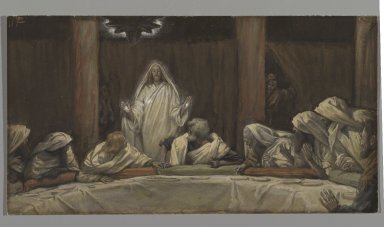
             John 20:19, 26

Doubt padlocked one door and
Memory put her back to the other.
Still the damp draught seeped in, though
Fear chinked all the cracks and
Blindness boarded up the window.
In the darkness that was left
Defeat crouched, shivering,
In his cold corner.

Then Jesus came
(all the doors being shut)
and stood among them.

                              Luci Shaw

The Appearance of Christ at the Cenacle
The Appearance of Christ at the Cenacle (James Tissot)

Reflecting the light

Someone shared something with me after the talk the other night that I thought you would all benefit from.  For those of you who weren’tLamp there, one of the points I made towards the end of the talk was that in order for lights to shine brightly, it needs to be dark around us.  In order for our lights to shine brightly in this world, the world needs to get darker.  In order to illustrate this point, I held up a little lit clay lamp and asked someone to turn off the lights.  After the lights came back on, a number of people remarked that the light was reflected brightly in my glasses.  I, of course, was not at all aware of that fact.  This woman who came up to me afterwards pointed out that all too often that is the case with each of us.  We are reflecting the hope of Christ, and we’re not aware of it at all.  So have hope.  You may feel like you’re in the darkness, but if you’re in Christ, you will reflect His light.  You may not see it, but others will.

Witnesses of hope

It always amazes me how God orchestrates these kinds of things: a reading that probably went to press months ago destined to be read by me today.

Rate this:

Tonight is the inaugural meeting of Witnesses to Hope, so you can imagine my surprise as I read the meditation for today’s Mass found in Magnificat and found these words by Mother Elvira Petrozzi:

Yes, Love generates love, and today there is an immense need of persons able to generate hope in Love . . . [She goes on to describe their work with the poor and destitute.] Daily we live an experience of hope that gives life to those from whom life has been stolen.  Because of this, we belive that in the darkest night it is possible to find light again.  Even in the darkest sadness, joy can be rekindled.  Even in the bitterest loneliness, a friend’s love can pierce a hardened heart.  Yes, we want to be witnesses of this hope.We want to announce to this world that the secret of rebirth is to open our hearts to that marvelous Father who waits for each of us as His most precious child.  (emphasis added)

It always amazes me how God orchestrates these kinds of things: a reading that probably went to press months ago destined to be read by me today.

Hope is a visor

Some random thoughts about hope:

Hope is a long patience! (Conrad deMeester)

Christ is held by the hand of hope.  We hold him and are held.  But it is a greater good that we are held by Christ than that we hold him.  For we can hold him only so long as we are held by him.  (Paschasius Radbert)

Moaning is connected with hope . . .  (John of the Cross)

Hope allows the soul only a visor that it may look toward heavenly things, and no more.  This is the ordinary task of hope in the soul; it raises the eyes to look only at God.  (John of the Cross)

I have meditated on that last quote quite often. God often narrows our perspective so that we will look only to Him. In St. John’s time, a visor was defined as “on a close helmet, a piece having slits or holes for vision”.   “St. Paul calls hope the helmet of salvation.  A helmet is a piece of armor that protects the entire head and covers it so there is no opening except for a visor through which to see.” (John of the Cross, N.2.21.7) That is what hope should be for us–that slit in our life that narrows our vision to look toward God.   If we could only remember when life seems to be closing in, that it could very well be the hand of God:

I lift my eyes to you,
    to you who have your home in heaven,
eyes like the eyes of slaves
    fixed on their master’s hand;
like the eyes of a slave girl
    fixed on the hand of her mistress,
so our eyes are fixed on the Lord our God,
    for him to take pity on us.  (Ps 123.1-2)

My eyes are always on the Lord . . . . (Ps 25.15a)

Thousands of stars

Seeing the stars at night requires deep darkness.

Rate this:

I can across this piece by Fr. Garrigou-Lagrange when I was going through a very dark time of prayer.  What he has to say applies also, of course, to any times of darkness in our lives–times when we can’t see the ending, wondering if it will be good or bad.  (Of course, God works everything for the good, but sometimes it’s hard to even see that, isn’t it?)  Fr. Garrigou-Lagrange writes: “If we are saddened at the approach of twilight, God could well answer us by saying: How can I otherwise reveal to you all those thousands of stars which can only be seen at night?”  Isn’t that the truth–we can only see stars if there is darkness–and a deep darkness at that.  And we can only see certain spiritual things (of just as much beauty as the stars on a clear, clear night) if we walk through certain darknesses that God allows.  “To You I lift up my eyes, O You who are enthroned in the heavens!” (Ps 123.1)  Lift up your eyes!

Stars at night

God loves ordinary people

“God loves ordinary people. That is why he made so many of us.” (Anthony Esolen)

Rate this:

This is a follow up to “Is my life of any account?” I’ve read this piece by Anthony Esolen in this month’s Magnificat twice now (and will reread it again, I assure you) and thought I would share part of it with you.  It’s from his comments on Gerard Manley Hopkins’ poem, “In Honour of Saint Alphonsus Rodriguez.

    . . . God loves ordinary people.  That is why he made so many of us.  Nor is there any shame in it.  The word suggests order,  the providential design built into our natures as men and women, and into the time and place and created world wherein we dwell.  The Church wisely blesses this order in what we call “ordinary time,” those times of the year when we are not celebrating a great feast such as Christmas or Easter, but cutting the wheat, watering the livestock, mending a fence, baking a loaf of bread, and otherwise merely living with one another with forbearance, a few good fights, some better forgiveness afterwards, and charity above all.  Anyone who does not find the wonder in such a life would probably also not see the beauty of a creek, or the gentle strength of a father’s hand as he rests there, fishing.
     It’s true that we are each of us called to be saints.  But if we suppose that we are all called to be loud and bustling saints, regular Sons (and Daughters!) of Thunder, we do not understand the wonder of the ordinary, and we are probably mistaking vanity for holiness, too.  Gerard Manley Hopkins, priest and poet, made no such mistake.  The man who could see the lush glory of weeds in April, or the shine of good soil after the farmer has tilled it, celebrated also a saint who reached the heights of holiness by being no one important at all.  Saint Alphonsus Rodriguez, a Jesuit, lived at the College of Palma in Majorca for forty years.  His job at that house was simple.  He opened the door to the main hall.  That’s what he did, faithfully and obediently.

Reminds one of Fr. Solanus Casey and Blessed Andre Bessette.  I wonder which one will be opening the door when we get to heaven?

There really is hope for us all. . .

Is my life of any account?

Is my life of any account compared with the likes of Mother Teresa?

Rate this:

Ever have days when you feel that your life is really of no account–I mean, compared with people like Mother Teresa of John Paul II?  You’re “just” at home taking care of three little kids OR you’re “just” working as a clerk in a drug store OR you’re “just ________________. . . you fill in the blank.  Reading this excerpt from the book, Mother Teresa’s Secret Fire, may encourage you.  (The book was written by the co-founder of the Missionaries of Charity priests.)  In God’s eyes, there are no “just”s.

How important can one small, unspectacular life be?  Consider this: the good that each of us can accomplish, even with resources and restricted reach, not even a Mother Teresa could achieve.  . . . No one else on the planet, and no one else in history, possesses the same network of acquaintances and the same combination of talents and gifts as each one of us does–as you do.

So have hope.  God has great confidence in you and in loving those in your life through you.  (And doing it perfectly isn’t really anywhere on his checklist, I assure you.)

Why Saturday is Mary’s Day

Saturday is traditionally observed as the day of Our Lady. John Saward explains why.

Rate this:

Lady of ConsolationHave you ever wondered why Saturday is traditionally observed as the day of Our Lady? A few years ago I was reading a book by John Saward (The Beauty of Holiness, the Holiness of Beauty), and, in a section about our Lady, he described Mary’s unfailing faith through the long, terrible day after Christ’s death when she alone kept faith in her Son.   I had never before heard of this mariological foundation for Saturday being traditionally her day:

The yes [her continued yes to the Lord that began with her Annunciation yes] of Our Lady does not end on Good Friday and [Christ’s] yielding of the spirit . . . . The faith and love of Our Lady last into Holy Saturday.  The dead body of the Son of God lies in the tomb, while His soul descends into Sheol, the Limbo of the Fathers.  Jesus goes down into the hideous kingdom of death to proclaim the power of the Cross and the coming victory of the Resurrection and to open Heaven’s gates to Adam and Eve and all the souls of the just.  The Apostles, hopeless and forlorn, know none of this.  “As yet,” St. John tells us, “they did not know the Scripture, that He must rise from the dead” (Jn 20.9).  In all Israel, is there no faith in Jesus?  On this silent Saturday, this terrible Shabbat, while the Jews’ true Messiah sleeps the sleep of death, who burns the lights of hope?  Is there no loyal remnant?  There is, and its name is Mary.  In the fortitude of faith, she keeps the Sabbath candles alight for her Son.  That is why Saturday, the sacred day of her physical brethren, is Our Lady’s weekly festival.  On the first Holy Saturday, in the person of Mary of  Nazareth, Israel now an unblemished bride, faces her hardest trial and, through the fortitude of the Holy Spirit, is triumphant.

And I take great comfort in knowing that Mary always burns the light of hope for me (and you!) as well.

‘The God of hope’ hopes for us

Some mornings it’s hard for me to choose which gem to share with you.  .  .  but this is the one that I finally decided upon.  It’s another from Amy Carmichael.  She looks at how Jesus always had hope for His disciples, and so this is true for us as well. She’s commenting on Romans 15:13: May the God of hope fill you with all joy and peace in believing, so that by the power of the Holy Spirit you may abound in hope.

     These words have often helped us to go on hoping for those who were disappointing us.  But this morning they came differently to me.
‘Ye are they which have continued with Me in My temptations.’  A few hours later — ‘Could ye not watch with Me one hour?’  Very soon after — ‘All the disciples forsook Him and fled.’
‘They have kept Thy word’ . . . ‘There was also a strife among them, which of them should be accounted the greatest’ –this had happened only a little while before.  And yet, so perfect was the understanding between Father and Son that He does not explain–to the Father the all-knowing Son says, ‘They have kept Thy word.’ How could He say it?  What does it mean to us?  Just this: Our Lord of Love, our blessed Lord Jesus, looks upon us with such loving eyes that He sees us as we are in our deepest, lowliest, holiest moments, in those hours when, like John, we lean upon His bosom, and He speaks to us, and we all but see His face.
He knows, as no one else can know, the deep longing of our hearts.  He knows, as no one else can know, how far we fall. ‘Not as though I had already attained–He knows that; but ‘I press on’–He knows that, too.
The love of the Father has the same golden quality of hope. ‘The God of Hope’ hopes for us, even for us.  He never loses hope.  He accepted the word of His beloved Son: ‘They have kept [intensely observed] Thy word,’ in spite of times when they had seemed most grievously to disregard it–when for example at our Lord’s own table they strove about the dreadful matter of pre-eminence.  The God of Hope saw what they wished to be, what they yet would be.  And He looks at us like that.  Is there not something in this that touches us to the quick?  How grieve a love like that?  And is there not encouragement, too, for the strengthening of our souls?       (Edges of His Ways)