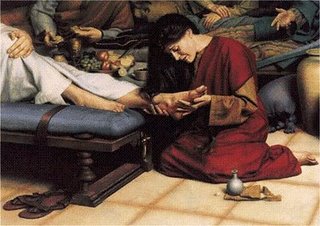
This morning I was meditating on Simeon and Anna. I know it’s Lent and not the Christmas season! That was part of my meditation. Simeon and Anna didn’t know, at the time, that it was the Christmas season. It was just another day of prayer in the Temple. But if Simeon had not been sensitive to the Holy Spirit, he would have missed the Child he had been waiting for all of his life. Thinking about this made me pray that I wouldn’t miss Christ’s coming to me today in whatever guise He takes. Let’s all keep watch for Him today. Maybe we’ll find that it’s really Christmas during Lent. 🙂
Category: Lent
Singing temptations away
How do you fight temptation? As we journey through the desert of Lent, we are sure to face temptations. Try this advice from Hannah Whitehall Smith, a nineteenth century write and evangelist:
Then my enemies will be turned back in the day when I call. This I know, that God is for me. (Ps 56.9)
Do you know what the psalmist knew? Do you know that God is for you, and that he will cause your enemies to turn back? If you do, then go out to meet your temptations, singing a song of triumph as you go. Meet your very next temptation in this way. At its first approach, begin to give thanks for the victory. Claim continually that you are more than conqueror through him who loves you, and refuse to be frightened off by any foe. Shout the shout of faith with Joshua and Jehoshaphat and David and Paul. I can assure you that when you shout, all your enemies will fall down dead before you.
Singing is such a splendid way of disarming the devil! It feeds your soul and drives him away, as Amy Carmichael reminds us:
The reason why singing is such a splendid shield against the fiery darts of the devil is that it greatly helps us to forget him, and he cannot endure being forgotten. He likes us to be occupied with him, what he is doing (our temptations), with his victories (our falls), with anything but our glorious Lord. So sing. Never be afraid of singing too much. We are much more likely to sing too little.
“Where are you?”
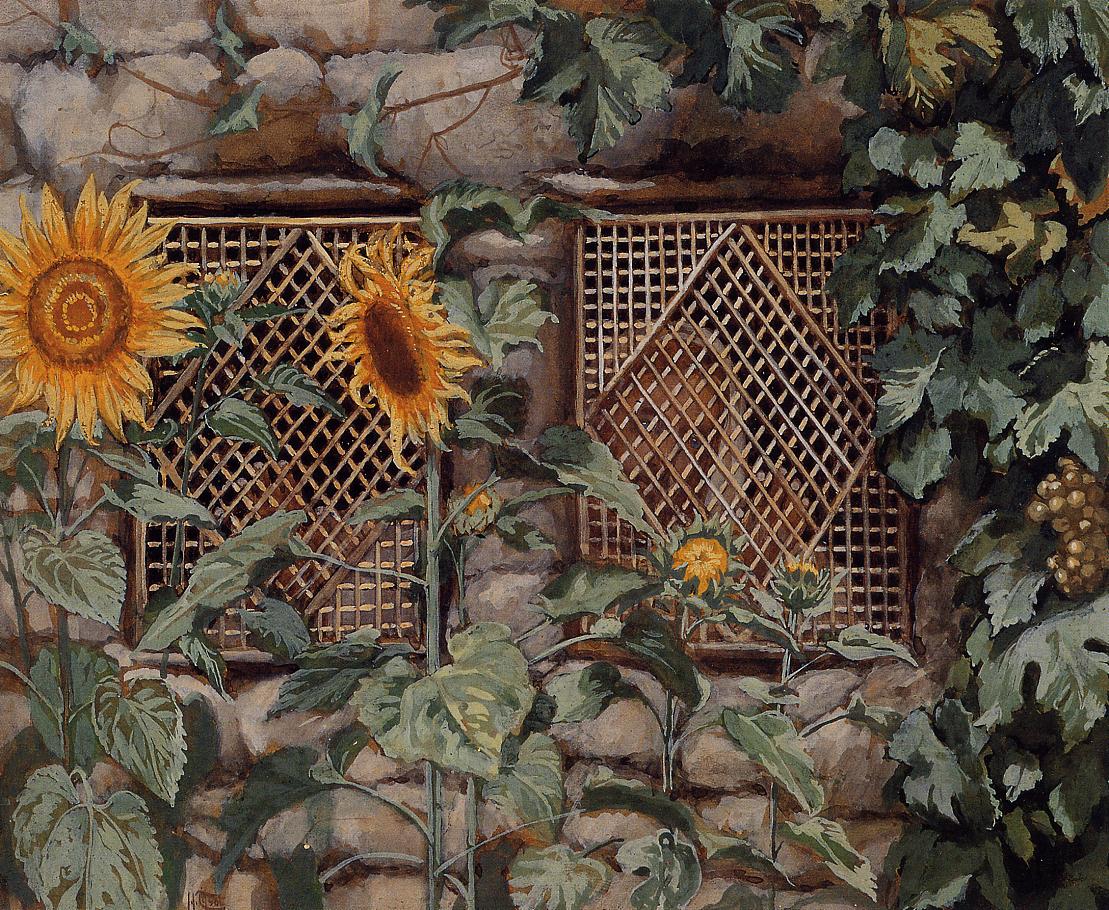 “See where he stands behind our wall. He looks in at the window, he peers through the lattice.” (Song of Songs 2.9)
This is the point of Lent: to open up to our Beloved who is looking in at us through the window. Fr. Blaise Arminjon writes: “For if God is love, there can only be in the final analysis a single sin: not to love, to refuse to open oneself to the waiting love.” After Adam and Eve sinned, the first words of God to them were “Where are you?” (Gen 3.9) God is all about relationship. He experienced the loss of relationship with Adam and Eve. His first words to them were not: “What did you do?” but “Where are you?” And that is what Lent is supposed to be all about for us: our relationship with Him, not what we have done. (If we concentrate on relationship, the other will fall in line.) So listen to Him saying to you: “Where are you?” Hear His desire to coax you out from wherever you may be hiding from Him. Take a moment, even now, to gaze at Him gazing at you through the lattice and listen to what He speaks to your heart . . .
The best form of mortification
One other wonderful piece of advice to consider as you prepare for Lent:
Blosius, a great Benedictine mystic, says that the best form of mortification is to accept with all our heart, in spite of our repugnance, all that God sends or permits, good and evil, joy and suffering. (Dom Marion)
Worth reading through again, slowly. This may be the hardest mortification you ever choose.
“Defect”
The poem for this Sunday is a wonderful introduction to Lent.
Defect
The flaw is no more
noticeable, even to me,
than a new moth-hole
in my sweater, or
a very bald spot
on the fabric of
my velvet vest.Yet when
I hold the cloth
up to the window
the sunlight
bleeds through.~Luci Shaw
Lenten resolutions
As you prayerfully consider Lent, pay close attention to these two pieces of sage advice from St. Jose Maria Escriva:
Choose mortifications that don’t mortify others.
A smile is often the best mortification.
And I urge you again to look first to those things that impede your knowledge of God’s incredible love for you. Perhaps your Lenten resolution should simply be to stand vulnerable in prayer before His love for five minutes a day or to read a Scripture verse that encourages you in the hope of His love.
Sanctity does not consist in this or that practice, it consists in a disposition of heart which makes us humble and little in the eyes of God, conscious of our weakness but boldly confident in his goodness as Father. (Therese)
Lent is coming
Lent is coming. To be honest, my usual response to that thought is one of clutching inside. I suspect that is not the best response, and every year I keep working at coming to more of an understanding of what perhaps God’s mind is on this season rather than my limited understanding or skewed understanding. I, like most Catholics who grew up when I did, tend to approach Lent, I think, from the angle of what I need to give up for Lent. What I become convinced of more and more each year is that God’s priority for Lent is not that. His priority is that we grow in our relationship with Him. Period. The only things worth giving up are those that impede our relationship with Him. Read this by Fr. Peter John Cameron to start you thinking about perhaps a different Lenten approach:
Here’s what to give up this Lent: the doubt that goes, “I can never get closer to God because I’m too sinful, too flawed, too weak.” This is a lethal attitude, for it based on the false presumption that we can possess something of our own–that does not come from God–by which we can please God. Nothing could be farther from the truth. Only what is from God can please God. But as long as such error persists, we estrange ourselves from God. Lent is not about lamenting our inadequacy. Rather, it is a graced moment to receive from God what he is eager to give us so that we can live the friendship with him that he desires. . . .
“Perhaps his sorrow is splendor”
From a profound book, Lament for a Son, written by Nicholas Wolterstorff on the death of his 25-year-old son from a mountaineering accident:
It is said of God that no one can behold his face and live. I always thought this meant that no one could see his splendor and live. A friend said perhaps it meant that no one could see his sorrow and live. or perhaps his sorrow is splendor.
And great mystery: to redeem our brokenness and lovelessness the God who suffers with us did not strike some mighty blow of power but sent his beloved son to suffer like us, through his suffering to redeem us from suffering and evil.
Instead of explaining our suffering, God shares it.
One less kiss

Following up on yesterday’s gospel which is one of my very favorite readings: I did a study once on all the New Testament scriptures that talk about women at the feet of Jesus. I usually meditate on various of them this time of year because most of them occurred near and at the time of the Lord’s Passion (like yesterday’s reading). Luke 7 recounts a story similar to yesterday’s Gospel, but in a different context, and in it, it is said that the woman “covered his feet with kisses” (Lk 7:38). Jesus himself remarks on this to Simon (at whose house he was) and actually upbraids him for not welcoming Him in the same fashion. “You did not give me a kiss . . . ” Let not the same be said of us. Let us then not hold back our kisses for His sacred feet. Mother Teresa once said something to the effect that if we don’t put our drop in the ocean, the ocean is one drop less. The same can be said for kissing the feet of Jesus: if we don’t give Him our kiss, He has received one less kiss . . . and it will be missed by Him. And note . . . for those of you who hold back because of your faults and failings . . . it was the kiss of a sinful woman that He valued.
One’s little pot of oinment
Today’s Gospel as we begin Holy Week is the story of Mary of Bethany anointing Jesus’ feet. A meditation from Amy Carmichael to ponder when we think we have broken our “little pot of ointment” in vain.
Things to remember quietly when one’s little pot of ointment seems to have been broken in vain. Of Thine own have we given Thee, for love is of God. The love, then, was His, and to Him first of all it was offered–to the human dear one not first but second. No pot of ointment was ever broken at His feet wihtout given Him some little quick sense of pleasure. So it was not all in vain. Then if it seemed to miss what we meant it to do for the one we love down here, it may be only for the moment. The remembrance may return and be very sweet, like a fragrance.
The more loving the heart is, the more it looks forward to giving a pleasure to the one it loves, the keener therefore the pang of disappointment when it fails, and the fiercer the inrush of depression. The heart is grieved and cannot rise to be glad. At such times it does help to know that love cannot be as water spilt on the ground. For it is of God. The fragrance of the ointment will yet fill the house. The one to whom we wanted to bring comfort will in the end find that which we brought. But the sweet and immediate comfort is-–‘Of Thine own have we given Thee.’ Dear Lord, did it comfort Thee?
 Witnesses to Hope