“How very much we do not want to be poor”

Well worth pondering from Heather King:

My friend Tensie runs a free clinic for farm workers on the central coast of California.  She once told me of a young Hispanic woman named Claudia who was dying of cancer; whose heart was broken at the thought of leaving her two-year-old daughter; whose patient endurance, love, and lack of self-pity were exceptional.

“In our culture,” Tensie observed, “we view suffering as an insult, a humiliation.  The people I see at the clinic suffer terribly, but they don’t view it as an insult.  They see it as inevitable, as natural almost.  In a way, to follow Christ is to examine our relationship to suffering.”

Ash Wednesday marks the season in which we especially ponder our relationship to suffering.  Praying, fasting, and giving alms are not arcane holdovers from a time when people more inured to suffering than we are found such practices easy.  Fasting has always been hard.  Fasting is a reflection of the fact that the more desperate we are, the more open we are to change.   Fasting demands that the more keenly aware we are of our empty hands and our empty stomachs, the more likely we are to realize we need help.  Fasting helps us to remember that we are all poor, and how very much we do not want to be poor.

I’ll do anything to keep from feeling “poor” myself, and as Lent approached last year, I thought: Those people who say fasting is just an ego-based endurance test are right.  This year I’m going to fast in a way that effects some real good.  I’m going to fast from criticizing people . . .

Ash Wednesday dawned, I waited to be transformed, and within an hour I was mentally nitpicking, criticizing, and judging any number of people.  A few days later I badmouthed someone out loud, the day after that I nakedly passed on a bit of juicy gossip, and from there the whole enterprise rapidly went downhill.  Nice try, but unh-unh.  Prayer without fasting is a gesture.  Mercy without fasting is a gesture.  Fasting is not a gesture.  Fasting is a consent to be consumed.

Burning-BushTo be consume by the fire of our own sin leaves cold, dead ashes.  To be consumed by the fire of Christ’s love is to have our delusions about ourselves consumed and to have our true selves left intact, like the burning-bush love that Claudia, who died at twenty-four, left behind for her daughter.

All through Lent a slow, underground fire burns, to burst into flame with the glory of the Resurrection on Easter morning.  Remember you are dust, and to dust you shall return.  And oh, what hangs in the balance during that interval between the day of our births and the day of our deaths, when for a cosmic instant we, too–beggars all–are called to burst into flame.

(Reprinted with permission)

“Where are you?”

Last week we were talking about Lent at the dinner table, and one of the Sisters shared about how she was suddenly struck this year about how Lent is really primarily all about relationship, our relationship with God.  That’s the point of the season: to restore us and strengthen us in our relationship with Him.  It’s about a Person.

That reminded me of this article that I wrote that I shared with you last year.  I think it’s worth a re-read.  (At least, I’m going to re-read it. ;-))

“So . . . what are you giving up for Lent?”  The best all-time answer I’ve ever heard to that question comes from Fr. John Peter Cameron, editor of Magnificat: “Here’s what to give up for Lent: the doubt that goes, ‘I can never get closer to God because I’m too sinful, too flawed, too weak.’”  Lent really is not about giving up, but about receiving. Fr. John goes on to say: “Lent is not about lamenting our inadequacy.  Rather, it is a graced moment to receive from God what he is eager to give us so that we can live the friendship with him that he desires. . . .”

This approach requires a major change of attitude on most of our parts.  We are so geared up for what we should do for God, when what is uppermost in the Lord’s mind is his desire to draw near to us, to give himself to us.  If what we decide to give up would, in fact, encourage greater friendship with him, that would be one thing, but for many of us, we fall too readily into the following two categories. Either we succeed in doing what we’ve set out to do and just grow stronger in our pride and self-sufficiency, and in a real sense, further from God.  Or we fail and  grow less confident in God’s mercy.  “How could I expect him to show me mercy after I fail to do one simple thing like giving up chocolate for Lent? I mean, how hard is that?”

Of course, I’m not saying that self-discipline isn’t important or that chocolate in someone’s life may not indeed be a stumbling block in his relationship with God, but for so many of us, the main obstacle we face is our lack of confidence in God’s goodness and his love for us.  We hide from him, as Adam & Eve did after they sinned.  We think that we can’t come to him unless we’ve got everything together.  But notice God’s first words to them after their fall.  They were not: “What have you done?!” but “Where are you?” (Gen. 3:9) After listening to the serpent, Adam and Eve doubted his goodness rather than placing their trust in his unbounded mercy.  Otherwise, they would have run to him like the prodigal son to his father.  His first concern was the restoration of relationship with them.

St. Thérèse encourages us along these lines of trust: “Sanctity does not consist in this or that practice, it consists in a disposition of heart which makes us humble and little in the eyes of God, conscious of our weakness but boldly confident in his goodness as Father.” (emphasis added)

Again, I am not minimizing the seriousness of sin.  What I am saying is that the first step, and the most important one, is dealing with mistrust in the goodness of God toward us.

So this Lent, you might reconsider what you should give up.  Perhaps it should be mistrust or doubt of the Lord’s goodness towards you. Look at the obstacles in the way you think about your relationship with Him. Listen to the Father calling out to you: “Where are you?” If you’re hiding because of lack of confidence in His goodness, try just taking one small step toward Him.  Come out from behind the bushes of doubt. Put aside the sin of mistrust and you might be surprised to see Him running toward you with arms wide open.

Lenten Grace – Great Gaps

Hope to the hopeless . . .

barnstormingblog's avatarBarnstorming

Where God tears great gaps we should not try to fill them with human words.
They should remain open.
Our only comfort is the God of the resurrection,
the Father of our Lord Jesus Christ,
who also was and is his God.

~Dietrich Bonhoeffer from “Circular Letters in the Church Struggle”

No greater gap was torn
than when Christ was separated from the Father,
forsaken,
choosing suffering for his brothers and sisters
by paying with his life a ransom we could never satisfy,
so dead broke are we
and captive to our sin.

Only the Word can fill
what remains open and gaping,
until we accept the comfort of his grace
freely given.

Grace great enough
to fill every hole
bridge every gap
bring hope to the hopeless
and restore us wholly to our Father
who was and is our God.


View original post

The powerless

Laura died this past Saturday.  I never really spent much time with her, but many of the women I live with did.  Laura had been one of the first residents of one of our Emmanuel Houses and had been lovingly teaching all who volunteered there for the past fourteen years.  Laura had lived with cerebral palsy in an institution until she was “rescued” by a priest who, along with others who befriended her, helped her to eventually live independently and get a college degree . . . by pecking out papers on a typewriter one key at a time, one hand stabilizing the other.  Eventually Laura had a stroke and was no longer able to live on her own and became a gift to those who serve at Emmanuel House.  It was very hard to understand Laura’s speech, but she spoke volumes nonetheless.  Trapped in her body, she still shone forth.  I can’t tell you how many times I heard the women I live with speak of how much they were learning from Laura.

I mentioned a couple of days ago that I am re-reading a book by Christopher de Vinck, The Power of the Powerlessness.  He tells a similar story about his brother, Oliver.  The main reason I mention all of this right now is not just for the sake of underlining the dignity of all those in such powerless situations, but also to remind each of us of our own dignity when we confront our own powerlessness, when we feel trapped in ourselves.   Laura had the ability to make a daily choice about how to respond to hers.  May we do the same and shine forth as she did.  Lent is a time for doing just that.

Laura Newell
Laura Newell

We all clap

Your bathrobe tie dropped into the toilet, the computer is taking forEVer, the telephone is ringing again, and you still don’t know what you’re making for dinner tonight. . . . and it’s only the beginning of Lent!  Read Christopher deVinck’s story below to remind you of a very, very important principle:

One spring afternoon my five-year-old son, David, and I were planting raspberry bushes along the side of the garage.  He liked to bring the hose and spray the freshly covered roots and drooping leaves.

A neighbor joined us for a few moments and there we stood, my son David, the neighbor and I. We probably discussed how much water a raspberry plant could possibly endure when David placed the hose down and pointed to the ground.  “Look, Daddy!”

If a wasp enters the house, I show my three children, David, Karen and Michael, how I catch the insect with a glass and a piece of thick paper.  I wait for the wasp to stop its frantic thumping and buzzing against the windowpane, then I place the open drinking glass over the creature and trap it.  Then, without pinching the wasp, I slowly slide the thick paper under the glass, and there I have it.

I invite the children to take a close look.  They like to see the wasp’s think wings; then all four of us leave the house through the front door for the release.

The children, standing back a little, like to watch as I remove the paper from the top of the glass.  They like to watch the rescued wasp slowly walk to the rim of the glass, extend its wings, and fly off into the garden.  We all clap, David, Karen, Michael and I.

When David was two he climbed the top of the small blue slide one afternoon in our backyard, and just before he zoomed down, he saw a few ants crawling around on the smooth metal.  “Daddy! Ants!”

We stopped and crouched down to see if we could count how many legs ants have (six); then I gently brushed the ants off the slide and David shot down with glee.

I choose to watch the wasp and count the legs of an ant.

“Look, Daddy!  What’s that?” I stopped talking with my neighbor and looked down.

“A beetle,” I said.

David was impressed and pleased with the discovery of this fancy, colorful creature.

My neighbor lifted his foot and stepped on the insect giving his shoe an extra twist in the dirt.

“That ought to do it,” he laughed.

David looked up at me, waiting for an explanation, a reason.  I did not wish to embarrass my neighbor, but then David turned, picked up the hose and continued spraying the raspberries.

That night, just before I turned off the lights in his bedroom, David whispered, “I liked that beetle, Daddy.”

“I did too,” I whispered back.

We have the power to choose.

Next time the computer freezes, your bathrobe tie falls in the toilet, and the phone rings again, remember you have the power to choose how to respond.  And maybe, just maybe, you could also choose to clap.  Let’s pray for each other this Lent.

P.S. If you’ve never read Chris deVinck’s The Power of the Powerless, from which this excerpt was drawn, do so.  You won’t regret it.

Where is Christ today?

[A repost from the past]

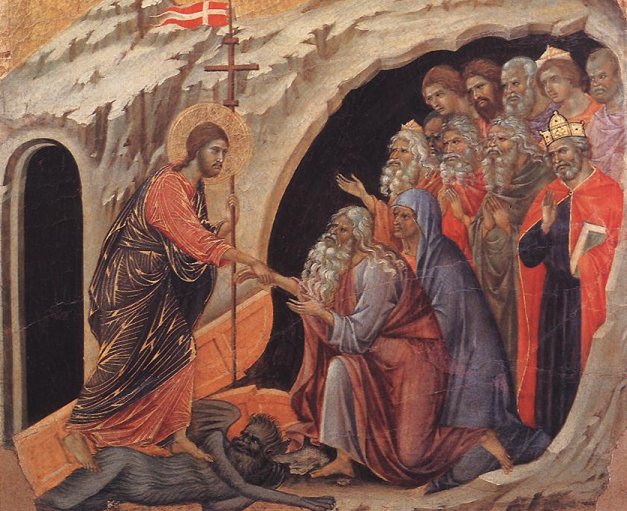
This is the day when everything is silent.  We can go about the day not giving much of a thought to it–just seeing it as the day between Good Friday and Easter Sunday. Yet monumental things were happening in the spiritual realm.  Christ descended to hell to set captives free.

This still has meaning for us.  So often we think nothing is happening in our own spiritual lives, yet God is about monumental things.  Have hope in the Unseen.

Christ descended into “Hell” and is therefore close to those cast into it, transforming their darkness into light.  Suffering and torment is still terrible and well-nigh unbearable.  Yet the star of hope has risen–the anchor of the heart reaches the very throne of God.  Instead of evil becoming unleashed within man, the light shines victorious: suffering–without ceasing to be suffering–becomes, despite everything, a hymn of praise. (Pope Benedict XVI, Spe Salvi)

And for those of you who feel that you are living “in darkness and in the shadow of death”, take heart, for you are exactly who he desires to visit.  From an ancient homily on Holy Saturday:

Greatly desiring to visit those who live in darkness and in the shadow of death, he has gone to free from sorrow the captives . . .

How can we ever comfort Him?

Today we remember the depths of Christ’s love for us.  But how can we ever love Him in return, how can we comfort Him in His suffering?  His suffering is too huge and our love is so small.  As I was pondering that question last night, the Holy Spirit called to mind something I read a year or too ago about this.  The author advised that we be like little children who try to comfort a suffering parent.  About all we can do as a child is hold our parent’s hand or kiss him or her.  Yet that provides great comfort for the parent.  All Christ asks of us is to be with Him today in His suffering, to hold His hand or kiss His feet, each in our own way.

This all reminds me of a painting by Giotto of Christ’s descent from the cross.  In it we see the women caressing Christ’s body: Mary, His dear Mother, and the women who followed Him.  Giotto places a figure square in the middle of the painting with its back to us.  He does that to prompt us to think about where we would be in the picture.  Take his prompting and let yourself enter into this mystery and hold Him and kiss Him today.

“Return to the most sorrowful woman the body, even if only lifeless, so that, although so diminished the crucified man may grow with kisses, with embraces.”

But if we find grace

This slideshow requires JavaScript.

Judas, Peter

because we are all
betrayers, taking
silver and eating
body and blood and asking
(guilty) is it I and hearing
him say yes
it would be simple for us all
to rush out
and hang ourselves
but if we find grace
to weep and wait
after the voice of morning
has crowed in our ears
clearly enough
to break our hearts
he will be there
to ask us each again
do you love me

Luci Shaw

Loving with Mary

This morning as I woke up, I began thinking again about contemplating our Lord’s Passion with Mary.  I was immediately struck by the thought of how much of her time and love was spent through these difficult days in loving those that Christ loved.  Peter would surely have flown to her after his denial.  How lost John must have felt after his flight in the garden.  Mary Magdalen and Mary and Martha (and Lazarus) of Bethany would have faced their own devastation.  There was the bitter anger at Judas that pervaded them all.  And so on with all of them. But just as Jesus gave her to us through John at the Cross, so He would have been urging her in the same way (by His Spirit) to go out to those He loved so much.

Perhaps your Triduum will be filled with the demands of others and you would rather be focusing more “directly” upon our Lord.  Perhaps it is His Spirit urging you to go where His Mother is going.  In following her and loving whomever she is loving, you will in fact be loving our Lord who loves them more than you do.