Pray with us

This is absolutely beautiful and so powerful.

In collaboration on a first-of-its-kind project for Holy Week, Wintershall Theatre Company and @christianart have joined forces on The Stations of the Cross: Pray with us, a short film depicting the fourteen scenes from Christ’s Passion. Filmed at Wintershall Estate against a striking 20-foot cinematic backdrop, each scene from the Stations of the Cross was carefully arranged, lit, and filmed to create the effect of a tableau vivant—a living painting.

“The tradition of tableaux vivants, or “living pictures,” dates back to the Middle Ages and gained popularity in the 18th and 19th centuries as a theatrical artform. In these staged scenes, actors would pose silently and motionlessly to recreate famous artworks or dramatic moments, often with elaborate costumes, lighting, and minimal movement. The tableau vivant artform has found new life in video, where the boundary between stillness and motion can be artfully explored, inviting the viewer to contemplation and often emotive experience.

“Written by Presented by Fr. Patrick van der Vorst”

The cross we bear from others

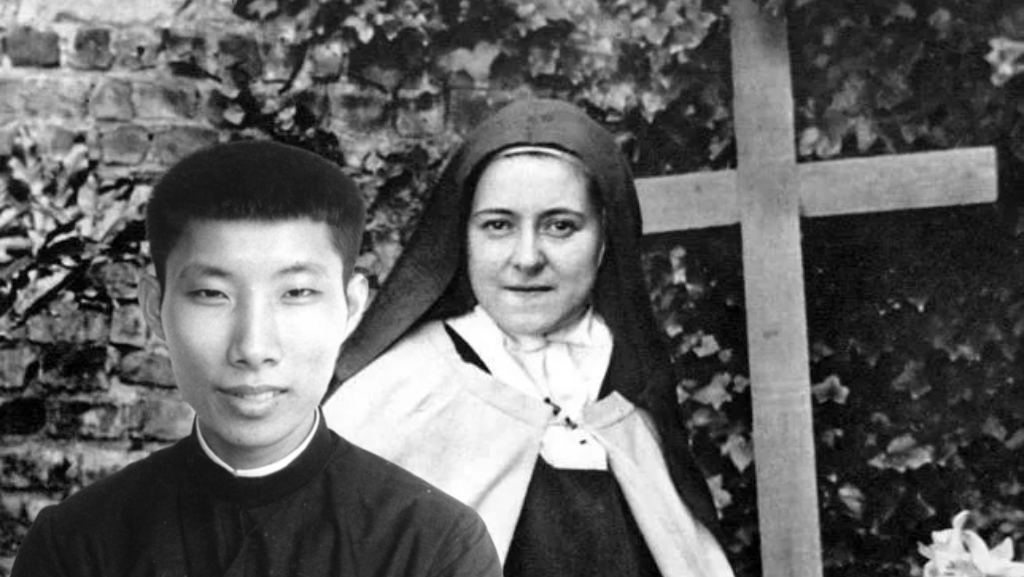
Sally Read, a poet herself, shared this poem by Sarah Law about Thérèse in her dying, her complete abandonment to God, even to the love of her sisters who were, in fact, inhibiting her dying–and that becomes part of the cross that she embraces.

The Cross

Because she couldn’t breathe–
was wracked with breath’s lack,
too weak to raise herself,

Marie and Céline have lifted her 
half-up from the bed, her
hurting arms spread and held

about their robed shoulders.
Tipped forward, she hangs
on the cross of herself,

as the night light flickers;
the last speck of sand has run
from the hourglass’s lung.

She is heavy as a world,
a dying sun. But Céline–
unready still–flings out her hand

to force the air to move again;
force the sickroom’s minutes back
into their fragile cycle,

and so they ease her down,
and she offers up their love. 

I feel so blessed to have discovered this poet who has an entire book (!) of poems dedicated to Thérèse.

“Oh my God, I am really unhappy!”

It’s been a bit of a rough week for me. This week is bookended by the anniversaries of two of my brothers’ passings, one who died just a year ago and the other many years ago from suicide. Also, another brother (closest to me in age) is currently homeless.

Not too long ago, after having read so much about him at Benjamin Embley’s blog, Contemplative in the Mud, I read Marcel Văn’s Autobiography. Văn had an incredible relationship with St. Thérèse who appeared to him and spoke with him often. I’ve been going back again and again to something she first said to him:

“If on the other hand, you are invaded by sadness, say to him again with an open heart: ‘O my God, I am really unhappy!’ And ask him to help you to accept this sadness with patience. Really believe this: nothing gives as much pleasure to the good God than to see on this earth a heart which loves him, who is sincere with him with each step, with each smile, as well with tears as with little momentary pleasures.”

“So when you speak to the good God, do so quite naturally as if you were talking to those around you.  You can speak to him of anything you wish: of your game of marbles . . . God takes pleasure in listening to you; in fact, he thirsts to hear these little stories which people are too sparing with him.” 

This has been the form of my prayer this week, a little child bringing all to her Father because that is the kind of Father that he is.

Photo from Contemplative in the Mud

And, if I may, could you say a prayer for all of my brothers? Thank you.

Blessed are those who mourn

Käthe Kollwitz’s Pietà

Photography by Walter Mason

This slideshow requires JavaScript.

“I have no right to withdraw from the responsibility of being an advocate. It is my duty to voice the sufferings of people, the sufferings that never end and are as big as mountains.” So wrote Käthe Kollwitz – artist, socialist, pacifist, and grieving mother – five years after her son Peter died on the battlefield in World War I. In 1937, she began working on her Pietà in his memory as war loomed again. In that second great bloodletting she would lose her grandson, also named Peter, killed in action as a draftee for Hitler, whose regime was hounding Kollwitz for her dissident activities.

In 1993, an enlarged casting of the Pietà was installed as the centerpiece of Germany’s National Memorial to the Victims of War and Tyranny on Berlin’s Unter den Linden boulevard. The sculpture is situated in the Neue Wache guardhouse, once a national­istic shrine that played a central role in the Nazis’ annual parade for war heroes.

Today, the remains of an unknown soldier and an unknown concentration camp prisoner rest beneath Kollwitz’s statue. Directly overhead, the oculus allows sunlight, rain, and snow to fall onto the agonized mother. “Blessed are those who mourn” – this place draws us into the heart of this cryptic beatitude, evoking the suffering of mothers all over the world, from Syria to the Congo.

Berlin photographer Walter Mason writes: “Kollwitz’s statue, alone in the middle of the room, commands a respect that is immediately understood by anyone who enters. The tourists come in off the street and, without exception, fall silent. The mother with her son is so wrapped up in her sorrow that she seems ­unapproachable; the visitors stand at a distance and partake in her grief.”

Originally found at Plough.com

Straining for the Light

black-84715_1280

For a long time the threat of a new year brought with it an onslaught of more darkness, more enervating melancholy, more long, gray days ahead to suffer through. It was nothing to celebrate.

At the end of one of those especially difficult years I met Alece Ronzino online. She too had experienced a year (or more!) like that, punctuated by loss and betrayal and hopelessness. In 2009 she decided to find one word to focus on in the new year, instead of a list of resolutions that were quickly and quietly abandoned. One Word 365was born.

One word can change everything. Forget New Year’s Resolutions. Scrap the long list of goals that you won’t remember three weeks from now anyway. Choose just one word. One word that sums up who you want to be or how you want to live or what you want to achieve by the end of 2016. One word. 365 days. A changed life. ~Alece Ronzino

The last four years I’ve participated brought some incredible changes to my life. I became more focused, more hopeful, more inspired to hold fast, keep going, and expect good things. I’ve been challenged to be fearless. I have committed to believing. I have thrown myself into creativity. Most recently, I have spent a year contemplating possibility and what that looks like fleshed out in real life, and right now it looks like The Mudroom. I doubted it was possible a year ago, yet giving space for possibility to bloom made it a reality.

I’ve been brought low and robbed of energy by chronic pain. I’ve spiraled into dark depression. Anxiety has left me dizzy and breathless. I’ve been facing childhood sexual abuse head on and I have the bruises and scars to show for it. I’ve been humbled by my own darkness, my secret sins that cast a shadow over my heart and steal the light from my eyes. I’ve staggered under the weight of loneliness and grief and fear and despaired of ever feeling strong again.

My One Word for 2016 is restore.

rsz_onewordcollage2016

The locusts have ravaged me, leaving me bereft. I hardly know what plenty, abundance, fullness feels like. I find myself returning to that field of devastation, the locusts leaving nothing of worth behind. But there is a promise and I am claiming it.

Joel 2:25-32 (ESV)
25 I will restore to you the years
that the swarming locust has eaten,
the hopper, the destroyer, and the cutter,
my great army, which I sent among you.
26 “You shall eat in plenty and be satisfied,
and praise the name of the Lord your God,
who has dealt wondrously with you.
And my people shall never again be put to shame.
27 You shall know that I am in the midst of Israel,
and that I am the Lord your God and there is none else.

In these verses God is not telling his people to buck up, man up, cowgirl up, grow up, deal with it, get over it, or pull yourself together. He is acknowledging that this is a straight-up disaster, a full-on calamity. He sees and validates the wreckage and the ruin that has devastated his people, who have been left desolate. He tells them that it was his great army, obeying his command, meting out justice, which caused this cataclysm.

But God.

God is a God of restoration, redemption, healing, and deliverance. He is a God of double portions and spacious places. He removes shame and exchanges it for radiance.

Jeremiah 30:17
For I will restore health to you, and your wounds I will heal, declares the Lord
Isaiah 61:7
Instead of your shame there shall be a double portion
Hosea 6:1
“Come, let us return to the Lord; for he has torn us, that he may heal us; he has struck us down, and he will bind us up.”

He will not leave us as orphans. He will not treat us as our sins deserve. He will not ignore our cries for mercy. There is no shadow of turning in him.

In Life Together, Dietrich Bohoeffer penned a paragraph that all of us should write on our mirrors. He was referring to the morning, but I have replaced day with year.

For Christians the beginning of the [year] should not be burdened and oppressed by besetting concerns for the [year’s] work. At the threshold of the new [year] stands the Lord who made it. All the darkness and distraction of the dreams of night retreat before the clear light of Jesus Christ and his wakening Word. All unrest, all impurity, all care and anxiety flee before him. Therefore, at the beginning of the [year] let all distraction and empty talk be silenced and let the first thought and the first word belong to him whom our whole life belongs.

My proclamation for 2016 is to not be oppressed by the besetting concerns for this year’s work, but to face it with excitement and expectation. I will remember that God stands at the threshold of this year, like a sentry, offering protection but also reminding me that every day is a battle, but one I don’t fight in vain or alone. Darkness and distraction are no match for the light of Jesus and his wakening Word. Restlessness, impurity, worry, and fear have no place in this year. My first thought and first word of this year, and every morning in it, belong to God who has “destroyed death and has brought life and immortality to light through the gospel.”

The onset of a new year isn’t a threat to me anymore. It doesn’t hold the same bleakness and grim prospects as it did previously. I’m determined to wrestle until I’m limping. I’m done with ashes and mourning and shadows and death. I’ve had enough of despondency and gloom. I’m aching for the light.

Who’s aching with me?

Tammy Perlmutter

Writer at Raggle-Taggle
Tammy Perlmutter writes about unabridged life, fragmented faith, and investing in the mess at her blogRaggle-Taggle. She founded The Mudroom to make room in the mess and create a space for people to beheard. Tammy guest posts a bit, writes flash memoir, personal essay, and poetry, leads writing groups, and preaches on occasion. She is also an advocate for women and mental health, an alum of the Voices and Faces Project testimonial writing workshop, The Stories We Tell, for survivors of sexual assault, abuse, and trafficking, as well as the Social Media Director for Threads of Compassion, an organization offering comfort to recent victims of sexual trauma. She will have an essay included in the book Soul Bare: Raw Reflections on Human Redemption, being published by InterVarsity Press in 2016.
 . . . reblogged from Mudroom

“Why Everything Does Not Happen for a Reason”

An excellent article by John Pavlovitz:

“Why Everything Does Not Happen for a Reason”

That phrase.

We’ve all received it personally gift-wrapped by well-meaning friends, caring loved ones, and kind strangers. It usually comes delivered with the most beautiful of intentions; a buffer of hope raised in the face of the unimaginably painful things we sometimes experience in this life.

It’s a close, desperate lifeline thrown out to us when all other words fail:

Everything happens for a reason.

I’ve never had a tremendous amount of peace with the sentiment. I think it gives the terrible stuff too much power, too much poetry; as if there must be nobility and purpose within the brutal devastation we may find ourselves sitting in. In our profound distress, this idea forces us to run down dark, twisted rabbit trails, looking for the specific part of The Greater Plan that this suffering all fits into.

Read the rest here.

Coming to the end of ourselves

Jerry Sitter, in his outstanding book on loss, A Grace Disguised, writes about the sudden loss of his wife, his daughter, and his mother, all in one tragic car accident.  We all suffer loss and Jerry writes so well about what is common to all of us in our losses.  Here is one sampling:

Loss forces us to see the dominant role our environment plays in determining our happiness.  Loss strips us of the props we rely on for our well-being.  It knocks us off our feet and puts us on our backs.  In the experience of loss, we come to the end of ourselves.

But in coming to the end of ourselves, we can also come to the beginning of a vital relationship with God.  Our failures can lead us to grace and to a profound spiritual awakening.  This process occurs frequently with those who suffer loss.  It often begin when we face our own weaknesses and realize how much we take favorable circumstances for granted.  When loss deprives us of those circumstances, our anger, depression, and ingratitude expose the true state of our souls, showing us how small we really are.  We see that our identity is largely external, not internal.

Finally, we reach the point where we begin to search for a new life, one that depends less on circumstances and more on the depth of our souls.  That, in turn, opens us to new ideas and perspectives, including spiritual ones.  We feel the need for something beyond ourselves, and it begins to dawn o nus that reality may be more than we once thought it to be.  We begin to perceive hints of the divine, and our longing grows.  To our shock and bewilderment, we discover that there is a Being in the universe who, despite our brokenness and sin, loves us fiercely.  In coming to the end ourselves, we have come to the beginning of our true and deepest selves.  We have found the One whose love gives shape to our being.

Praying for you, that through whatever loss you are experiencing right now, that you might know the fierce love of God for you.