“God never wastes His children’s pain.”

For those of you who seem to be suffering fruitless pain, a word from Amy Carmichael:

But to what end is pain?  I do not clearly know.  But I have noticed that when one who has not suffered draws near to one in pain there is rarely much power to help; there is not the understanding that leaves the suffering thing comforted, though perhaps not a word was spoken; and I have wondered if it can be the same in the sphere of prayer.  Does pain accepted and endured give some quality that would otherwise be lacking in prayer?  Does it create that sympathy which can lay itself alongside the need, feeling it as though it were personal, so that it is possible to do just what the writer of Hebrews meant when he said, “Remember them that are in bonds, as bound with them; and them which suffer adversity, as being yourselves also in the body“?

. . . What if every stroke of pain, or hour of weariness, or ay other trial of flesh or spirit, could carry us a pulse-beat nearer some other life, some life for which the ministry of prayer is needed, would it not be worth while to suffer?  Ten thousand times yes.  And surely it must be so, for the further we are drawn into the fellowship of Calvary with our dear Lord, the tenderer are we toward others, the closer alongside do our spirits lie with them that are in bonds; as being ourselves also in the body.  God never wastes His children’s pain.  (Rose from Brier, p. 124)

“Perhaps his sorrow is splendor”

From a profound book, Lament for a Son, written by Nicholas Wolterstorff on the death of his 25-year-old son from a mountaineering accident:

It is said of God that no one can behold his face and live.  I always thought this meant that no one could see his splendor and live.  A friend said perhaps it meant that no one could see his sorrow and live.  or perhaps his sorrow is splendor.

And great mystery: to redeem our brokenness and lovelessness the God who suffers with us did not strike some mighty blow of power but sent his beloved son to suffer like us, through his suffering to redeem us from suffering and evil.

Instead of explaining our suffering, God shares it.

“Our wounds are part of who we are”

Two songs are coming to mind today.  One was written by a friend of mine, Kitty Donohoe, on 9-11 which she was later invited to sing at the dedication of the Pentagon Memorial.  The name of the song is “There are No Words.”  Michael Card in his book, A Sacred Sorrow, talks about the importance of lament in our lives, the need to struggle through our griefs to God, as Job did.  In listening to Kitty’s song (which you can do here), you may wonder where God is in it.  My take on it is that it’s the beginning stage of a lament, trying to begin to grieve.  In the beginning, Job himself cursed the day he was born . . . but he stayed in the struggle with God, and we know the ending.  And we know there is “a balm that can heal these wounds that will last a lifetime long.”

The second song is by Michael Card: “Lift Up Your Sorrows”, an encouragement to true lament, to stay in the pain and grief, wrestling through it to find the Lord.

And one more here, another by Michael:”Underneath the Door.”   It is in a sense a testimony to his own struggling through pain in his life to meet God in it.   “But our wounds are part of who we are and there’s nothing left to chance/And pain’s the pen that writes the songs and they call us forth to dance.”

Darkness is not dark to thee . . .

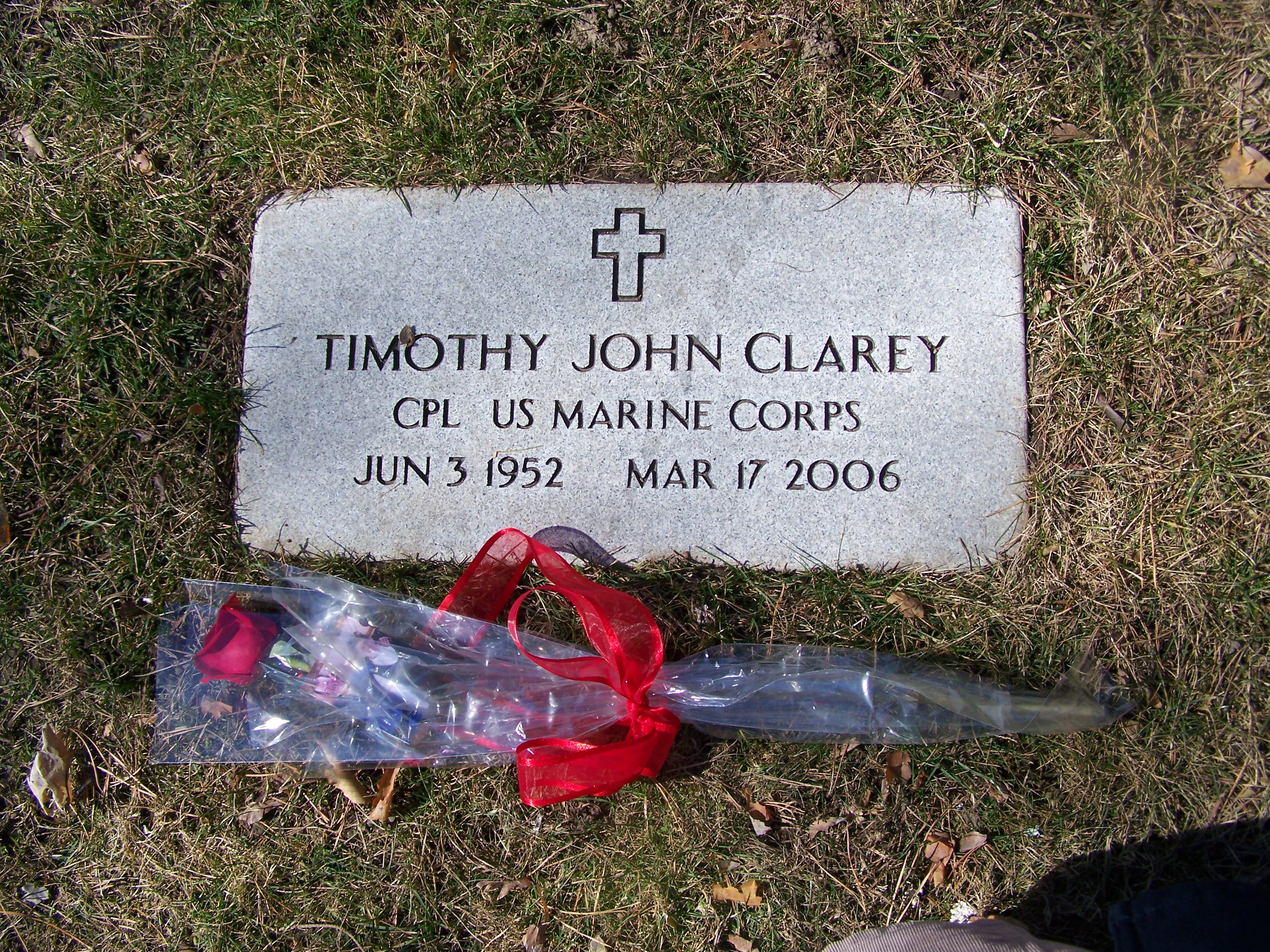
On Tim’s first anniversary, I was still on crutches (from a broken ankle), but all the sisters in my house drove me up to Tim’s grave.  They even brought a folding lawn chair for me to be able to just sit at his grave.  I read aloud from Psalm 139:

Where can I go from your Spirit?
Or where shall I flee from your presence?
If I ascend to heaven, you are there!
If I make my bed in Sheol, you are there!
If I take the wings of the morning and dwell in the uttermost parts of the sea,
even there you hand shall lead me,
and your right hand shall hold me.
If I say, “Let only darkness cover me,
and the light around me be night,”
even the darkness is not dark to thee,
the night is bright as the day,
for darkness is as light with thee.

Sitting with me

I’ve been thinking about what I found most supportive after my brother, Tim, died.  I think of a few things.  People who just sat with me, were with me, not saying much, just being there.  Like Job’s friends who sat with him in silence–probably the only thing that they did right.  People who said something when they didn’t know what to say–but at least they said something, not pretending that nothing had happened.  People who didn’t try to “fix” me by giving me all kinds of perspective, Christian or otherwise.  Again, sometimes the best thing was just being there with me, not necessarily saying a lot.  Not leaving me entirely alone.  (I was afraid to be alone those first days after he died.) People who surprised me with gifts: two dozen white roses, a dinner, a card.  People who would ask me, “Can I do anything for you?” and be okay with me saying, “No, but thank you so much for asking.”

Friends who still recognize that I’m grieving, even four years later, and still “sit with me” in it.  To you especially, I say thank you.

Arise, belovèd, come

A very good and dear friend died very unexpectedly from cardiac arrest yesterday. . . .  This song we sing keeps going over and over in my mind:

“Arise, belovèd, come,
For spring adorns the land;
The vine in flower will bear sweet fruit;
Arise, and take my hand.”

The voice of Christ impelled
Her heart to rise and go
To hidden places carved in rock
That only lovers know.

“Arise, beloved, come,
and let me see your face,
and I will be your summer sun,
and you my dwelling place.”

She lived in faithful prayer,
The Sun her constant flame
Through autumn gold and winter snow,
Until he called her name:

“Arise, belovèd, come,
For summer walks the land.
The vine in flower has borne its fruit,
The harvest is at hand.”

~Genevieve Glen, OSB

Responding to Haiti

If you’re like me, you feel heartsick and helpless about Haiti.  I found a lot of consolation in this excerpt from a letter of Caryll Houselander’s:

It struck me last night that many people are increasing their fear by thinking in crowds, i.e. they think of hundreds and thousands suffering etc., whilst the fact is, God is thinking of each one of us separately; and when–say–a hundred or a million are suffering, it is God who has each one separately in His own hands and is Himself measuring what each one can take, and to each one He is giving His illimitable love.  This thought, though obvious, consoles me a lot.

May each suffering soul know that “illimitable love” of God.

In time of need

Yesterday was the funeral for my aunt and the reason for my not posting.  Today, of course, I am a bit weary.  The funeral went well, but now, in addition to what I call the “mother-wound” I carry in my heart because of the loss of my own mother, I now have an “aunt-wound” because of the loss of my “other mother”.   This morning when I prayed, I picked up a collection of Amy Carmichael’s writings called Thou Givest . . . They Gather and read this:

“I cannot get the way of Christ’s love.  Had I known what He was keeping for me, I should never have been so faint-hearted”, Samuel Rutherford wrote long ago.  Have we not often had cause to say so too?  But if for a season we are in heaviness, if the morning after a night of pain, or prayer, or fierce fight of temptation, or any other weariness, finds us arid as a burnt-up bit of land, there is a perfect word waiting to hearten us: Grace to help in time of need–in time of need–that is the word.  Often and often I have drunk of that living water very thirstily.  Blessed be God for this brook in the way.  “For we have not a high priest that cannot be touched with the feeling of our infirmities; but One that has been in all points tempted like as we are, yet without sin.  Let us therefore draw near with boldness to the throne of grace, that we may receive mercy, and may find grace to help in time of need.” (Heb 4.15-16)

Now, I must honestly confess that I sometimes have mixed reactions to reading something like this.  This is what I begin to think: “But will I really feel refreshed after I pray?  Many a time I have continued on arid after coming to Him.”  (I call to mind that time I spoke of earlier when I cried out, “Lord, have you forgotten me?”)  But even as I thought that this morning, I felt the Holy Spirit prompting me: “But can you not trust that if that is the case, that the Father, in His love, has a greater purpose in allowing it?”  And, you know, I cannot but answer yes to that because I know “in my knower”–as they say–that all that the Father does, He does in love.  If I continue on in weariness and grief and aridity, He must have a greater purpose in it all.  And I thank Him for reminding me of that.

The Homecoming

Still thinking a lot about our Homeland, and, of course, about my aunt’s journey there.  I was thumbing through my collection of Jessica Power’s poetry and found this most apt poem.  (Poetry is one of the solaces in my life.)

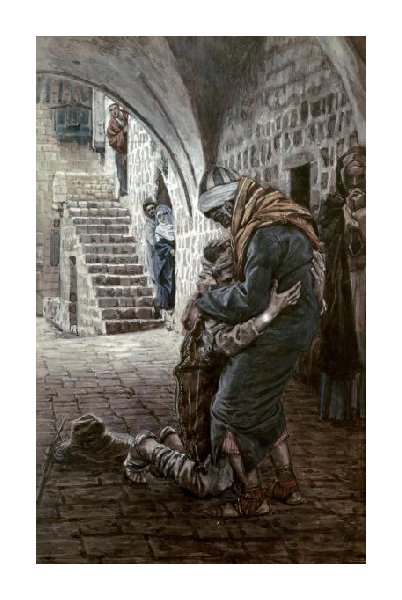
Return of the prodigal son (Tissot)

The Homecoming

The spirit, newly freed from earth,
is all amazed at the surprise
of her belonging: suddenly
as native to eternity
to see herself, to realize
the heritage that lets her be
at home where all this glory lies.

By naught foretold could she have guessed
such welcome home: the robe, the ring,
music and endless banqueting,
these people hers; this place of rest
known, as of long remembering
herself a child of God and pressed
with warm endearments to His breast.

            ~Jessica Powers, The Selected Poetry of Jessica Powers, p. 53

The same will be true for us: the robe, the ring, the banqueting, and best of all, the warm endearments as we are pressed to His breast.

Come soon

My mom had only one sibling, a younger sister, my Aunt Dorothy.  After my mom died ten years ago, my aunt became my other mother.  I would tell her: “You’re the closest thing to my mother that I have, and I’m the closest thing to my mother that you have.”  I could go visit her and feel like I was at my mom’s.  I could find the same unconditional love there as I did at my mom’s.  She’s been sick the last couple of months with recurrence of cancer, and I was able to spend some good times with her.  My cousin, Matt, called yesterday and said that she had taken a turn for the worse, so I drove up immediately to see her.  She was unresponsive, but I was able to tell her I loved her and God loved her and thank her for everything.  This morning I found out that she died peacefully a half hour after I left, with her two youngest children holding her, one of them with her hand on my aunt’s heart. 

I can’t help but think that I’m starting Advent early.  Advent is all about Christ’s coming, His first coming and His second coming, and these kinds of comings at the moment of death.  Of course, I’m mourning her loss.  I’ve lost my other mother.   I’m now the oldest on that side of the family.  But she’s with the One who loves her the most.  The One we all long to be with.  This poem has been going through my mind the past few hours. 

Come Soon

I set my candle where the shadows loom,
A flame of faith between the eyes of fate,
And I am waiting in the windy gloom;
O come, my Love, for it is growing late.
Small doubts on darkling wings flit here and there
Uncertainly in the grey, lingering light;
Mysterious music haunts the troubled air,
And none but you can comfort me tonight.

I wait upon the moment’s hazard now;
Is there no power can hold the darkness back
Until you come?  O do not disavow
Your promised love–the one thing I most lack.
The hour is late, dear Love, come soon, come soon;
Then shall the night be lovelier than noon.

               ~Hazel Littlefied Smith

My aunt now knows the one thing she most lacked, for her Love has come for her.  May He come soon for all of us “waiting in the windy gloom.”