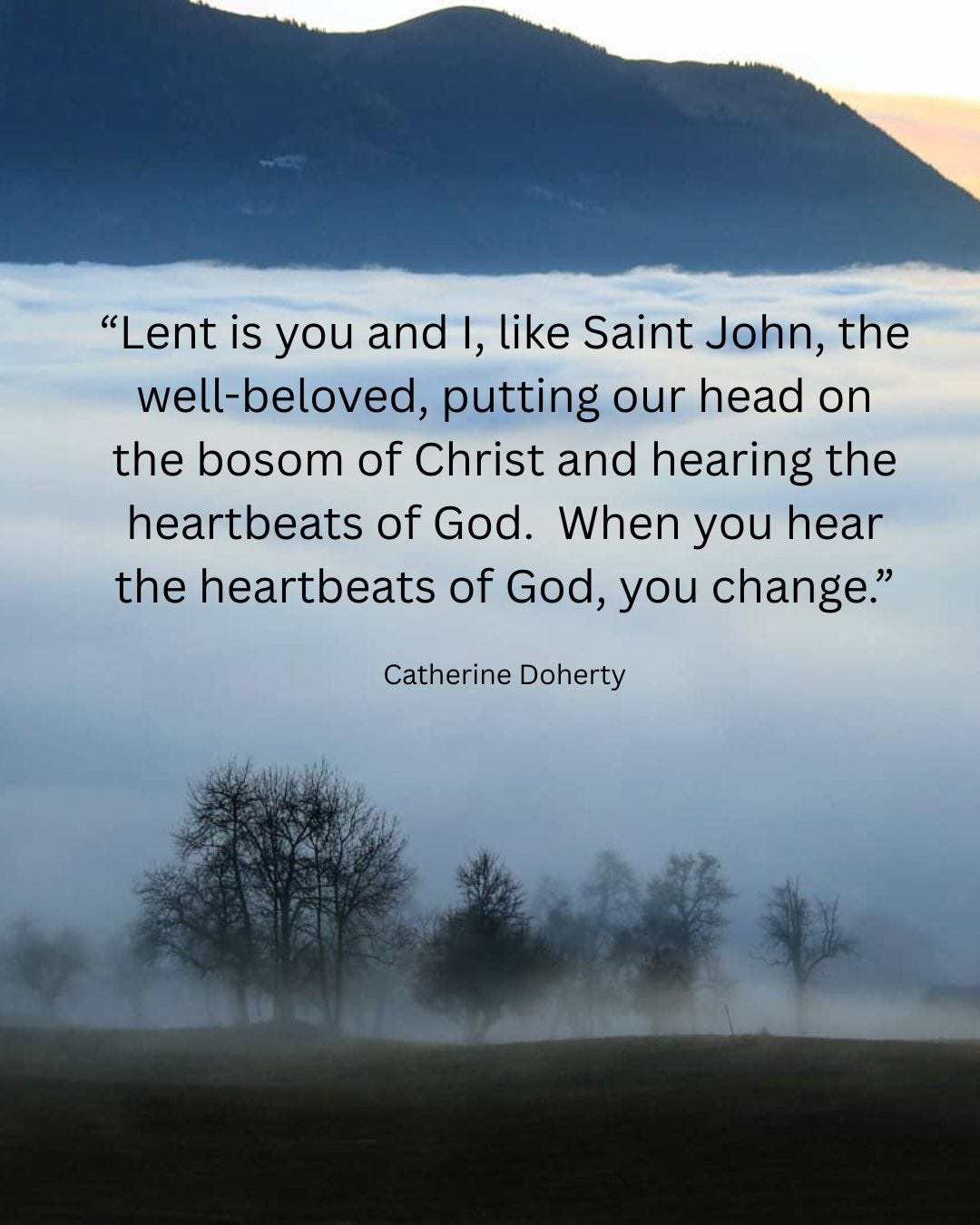
I posted this over at my Substack account at the beginning of Lent, and it continues to accrue a lot of likes and restacking since then. I ask myself why.
I recently saw an article entitled, “Already dropped your Lent resolution? Consider this.” You start seeing these kind of articles pretty frequently this time of Lent. Nothing really wrong with what was said in the article and also not surprising. Lenten resolutions can be so similar to New Year’s resolutions. They usually don’t last very long. Full confession: I do neither—and for this simple reason: the focus.
Lent can be all about what you’re doing—many times out of a good heart. You want to show God you’re serious about your life, about your faults and imperfections. Or all you’ve ever known or heard about Lent is “giving something up.” So you either pick something random or something that you really like or are addicted to—sometimes to the detriment of others, especially if it’s coffee. (St. Josemaría Escrivá said, “Choose mortifications that don’t mortify others.”)
Or because you’re not really sure what to do, you jump into one of the 40 Day challenges that are being offered somewhere out there and hopefully last more than a week.
As I’ve already said, nothing really wrong about that.
But what if there might be a different way of looking at Lent?
What if you just simply, as Catherine Doherty describes so well, lay your head on Christ’s heart in order to hear God’s heartbeats and trusted that the more you do that, the more you will really change?
What if you lay your head on his heart and you rest there? You let yourself be held and embraced. You surrender like a little child that has fussed and whimpered and finally gives up. And you wait.
God is always initiating.
If you rest there and listen to his heartbeats, you won’t miss what he has for you, what he wants to do in your life.
Perhaps the first thing he wants—and honestly, I think this can be the hardest for so many of us—is for you to hear what his heartbeats are saying. “I love you. I love you. I love you.” With each heartbeat.
For God, that’s always the starting point for each of us. Not just at the beginning of our spiritual lives, but the starting point of each day, of each minute.
The essence of the life of the Trinity is the embrace of the three Persons. The Father embraces his Son, the Son returns this embrace which is, in truth, the Holy Spirit.
The Son is perpetually leaning his head against the heart of the Father. By baptism, we are introduced into this embrace. So, in truth, that is where we are. John the Beloved knew this as he wrote his gospel. He referred to himself as “the one Jesus loved” not just as a way of referring to himself, but also so each of us could see ourselves as “the one Jesus loved”.
So remind yourself that this is your starting place. If that is the only thing you do during Lent, it will be the most important thing that you do.
Jesus knew his identity as the beloved Son of the Father before he went into the wilderness. The Father spoke over him when he was baptized, “This is my beloved Son.” It was after that that he went into the wilderness, led by the Holy Spirit, the love between him and the Father.
So start there—and stay there. Consider whether your lenten resolutions or programs that you are struggling with are resulting from listening to his heartbeats or just something you feel that you have to do in order to have a successful Lent.
Be like Jesus. Lean on his heart before you go rushing out into the wilderness.
P.S. And speaking of the wilderness, read this.
Praying for you.

 Witnesses to Hope