Only God knows what you yourself will have to suffer. And he will be there to take you by the hand, to go with you step by step, and to support you in all trials. Little Brother Marcel Văn CSsR (19…
Source: Only God Knows
Only God knows what you yourself will have to suffer. And he will be there to take you by the hand, to go with you step by step, and to support you in all trials. Little Brother Marcel Văn CSsR (19…
Source: Only God Knows
I’m one of those people who constantly gets stuck in the rut of trying to fix myself, to make myself better, and then to approach God. Be perfect before I seek His help. Well, you can imagine how well that works out. God, in His great mercy, keeps working on changing that attitude. That’s why I love this piece by Sister Ruth Burrows. The answer is in the second to the last sentence. Read on.
Let me stress a little more the supreme importance of refusing to evade our own personal poverty, refusing to be discouraged by it. Only too easily, self-disgust and discouragement become spiritual waste. I think it is of utmost importance to use everything for loving. After all, our lives are made up of “nothings”! We can be on the lookout for the big occasions and let slip the hundreds of little opportunities when divine love is asking to be let in.
Nothing about us is hidden from the loving, compassionate eyes of God, but when we are feeling miserable within, shamed, silly, dirty even, we hide away. God isn’t in all this, we implicitly assume. But God is in all this, to us, contemptible stuff. We love very much by this lack of childlike trust.
Through what is happening to us, we are brought to face our sinfulness, our selfishness, our inadequacy or whatever it is. Yet this is God’s moment. It, I believe, in the constant, almost hourly choices that these humiliating, self-revealing experiences afford us, that true holiness and union with God is brought about. I’m sure that what God longs for us to do is never to stop looking in his compassionate eyes. Nothing is too small, pathetic or shameful to be used for love.
And what about those times when you feel like you’re just not making a good confession?
No matter how weak you are, do not think that what you need to do in order to enjoy his redemption is impossible or so difficult that you have to despair of obtaining it. It is enough for you to direct a heartfelt sigh to God, with sorrow for having offended such a Father and with the intention of amendment. Make known your sins to a priest who can absolve you. For your greater consolation, even your ears of flesh will hear the sentence of your trial in what is said to you: “I absolve you from all your sins in the name of the Father and of the Son and of the Holy Spirit.
Even if it seems to you that your sorrow is not as perfect as it ought to be, and for this reason you lose heart, do not be discouraged. So great are the Lord’s desires you be saved that he supplies what we lack with the privilege he gave to his sacrament of making one who is without sorrow to be contrite. If it seems to one that you are not even capable of doing this little bit, I tell you not to presume to do it on your own, but call upon the heavenly Father. Ask him, through Jesus Christ, his Son, to help you to be sorry for your past life, to propose amendment for the future, to confess well, and finally, for whatever else may be necessary. He is such that there is no reason to expect from his hands anything other than every kind of tenderness and help. Since he is the one who gives pardon, he inspires disposition for it.
If, with all this, you do not feel consolation, even though you have heard the sentence of your absolution, do not be discouraged or abandon what you have begun. If in one confession you do not experience consolation, in another or in others you will . . . . Certainly it happens that the words of sacramental absolution may not give the man such certainty of pardon that he may have security or evidence of it. But they do provide such rest and consolation that the powers of his soul, humiliated and broken by sin, rejoice. (St. John of Avila)
A very good article by Stephen H. Webb on depression from First Things:
Christians don’t talk enough about depression. Emotional pain, for one thing, can be hard to share. Despair can feel very physical for the sufferer, weighing heavily on the heart and clogging the brain, but its surface features can be easily overlooked or
missing altogether. A depression that finally lifts leaves no scars on the
skin to show how deep the wound was and how long the healing took. Besides, such anguish is so personal that it is hard to share it with anyone other than members of the family or the medical profession.
Those who suffer from depression are usually very grateful for all the pharmacological breakthroughs  surrounding serotonin and other neurotransmitters. Philip Rieff brilliantly criticized the triumph of the therapeutic in American culture, but the fact is that chemistry has rendered psychology suspect at best or irrelevant at worst in the treatment of mental illness. This trend has not served the church well. Theology is a form—arguably the original form—of therapy, and if the church is to compete with the pharmacy, it has to have some good news of its own concerning depression.
Depression is a complex phenomenon with multi-causal roots. Medical definitions are informative and essential, but no other kind of pain has such a visceral spiritual component. Ironically, faith can be a source of aggravation as well as relief. Anyone who even thinks about suicide typically feels deeply ashamed, but Christians in this situation have even more guilt heaped upon them due to the way suicide is usually treated as the gravest of sins. The helpful sometimes tell Christian depressants that they should look outward, to the service of others, and upward toward God rather than obsessing over inward states of mind that are typically defined in secular psychological terms. This is surely right, but Paul tells us that the faithful have the mind of Christ. Does that apply to the faithful whose minds have become utterly confused?
Many depressed Christians instinctively turn to God-help, not self-help, literature, but there is little of that out there, and God himself is distant to their cries. Perhaps that can serve as a theological definition of depression: When your need for God is as great as your feeling of God’s absence.
You can read the rest here.
“James writes, ‘Mercy triumphs over judgment’ (2.13). He is probably talking about the mercy practiced by human beings, but the statement is true to a much greater extent if it is applied to God’s mercy. It will be God’s mercy in the end that will triumph over all injustices and the lack of human mercy. The author of the life of Silvanus of Mount Athos narrates a rather significant episode about a holy monk. This monk, a great man of God, had attained such a compassion for humanity that he was always weeping and imploring God’s mercy for himself and everyone else. One day when he was close to despair, the Lord appeared to him and asked, ‘Why are you weeping like this? Do you not know that I am the one who will judge the world? I will have mercy on every person who called on God even once in his life.'” (Fr. Raneiro Cantalamessa, The Gaze of Mercy)
Some of you may remember Colleen’s post a couple months ago. She’s the sister of one of our Sisters who broke her leg severely. She is now on the mend and can walk with a walker. Here she shares the tough time she went through after Christmas and the beautiful work God is doing in her life:
Along with my outward healing the real renovation is happening on the inside. A peace has come over me that has never resided in me before… it is profoundly stripping away the exterior noise. When I gave my life to the Lord in a new way 3 years ago I jumped into everything I could to “soak up” the Lord – I sought Him in programs, retreats, charismatic renewal events, the crazier the better – and all of those things were good, I think they served a very necessary purpose at the time… I was leaving an entertainment rich lifestyle but entering into something rich and busy and the transformation wasn’t horrible – it was livable – God filled the gap of missing friendships with new friendships in Christ, our social calendar was just as packed and God was always a topic at social gatherings. I thought “this is it Lord, this is what conversion is all about! it isn’t so bad, you have filled my plate – and it is good.”
I began going to daily Mass, weekly confession and thought “oh, oh, okay God, THIS is what you meant by conversion, the crowds are smaller a lot older more quieter… but this is what you are putting on my plate – and it is good”.
When my fall first happened I was filled with God’s grace, seeing a blessing in every day. I knew that people’s prayers were sustaining me, I felt full of hope, I had many visitors, things were a bit quieter than daily Mass as I relied on others to drop by – but God often brought people at my doorstep and my days were filled with lovely visits and tea and prayer. I had finished my first course at Sacred Heart Seminary, I felt like “wow this isn’t so bad – even in physical difficulty God filled my plate – and it is good”
After Christmas the change was different, I had to go out of the house for doctors appointments and weekly Mass bringing a fear that wasn’t there before. Day’s were much lonelier as life resumed, kids went back to school and less apt to help with my day to day needs, I no longer had personal support workers in, My husband was taken away for several days at a time with work presenting new challenges and fears about being alone, I began a new course in Sacred Scripture – which was totally of God, but much more challenging and I didn’t see His reasoning in that right away… my plate felt empty, abandon. Weekly confession (in my home, Father would drop by) wasn’t possible anymore as Father’s schedule had changed, the people who were bringing me communion during the week stopped for valid reasons too. I was confused, I thought “Lord you know I need to receive you in the Sacraments, why are you not providing this for me?” I felt like the Lord had somehow dropped the ball, did He not see that I needed Him more than ever??? For weeks I was agitated and I couldn’t focus on prayer or school or anything. Many church related social things were happening and I thought “Lord I am supposed to be doing all these things, learning about You, growing in faith – why am I shut in? why am I being removed from all of these GOOD things??” No answer. No answer. No answer.
I was looking for the fire and the earthquake, the action so to speak. Feeling empty and useless, I picked up scripture… and I heard a small voice. The next day I picked up scripture, and I felt the Lord speaking to me. I had read scripture and certainly felt the Lord before – but this was different – this was very very different. Each day I poured over scripture and something inside of me changed. I would go to mass on Sunday and cry through the readings and then the liturgy of the Eucharist came alive like it never had before.
The other day a friend came to visit and confided in me about things that were happening on a social level, which I would normally jump into and try to problem solve and I felt the Lord tell me it was no longer my place – the Lord was clear, I clearly heard His voice and I knew my life as I had known it would be changed again. Who I thought I was, was fading away… my old habits, even one’s I thought were good – were not inline with what God’s plan for me is. I have no idea what His plan is, yet I am being told clearly to abandon the ideas I had for my life. Open you schedule, clear your calendar, listen to My voice. I remember my mum emptying her purse twice a year, and then transfer everything from her “winter purse” to her “summer purse”…. the Lord is telling me to empty my purse and there is no indication of picking up anything from the old and putting it in the new – like scripture talks about the wine skin…
At the beginning of lent I received a scripture that I know is God’s living word for me right now ““Therefore, behold, I will allure her, and bring her into the wilderness, and speak tenderly to her.” Hosea 2:14 And God is, and in this the pace for my life has changed. Whatever happens around me, is going to happen around me, but God is fastening me to His Word – He is setting up an eternal desert for me to return to – not a desert of tumble weeds and desolation – this desert is a quiet place to hear His voice, where an oasis of living water stands and when the world claims to have the answers, or life is difficult on the outside, or busy in a good way with the Lords’s work….I will be drawn back. It is our place, where He allures me and speaks to my heart.
A very insightful comment from Fr. Cantalamessa on the real meaning of the will of God:
“People unconsciously link God’s will to everything that is unpleasant and painful, to what in one way or another is seen as destroying individual freedom and development. It is as though God were the enemy of every celebration, joy, and pleasure. People do not take into account that in the New Testament, the will of God is called ‘eudokia‘ (see Ephesians 1:9; Luke 2:14), meaning ‘goodwill, kindness.’ When we pray, ‘May your will be done,’ it is like saying, ‘Fulfill in me, Father, your plan of love.'”
Friday: from the archives
Jesus does not want our sins, our weaknesses and faults, to keep us from coming to Him, to keep us from intimacy with Him. I post again this painting by James Tissot. Put yourself in this woman’s place, a great sinner. Touch His feet, kiss His feet. And see the Lord reaching out to you in His tender love.
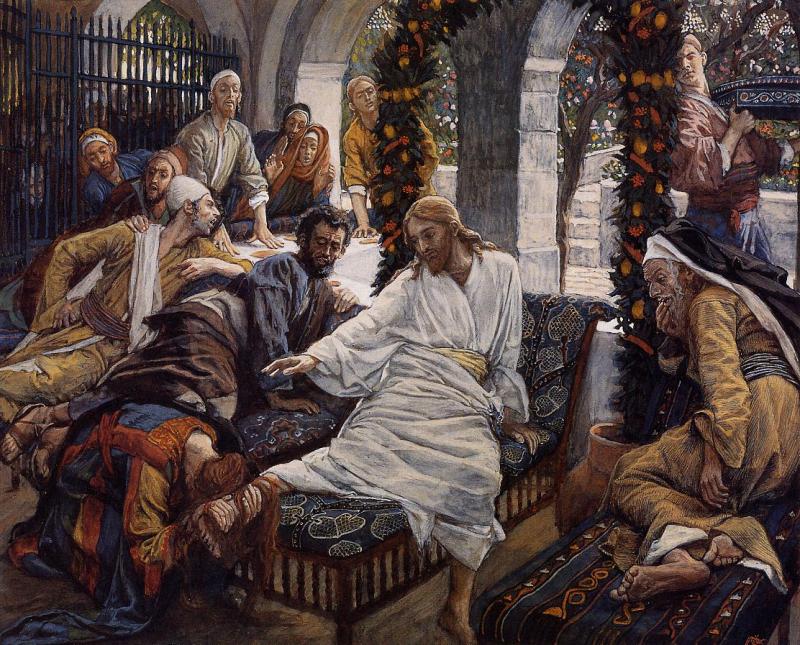
He said to Simon the Pharisee, “You gave me no kiss . . . ” (Lk 7.45). The Lord of Love will miss your kiss if you don’t draw near to Him . . .


 Witnesses to Hope