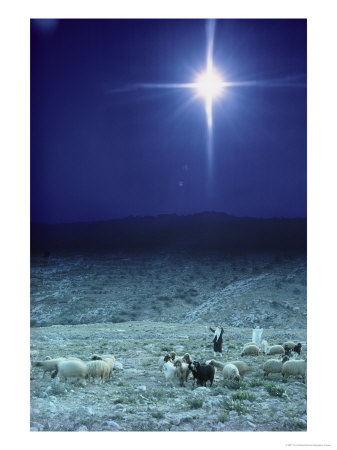
 “We are in the liturgical season of Advent, which prepares us for Christmas. As we all know, the word ‘Advent’ means ‘coming’, ‘presence’, and originally meant specifically the arrival of the king or emperor to a particular province. For us Christians it means a wonderful and overwhelming reality: God himself has crossed his Heavens and stooped down to man; he has forged an alliance with him entering into the history of a people; He is the king who descended into this poor province that is Earth, and has made a gift to us of his visitation by taking on our flesh, becoming man like us. Advent invites us to follow the path of this presence and reminds us again and again that God has not withdrawn from the world, he is not absent, he has not abandoned us to ourselves, but comes to us in different ways, which we need to learn to discern. And we, too, with our faith, our hope and our charity, are called every day to see and bear witness to this presence, in a world often superficial and distracted, to make shine in our lives the light that illuminated the cave of Bethlehem.” (Pope Benedict XVI, 12/12/12)
Christ comes
A Sunday-poem from Sr. Genevieve Glen, OSB:
Christ comes, the promised peace of God,
His hands with healing filled,
In him is brokenness made whole
And love from hate distilled.
And when he comes, for whom we long,
Then will all rage be stilled.
Christ comes, the promised hand of God,
To cast the veil aside
That shrouds the world in bitter grief,
Where none from death can hide.
And when he comes, for whom we long,
Then will all tears be dried.
Christ comes, the promise kept by God,
The faithful One, and true.
In him is ev’ry hope confirmed
And ev’ry fear subdued.
And when he comes, for whom we long,
Then all will be made new.
Friday: from the archives
An Advent homily by Fr. Pat McNulty from Madonna House:
Faith: A Subjunctive Mood
It was about 3 a.m. when I pulled my car into the checkpoint at Canadian Customs and Immigration. Though there were trucks in their own lane, mine was the only car around.
The middle-aged man in the booth requested my ID and then asked, “Where are you going?”
“To Madonna House, a Roman Catholic community in Combermere, Ontario.”
“What’s the purpose of your visit?”
“I’m a priest and I’m going there for a retreat.”
“Odd day-um qui lay-tiff-i-cot,” he said.
“I beg your pardon.”
“Ad deum qui laetificat…”
“Oh, ahhhh… Juventutem meum,” I answered.
The man smiled, gave me back my ID and said, “Better brush up on your Latin, Father. Welcome to Canada. Have a nice day.”
That was, of course, a long time ago, back when every Catholic boy who had ever served at Mass knew that Latin phrase. Those were the first words out of his mouth after Mass began at the foot of the altar.
You can read the rest here.
Taking time to pause
I know I just shared a post from Ann Voskamp, but I can’t pass this one up either: What Your Christmas Needs because I know that it’s what you all need to read right now: the importance of pauses. Make sure and look at the first video she shares: The Christmas Scale. It makes the point so powerfully. May you find the grace to pause . . . .
True obedience
The meditation for today from the Magnificat Advent Companion:
 How appropriate that commemoration of the events that lead to the image of Our Lady of Guadalupe begin immediately after the feast of the Immaculate Conception. For Mary, preserved from original sin, knows that the deepest and truest need of our heart is to be loved by God and to experience the unique preference he has for each of us. True obedience flows from our rejoicing over this preference. The serpent lied to Adam and Eve and made them think that the greatest human need is to be as powerful as God. We have sustained this wound, which makes us mistakenly think that to achieve and to impress is more satisfying than simply to be loved, when the merest reflection shows the opposite to be true. We see the interplay between Mary’s sinless clarity and the wound of original sin in her dialogue with Juan Diego, when he complains that he is not accomplished enough to be an emissary to the bishop. Mary reminds him that he is chosen, he has been preferred, and this is all that is necessary; in fact, this is everything. Let us pray to our Lady for our conversion, that our experience may teach us that it is not relying on accomplishments, but rather rejoicing in his love that makes our lives bear the fruit of his presence. (Fr. Richard Veras, emphasis added)
How the shepherds waited
A few years ago, Pope Benedict XVI related the tradition of setting up the crib immediately after the feast of the Immaculate Conception, “as if to relive with Mary those days full of trepidation that preceded the birth of Jesus.” We decided to do that this year–to set up our crib in our chapel, but with only the animals and the shepherds. Now every time we pray I find my eyes drawn to that scene, and it is proving to be a source of very fruitful meditation. Those shepherds are clueless about the coming birth of the King of Kings. They are just faithfully doing their job, watching the sheep. Isn’t that how it is for us? We are clueless about so much of the spiritual life, of the wonders that God has planned for us. The best thing we can do in preparation is to simply do God’s will for us today, to watch our sheep, so to speak. And He will indeed come to us! In our fields. As we do His will wherever He has us. Do not give up hope. He has His eye upon you.
Christmas Cleaning
Just in case you missed this one by Ann Voskamp: The Best Way to do Christmas Cleaning As usual, full of beauty and hope.

Advent Sunday
A Sunday-poem by Christina Rossetti:
Advent Sunday

Parable of the Wise and Foolish Virgins (detail)
Behold, the Bridegroom cometh: go ye out
With lighted lamps and garlands round about
To meet Him in a rapture with a shout.
It may be at the midnight, black as pitch,
Earth shall cast up her poor, cast up her rich.
It may be at the crowing of the cock
Earth shall upheave her depth, uproot her rock.
For, lo, the Bridegroom fetcheth home the Bride:
His Hands are Hands she knows, she knows His Side.
Like pure Rebekah at the appointed place,
Veiled, she unveils her face to meet His Face.
Like great Queen Esther in her triumphing,
She triumphs in the Presence of her King.
His Eyes are as a Dove’s, and she’s Dove-eyed;
He knows His lovely mirror, sister, Bride.
He speaks with Dove-voice of exceeding love,
And she with love-voice of an answering Dove.
Behold, the Bridegroom cometh: go we out
With lamps ablaze and garlands round about
To meet Him in a rapture with a shout.
December Eighth
December Eighth

Beloved, Mother of us all,
To-day we remember
That, of all earth’s millions,
You, Mary, in the womb,
Were shining, whole,
And Godward-turned.
You only, O Morning Star,
Lighted the clouds of sin and waiting.
You only, Immaculate Ark,
Glided above the depths of the primal curse;
For you were to bear safely over those waters
Emmanuel, your little Son, from whose baby hand
Streams the rainbow up which we climb to God.
You only, little white moon, are the crystal
Reflection of our Sun.
But for your whiteness, O Gate of Heaven,
We had never entered, nor seen our God.
But for your loveliness, O Mystic Rose,
We had never breathed the Rose of Sharon.
White Tower of David, Ivory Tower,
Princess whose beauty lured Love’s kiss when life began,
Mother, who died a thousand deaths for us,
We thank Him for you.
To-day, when He smiles to see His image in you, clear,
Remember us.
~Sr. St. Francis S.S.J.
Friday: from the archives

Take a moment–perhaps with a cup of tea and a lit candle–to sit quietly and read this editorial from this month’s Magnificat by Fr. Peter John Cameron. If you don’t have time at the moment, print it out or bookmark it to read at a time when you have the space and quiet to read it slowly. Don’t scan this quickly; it deserves the right pace to speak to your soul. And may it speak deeply to your soul . . .
The Catechism of the Catholic Church teaches that Jesus knew and loved us each and all during his life, and gave himself up for each one of us (see 478). Which means that from the moment Christ is conceived in the womb of the Blessed Virgin Mary, Jesus is loving us and giving himself to us personally. He is calling to our hearts, wooing us with all his…
View original post 727 more words
 Witnesses to Hope