He will never fail you but will help you in all your troubles, and you will find him everywhere. (St. Teresa of Jesus)
“At times it seems I am getting worse”
The beginning of the second chapter of Fr. Tadeusz Dajczer’s book, Amazing Nearness:
I get so disheartened. I am frequently in touch with the Lord, yet I am always falling away from Him. I am always falling in the same old way. At times it seems I am getting worse. Furthermore, it is He who is inviting me to follow and unite with Him. I am not starting it. He is. He is the way; He is lighting the way. He is the grace that leads me on. I know so little about this because He doesn’t want me to know His mysterious operations within me.
I ask how I can avoid getting so disheartened. Yet it is success that should really surprise me. I have to remember that the Lord only enters my heart through the failures that cause my spiritual emptiness. That is where faith comes in. He wants me to be inundated with problems so He can stay with me. Then I will want Him more and more.
I need to be patient with myself. He doesn’t get disheartened with me, so why should I get so upset? He loves me just as I am.
Fr. Dajczer, of course, is not condoning complacency here. We need to, of course, be quick to repent and try to change. But he recognizes that even as we try so hard, there are many times when we still fall. These are the times he is speaking about:
It is often hard for me to be forbearing [with myself], as I want everything immediately so that I am better than others. Yet God is not in a hurry. I am the hasty one with an interior hubbub. This impedes my spiritual progress. My impatience may look like zeal or even righteous indignation. I forget that this can be self-love or greed.
The answer, as always, is full surrender to Him, to His time and His plan. To be patient with ourselves and with Him. ” He wants me to be inundated with problems so He can stay with me. Then I will want Him more and more.”
A very kind Father
Friday: from the archives
The Pharisee becomes the publican
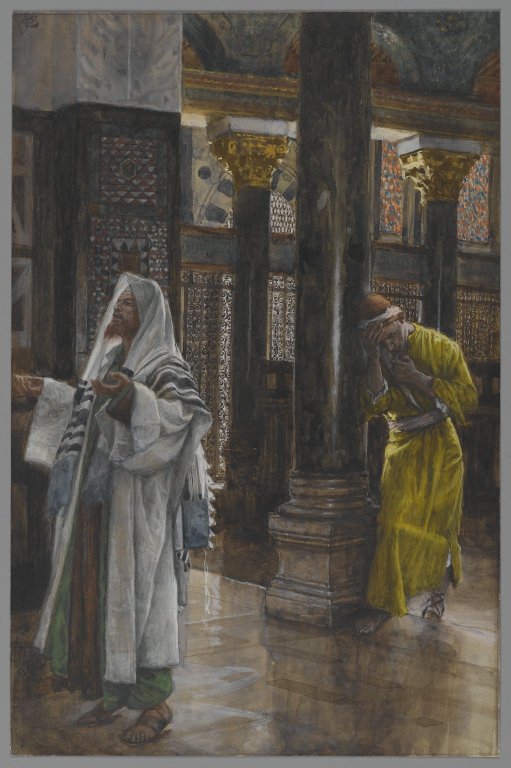 One thing that can cause me discouragement is dealing with besetting sin–you know that thing you keep taking back to confession over and over. One of mine is critical thinking. A few years ago I read Sr. Ruth Burrow’s autobiography, and in it she spoke about this being one of her ongoing faults as well. However, she found what I think is a very clever way to deal with it:
Perceptive, quick to see the flaws in another, I was prone to criticism, finding a certain satisfaction in seeing another at fault as though this, in some way, raised me up. I knew that no fault would so displease our Lord or stop his grace as this harsh judgment on his children. I realized I had the mentality of a pharisee but, I thought to myself, if a pharisee had turned to our Lord and admitted his hardness of heart, his crabbed, mean spirit and asked for help, our Lord would have helped him. So I did the same. The pharisee became the publican. I came to realize that temptations to pride, the sin of the pharisee, could make one a publican. The stone which the builders rejected could become head of the corner. I tried to use these bad tendencies to grow in humility.
And the Angels danced, don’t you think?
He seeks until He is weary
From the beginning of a newly published book, Amazing Nearness, by the author of The Gift of Faith, Fr. Tadeusz Dajczer:
In my daily life, I am constantly getting lost. Yet that means He can constantly find me. The more I need Him, the closer He is. I can ceaselessly discover that in weariness He sought me. This means loving until weary. Because of Original Sin He constantly searches for us to the point of weariness and exhaustion, humanly speaking.
In the Eucharistic encounter, Jesus regularly finds me quite lost. Yet, I am normally lost, needing to be found. So no need for regrets. If I am lost I can only be found in Eucharistic love. He can only find me when I am lost and beginning to search for Him. Love needs two. It is a grace always given to me to seek Him through faith, hope, and love.
Fr. Dajczer is here making a reference to the story of Jesus and the Samaritan woman in John 4. “Jesus, wearied as he was with his journey, sat down beside the well.” Augustine points out that Jesus is weary because He is on a journey to seek us each out. He is thirsty for our faith. He knows that we are lost and constantly sets out to find us. If you feel lost today, take heart that He is seeking you and looking for you. Let yourself be found by Him.
To pray with words, sighs, and desires
from “Contemplative in the Mud”:
You must not tremble
From a letter by Father John, a Russian monk, written to a lay person (1947):
I received your cordial note. I was happy with your last words: ‘I am not troubled at all, but peaceful’. According to the Holy Fathers, that is how it should be: if you falter in some virtue, you must not tremble; if you fall–get up; if you fall again, get up again; and so on till the final hour of death. O Lord, glory to thy mercy. Great is thy goodness, that Thou has given repentance to us sinners, for Thou didst come to earth not for the righteous, but for us sinner.
You did draw up pure water, but a toad had unexpectedly got into the well. Throw it away and the life-giving water will still be pure.
Mary words
“Oh, how easy is it for those who love Mary to find her, and to find her full of compassion and love.”
~St. Albert the Great
Mary words
“The love that this good mother bears us is so great that as soon as she perceives our wants, she comes to our assistance. She comes before she is called.”
~Richard of St. Lawrence

