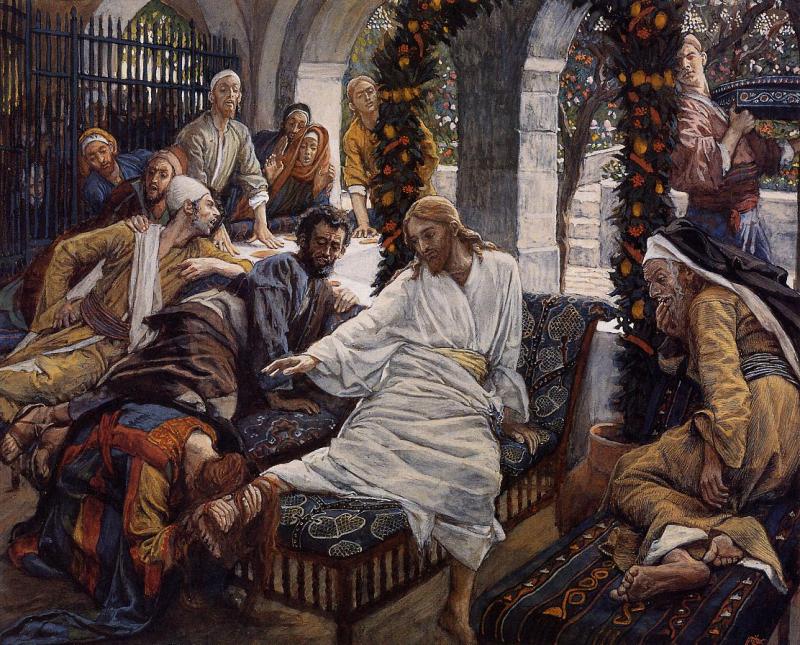
“There is nothing brighter than the eyes of God”

Romano Guardini wrote this beautiful meditation on what it means that God sees us.  I think you’ll find it very hope-filled.

“There is nothing brighter than the eyes of God, nor is there anything more comforting.  They are unyielding, but they are the source of hope.

“To be seen by him does not mean to be exposed to a merciless gaze, but to be enfolded in the deepest care.  Human seeing often destroys the mystery of the other.  God’s seeing creates it.

“We can do nothing better than to press on into the sight of God.  The more deeply we understand what God is, the more fervently we shall want to be seen by him.  We are seen by him whether we want to be or not.  The difference is whether we try to elude his sight, or strive to enter it, understanding the meaning of his gaze, coming to terms  with it, and desiring that his will be done.

“We can do nothing better than place ourselves and all that we have in God’s sight: ‘Behold me!’  Let us put away the fear that prevents us.  Let us abandon the sloth, the pretense of independence, and the pride.  ‘Look at the good!  Look at the shortcomings!  The ugly, the unjust, the evil, the wicked, everything—look at it, O God!’

“Sometimes it is impossible to alter something or another.  But let him see it at any rate.  Sometimes one cannot honestly repent.  But let him see that we cannot yet repent.  None of the shortcomings and evil in our lives are fatal as long as they confront his gaze.  The very act of placing ourselves in his sight is the beginning of renewal.  Everything is possible so long as we begin with God.  But everything is in danger once we refuse to place ourselves and our lives in his sight.”  (Romano Guardini, The Living God, Sophia Institute Press, 1997)

“How are you doing?”

Yesterday was the sixth anniversary of my brother Tim’s death.  He would have been 60 this year.  As many of you know, he took his own life and the impact on all of us who loved him was devastating.  What I want to share here is a set of e-mails between me and my spiritual director from three years ago at this time of year.  Fr. Dan, remembering that Tim’s anniversary was coming up, had sent me a short e-mail, simply asking “How are you doing?”  My response is very frank.  I share this with you for a few reasons.

One: it means so much for people to remember, to remember anniversaries.  Every year since she found out, a friend always shows up on my brother’s anniversary with a plant.  I, of course, do not expect her to do that every year for the rest of my life, but she obviously knows enough about the pain of a suicide to know how much this touches me.  Just saying those four words: “How are you doing?” can make a world of differences.  Even if my answer is “I’m really doing fine,”  I am still so touched that you have remembered.

Two: Losing someone to suicide is a grief that never goes away and is very paimnful for years.  It is unlike any other grief.

Three: I hope that both my frankness and my sharing of how God meets me in my pain and Fr. Dan’s response to me may bring hope to someone out there who may be struggling in a similar way. . .

(I am editing some of this.)

Dear Fr. Dan,

How am I doing?  It really depends these days on when you ask.  But, if you have the time, I am going to try to verbalize a few things.  I am suffering.  I am suffering most acutely from Tim’s death, but also the many other losses in my life: at the end of my first of college: the tragic death in a car crash of a very close friend; my parent’s divorce and subsequent disintegration of my family; my brother Paul’s death in a car accident at the age of 24; my mother’s death; Tim’s violent death.  They all kind of rush in upon me sometimes. . . . Some days I want to run away.  Some days I just want to shout out: “My brother put a gun in his mouth and killed himself!” Most days I don’t even know how to pray.  I get irritated by stupid questions people ask me about things.  And I have to keep leading us [as Superior of our order] and making decisions and answering stupid questions with love and kindness.  I feel alone and afraid a lot.  Friends I have depended on are not there as they were.  I could cry at the slightest kindness shown me.

And yet in the midst of the suffering, there’s a desire to offer it up, to kiss this Hand from whom it all comes. . . . There’s also a slight hope that I will come to know Christ and His love through it in a way that I would never know otherwise.  There are pinpoints of light.  Last night as I was going to sleep and dealing with fear and pain, I starting thinking, I’m walking through the valley of the shadow of death, the valley of deep darkness.  And the words from Psalm 23 hit me: “I will fear no evil”–and I knew that Satan couldn’t touch me there.  And then this morning when I woke early and was encountering the same things, the rest of that verse came to me: “because You are with me.”  And that brought back to mind Dr. Regis Martin’s article on Christ’s descent into hell which, as you know, has spoken eloquently to my soul.  Paul of the Cross (among others) counsels us to join our sufferings to the different mysteries in Christ’ life: “I will try with all my strength to follow the footsteps of Jesus.  If I am afflicted, abandoned, desolate, I will keep him company in the Garden.  If I am despised and injured, I will keep him company in the Praetorium.  etc.” Perhaps Christ is inviting me to “live” in the mystery of His descent into Hell, to walk with Him through the valley of the shadow of death. I am once again re-reading Dr. Martin’s article, and once again it clarifies and strengthens me.  There’s some experience this morning of His having entered through the ‘barred doors” of my heart, my own little “hell.”  The pain is still there, but there”s also a knowledge that He’s there and I’m not alone.

I must thank you for your kindness in asking me how I’m doing.  Four small words, but when sincerely said can make such a difference for people. And I don’t mean to complain by anything I’ve said here.  Many people have been very kind to me these days, but the suffering continues.

It’s funny, isn’t it–when you’re in the middle of suffering and pain, it just seems like there’s no end, that it just has and always will be this way, and then a few little words: “You are with me” can open up a whole spiritual perspective that makes all the difference.  The wounds are still there, but there’s a little balm.  The mental torment can continue, but I don’t fear that I’m going crazy.  Hell becomes the place where Christ descends and meets me in the scariest places in my life, where one one else can really go but Him.

Fr. Dan’s reply:

Peace be with you.

As you tell of your experience in these days, Paul’s words in Rom 8:38-39 seem so apposite: “For I am sure that neither death, nor life, nor angels, nor principalities, nor things present, nor things to come, nor powers, nor height, nor depth, nor anything else in all creation, will be able to separate us from the love of God in Christ Jesus our Lord.”  Christ grasps you firmly.  He is walking with you, unobserved by your, through the valley of the shadow of death, and sustaining you by the banquet He has prepared for you.  The reality of the fear and terror of events you describe, which leave a remnant of their foul odor in your memory even long after the events themselves have passed, only prove the more the reality of what you hope for.  That hope is your anchor in Christ, which allows him–like a great heavenly winch!–to draw you through (not around!) those very terrors into the Kingdom.  The psalm says that the banquet is set for you, but “in the presence of my enemies.”  The greatness of these enemies is infinitely surpassed by the greatness of His mercy, which is always for you.  Keep doing what you know to do: relying on yourself for nothing, and on Him, and His infinite mercy, for everything.

Christ walks with each of you through whatever valley you are in right now.
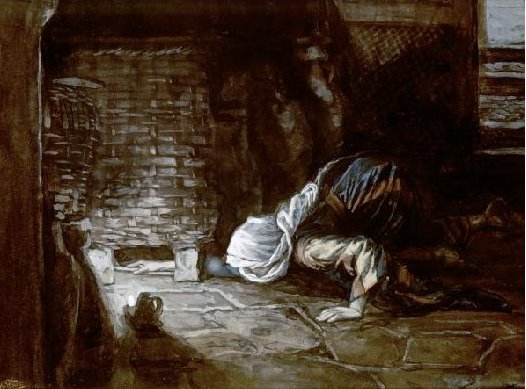
Put yourself in this woman’s place

Jesus does not want our sins, our weaknesses and faults, to keep us from coming to Him, to keep us from intimacy with Him.  I post again this painting by James Tissot.  Put yourself in this woman’s place, a great sinner.  Touch His feet, kiss His feet.  And see the Lord reaching out to you in His tender love.

He said to Simon the Pharisee, “You gave me no kiss . . . ” (Lk 7.45).  The Lord of Love will miss your kiss if you don’t draw near to Him . . .

At the top of the stairs

On those days when I think, “This is never going to change in me”, the Holy Spirit often reminds me of these words of St. Thérèse:

“At the top of the stairs He is looking at your lovingly.  Soon conquered by your vain efforts, He will come down Himself, and taking you in His arms, will carry you forever into His kingdom where you will not leave Him again.  But if you stop lifting your little foot, He will leave you on earth for a long time.”

Human doings

Something to think about:

“We are so used to being busy that we treat it as an essential characteristic of the good life.  Ask people how they are doing and they will often answer by telling you how busy they are.  It has become a mark of success–as if someone who is not busy must certainly be leading an unfulfilling and unsuccessful life.  If we are busy, we feel that life is meaningful.

“Human beings have become human doings.  Simply being feels like not enough–perhaps even personal failure. . . . But our problem is deeper than busyness.  Tragically, we live much of our lives on automatic pilot.  we go through our days as sleep walkers–unaware of God’s presence, inattentive to God’s gifts and invitations, and failing to be present to either ourselves or God. We fail to notice God in the ordinary events of our ordinary days.  God is present–in the world around us, in the people whom we encounter and in our work.  Sadly, it we who are absent.”  (Juliet Benner, Contemplative Vision)

“God desired a harlot . . .”

As some of you know, I have a little book of art pictures and quotes that I periodically use for meditation.  I have been pondering the picture below of the sinful woman anointing Jesus’ feet (James Tissot).  And below it is a beautiful quote from John Chrysostom describing the love of God for us, each of whom is indeed the sinful woman.

“God desired a harlot, and how does He act?  He does not send to her any of His servants.  He does not send any angels or archangels, cherubim or seraphim.  No, He Himself draws near to the one He loves, and He does not take her to Heaven, for He could not bring a harlot to Heaven, and therefore He Himself comes down to earth, to the harlot, and is not ashamed.  He comes to her secret dwelling place and beholds her in her drunkenness.  And how does He come?  Not in the bare essence of His original nature, but in the guise of one whom the harlot is seeking, in order that she might not be afraid when she sees Him, and will not run away, and escape Him. He comes to the harlot as a man.  And how does He become this?  He is conceived in the womb, He grows little by little, as we do, and has intercourse with human nature.  And He finds this harlot thick with sores and oppressed by devils.  How does He act?  He draws nigh to her.  She sees Him and flees away.  He calls the wise man, saying, ‘Why are you afraid?  I am not a judge, but a physician.  I come not to judge the world, but to save the world.’  Straightway He calls the wise men, for are not the wise man the immediate first fruits of His coming?  They come and worship Him, and then the harlot herself comes and is transformed into a maiden.  The Canaanite woman comes and partakes of His love.  And how does He act?  He takes the sinner and espouses her to Himself, and gives her the signet ring of the Holy Spirit as a seal between them.” (John Chrysostom)

What wondrous love is this!

“It was because a man lay on the road . . .”

A painting or a song can be so powerful.  The picture below can be found on the cover of the first volume of Fire of Mercy by Erasmo Leiva-Merikakis, a Trappist monk.  I have been meditating on it this Lent.  I know I have posted about this picture before, but can’t help sharing it with you again.

Good Samaritan

This is how the back of the book describes this picture:

The book’s cover portrays Christ as the Good Samaritan in an illumination taken from the mid sixth-century Syrian Codex Rossanensis. The fire of God’s mercy, poured out without reserve by the Father into the Heart of his incarnate Word, impels the Son’s eager gaze earthwards.  Christ Jesus, Son of God and Son of Mary, the living ‘image of the invisible God’ in whom ‘the whole fullness of divinity dwells bodily’ (Colossians 1:15, 2:9), bends down his sun-like nimbus—the very splendor of his glory, inscribed with the cross of his suffering—in a full ninety-degree angle, to show the perfection of His descent among us.  The eternal Lord of the ages thus moves into position to nurse with divine tenderness the green body of decaying humanity, prostrate with festering wounds: ‘Through the tender mercy of our God, the Dawn from on high has visited us, to give knowledge of salvation to those who sit in darkness and the shadow of death’ (Luke 2:78f).  For his part, the dazzling angel has found a new mode of praise: to stand by his Master, marveling and ministering as he holds the gold bowl of grace and compassion, awestruck at the depth of the Word’s condescension.  What even angelic hands cannot touch unveiled, that Christ lavishes with open gesture upon the flesh and soul of his beloved brother, sin-wounded man.

Sometimes I just sit and meditate on how I am that green man lying in the road and try to imagine Christ standing over me pouring out His mercy–that even the angels cannot touch–upon me.  Peguy says: “It was because a man lay on the road that a Samaritan picked him up.”  It is because we lay on the road that Christ picks us up . . .

1000 years is as one day

See this plant?  It was grown from seeds brought back to life.  No big deal, you might think.  Well, the seeds were 32,000 years old!  They “had been entirely encased in ice, were unearthed from 124 feet (38 meters) below the permafrost, surrounded by layers that included mammoth, bison, and woolly rhinoceros bones.”   According to National Geographic: “A Russian team discovered a seed cache of Silene stenophylla, a flowering plant native to Siberia, that had been buried by an Ice Age squirrel near the banks of the Kolyma River. Radiocarbon dating confirmed that the seeds were 32,000 years old.”

Sooooooooo, if you are tempted to hopelessness about areas in your life that seem to be taking forever to change . . . or about people that you know whose lives seem irreparable, have hope!  To the Lord, a thousand years is as one day, and as we well know, He can bring the dead to life.  All in His own time . . .