What I’m reading

I haven’t updated “What I’m reading” in way too long, but I’m now reading two books which I’d like to pass along.

The first is A Grace Disguised, how the soul grows through loss, by Jerry Sittser.  As many of you know, I have gone through a lot of loss in my own life.  Consequently I am cautious about recommending books about loss.  I am only half way through Jerry’s book, but I can highly recommend what I’ve read so far.  He lost his wife, his mother, and his four-year-old daughter within minutes of a head on car crash caused by a drunk driver.  Some excerpts:

“All people suffer loss.  Being alive means suffering loss.”

“I question whether experiences of severe loss can be quantified and compared.  Loss is loss, whatever the circumstances.  All losses are bad, only bad in different ways.  No two losses are ever the same.  Each loss stands on its own and inflicts a unique kind of pain.  What makes each loss so catastrophic is its devastating, cumulative, and irreversible nature.”

“Sudden and tragic loss leads to terrible darkness.  It is as inescapable as nightmares during a high fever.  The darkness comes, no matter how hard we try to hold it off.  However threatening, we must face it, and we must face it alone.
“Darkness descended on me shortly after the accident . . . .”

“Loss forces us to see the dominant role our environment plays in determining our happiness.  Loss strips us of the props we rely on for our well-being.  It knocks us off our feet and puts us on our backs.  In the experience of loss, we come to the end of ourselves.
“But coming to the end of ourselves, we can also come to the beginning of a vital relationship with God.  Our failures can lead us to grace and to a profound spiritual awakening.  This process occurs frequently with those who suffer loss. . . .”

I’ll talk about the second book tomorrow.

Our Lady = Laser Light

A Sunday poem about Our Lady:

Our Lady = Laser Light

Our Lady, Laser Beam, incredible creature held
in God’s omnipotent hand, for help of deviant, unwise man;
pure straight-line, steady, truth’s most leashed light,
love’s billions more than surface-sun concentrated fire,
sure, unwavering, non-fanning beam, heaven-homing radar-ray.

Coherent, clear, no unsimple spectrum spread,
but narrow one-wave-only burning arrow-jet
that in a single photon-packed burst of focused fire,
with a needle point annealing heals smallest rent in eyes;
light that lures dark-lurking cancers of the soul
to absorbent ruin, fuses lips of lesions and wide wounds
unites, not rough-stitching but with a mother’s gentle
hand and surgeon’s high finesse; and with no scarring pain
erases demon-traced tatoos that mar God – consecrate limbs.

Humble, immaculate beam borne by peasant Bernadettes;
yet fiery-potent force that light-explodes gloom-visaged
serpents of evil; slender, sensitive finger probing
for uncoined gold hid deep within us; mercifully wise
lens in whose clear scrutiny we see, multi-dimensional,
known and secret faces unparalleled path-finder ray
spearheading balanced tunnel through mountains of rock-doubt
and tightly-tangled fears, into the open valleys of whole air.

Final, lucent tool in God’s hand, cutting flawless-faceted
blue-brilliant Christ-diamonds, light sculptured souls of men,
Our Lady, Laser Light, inerrant, bright rod-road trajectory-less,
high-given guide-line, shortest-surest, pure light-fire path
flaming straight out, unfaltering, even to infinity …. to God.

Albert Joseph Hebert, S.M.
Mary, Our Blessed Lady
New York: Exposition Press, 1970.

“He lived in God’s favorite place.”

That title caught my eye as I was leafing through the November 2011 edition of Restoration (published by Madonna House).  The article is a homily given by one priest at Madonna House at the funeral of another priest.  He speaks of the deceased as often being in “the right place for the wrong reason.”  A soul so abandoned to God that he didn’t always realize how God was using him.  “That’s why he showed up in so many of our lives just when we needed him to be there. Whatever he was up to—whether it was fixing a door or a chair—it often turned out that the real reason he was there was that you were there, and you needed him.” You can read the homily here.

“Lord, show us the Father.”

You can almost hear the sound of exasperation in Jesus’ reply to Philip’s request: “Have I been with you so long, and yet you do not know me, Philip?  He who has seen me has seen the Father: how can you say, ‘Show us the Father’?” (Jn 14.9)  This week long I have been remembering and pondering a conversation I had with a good priest-friend of mine.  He made the insightful comment that he considered one of Christ’s greatest sufferings to be that so, so many did not grasp the most important part of His mission–and that was: to reveal the Father’s love to us.  How frustrating for Jesus to have so very few whose hearts and eyes were open to perceive this desire of His Heart and to satisfy it.  Imagine for yourself what it is like to try to communicate your own love and appreciation of someone dear to your heart.  You want everyone to know the goodness of this person you know.  One of my own favorite things is to introduce my friends to each other–so that these wonderful people that I know may get to know each other.  And here is Jesus who wishes to open the depths of our souls to the Father of all goodness. . . and we so often say with Philip, “Where is He? Show Him to us.”

Come, Holy Spirit, open our hearts wide to the full revelation of the Father through Jesus.  Help us to satisfy this never ending desire of His to “show us the Father.”

The voice of the Father

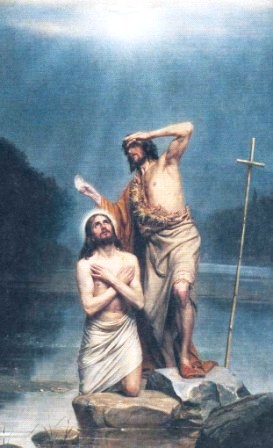
One of the wonders of the Lord’s Baptism, which we celebrate today, is that for the first time Christ heard His Father’s voice as a man.  This has incredible meaning for us, this unveiling of the heart of the Father for us:

“It is as man that he now hears his Father and sees the Spirit, and he rejoices that, because he now dwells humbly among the sons of men, the Father can no longer speak to him without his fellow-man feeling something of the vibration of that resounding Voice.  Christ brings man not so much a teaching as a dazzling proximity to the inner life of God.  And the very essence of the divine life, the very life-breath of the Son, is the good pleasure, the gracious favor and delight of the Father.” (Erasmo Leiva-Merikakis)

Through His baptism by John, Jesus shows us the way to attaining this inner life.  He humbly show us; He patterns for us what He has no need of.   As Leiva-Merikakis points out: “His present task is to show what human repentance in the presence of God is to be, and it surely comes to him as no surprise that the gift of the Spirit is the result of such repentance and turning to God.”  All God the Father asks of us is humility and repentance, something attainable by each of us.  We are not asked to accomplish great ascetic works or perform great deeds.  All that is needed is a humble and contrite heart . . . and then we each hear spoken to us personally: “Here is my beloved son/daughter, in whom I am well pleased.”

“Let us celebrate the festive day”

Awake, Mankind!  For your sake God has become man.  Awake, you who sleep, rise up from the dead, and Christ will enlighten you.  I tell you again, God became man.
You would have suffered eternal death, had he not been born in time.  Never would you have been freed from sinful flesh, had he not taken on himself the likeness of sinful flesh.  You would have suffered everlasting unhappiness, had it not been for this mercy.  You would never have returned to life, had he not shared your death.  You would have been lost if he had not hastened to your aid.  You would have perished, had he not come.
Let us then joyfully celebrate the coming of our salvation and redemption.  Let us celebrate the festive day on which he who is the great and eternal day came from the great and endless day of eternity into our own short day of time.

~St. Augustine, Sermon 185

Empty enough

If you are feeling empty today, then you are ready for the Christ Child to enter in:

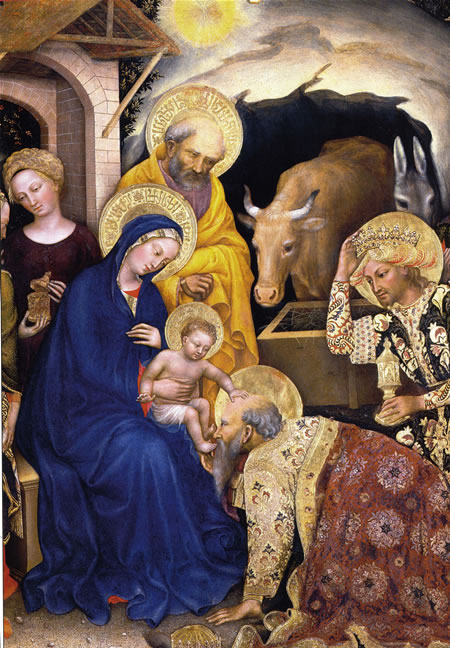
“And yet a paradox is involved here: this greatness and depth of God can be perceived only by babes, the nêpioi or ‘infants’–those who have no words of their own–and not by those who are wise and possess understanding according to the logic of the world.  Not in vain does Saint Bernard say, Non consolatur Christi infantia garrulosChrist’s infancy does not console the garrulous.’  To these–mere babes, to those of innocent heart–God reveals his inmost secrets as to his intimate friends and dear children.  There is a clear affinity between God and children.  This truth is at the center of the mystery of Christmas, when God is revealed in the form of a baby.  More than mere ‘affinity,’ this is actual identification: The eternal God becomes what he most loves on earth–a child.  But this is no mere sweet sentimentality on God’s part: If he loves the childlike, it is because they are empty enough to receive what he wants to give, a mystery Guerric of Igny expounds:
‘If in the depths of your soul you were to keep a quiet silence, the all-powerful Word would flow from the Father’s throne secretly into you.  Happy then is the person who has so fled the world’s tumult, who has so withdrawn into the solitude and secrecy of interior peace, that he can hear not only the Voice of the Word, but the Word himself: not John but Jesus.'”  (Erasmo Leiva-Merikakis)

Bleak winters.

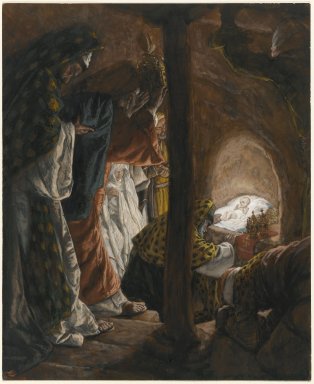
“In the lives of those who believe and pray, there are bleak winters of the spirit.  We seem to go along well for a while in prayer and relationships and life generally, but from time to time we disintegrate.  It is very painful.  You may suspect that this will prove to be a creative disintegration, that God is re-creating you, putting you together in the likeness of his Son at a new and deeper level.  Certainly this does happen: growth is not easy; there is a probably distressing period for the caterpillar on the way to butterflyhood.  We are all participants in this experience from time to time, and a chrysalis needs sympathetic understanding, so we should be gentle and patient with ourselves, as with others.  Nevertheless, they are hard to live through, these winters of the spirit.  When you know yourself to be sterile, helpless, unable to deal creatively with your situation or change your own heart, you know your need for a Savior, and you know what Advent is.  God brings us to these winters, these dreary times of deadness and emptiness of spirit, as truly as he brings winter after autumn, as a necessary step towards next spring.  But while we are in them they feel like a real absence of God, or our absence from him. . . . .In the winters of your prayer, when there seems to be nothing but darkness and a situation of frozenness, hold on, wait for God.  He will come.”  (Maria Boulding)

I hope this provides encouragement for you.  Know that I’m praying for you . . . all of you who “know what Advent is.”