He comes without waiting for us to ask him

Mary arose and went to Elizabeth without Elizabeth having asked her.  This is the way Christ is always with us.  He comes to us without waiting for us to ask Him. May this Feast remind us of that:

The visit that so honored and overwhelmed Elizabeth had not been sought by her: part of the very honor consisted int he fact that Mary had paid it of her own accord. . . . Our God treats us His poor creatures, in the same way. Whether the sinner who needs converting, or the just who is called to a higher life and the way of perfection, be concerned, He alike comes without waiting for us to ask Him.  We are often not thinking of Him specifically at all–we may have forgotten Him; but He seeks us out–goes before us–or as sacred language has it, “prevents” us: we feel and know His grace, suddenly present with us, as the Baptist knew it in his mother’s womb, when we have done absolutely nothing to call it down.  (Jacques Benigne Bossuet)

“. . . when we have done absolutely nothing to call it down.”  What hope-filled words.  A blessed Feast!

Be still and see that I am God

A Sunday-poem from Mother Mary Francis:

"Be Still, and See That I Am God"
            (Psalm 46:10)

Grief went to serve sub-poena upon God:
Come to the witness stand.  Defend Yourself
From accusation that You've sudden grown
Inadequate to parenting Your world
Or me or all whomevers.
                         Where went Abba?

Has no one seen Him?  Shrill cacophony
Demands Him.  But He's nowhere to be seen.

Down cosmic boulevards loud seekers sought Him,
At impotent Omnipotence raised cries.
How lapsed skills managerial?  Why is
Desk of Divinity left unpresided

While worlds and hearts keep shouting:
                         Where went Abba?

With hounds of noise they hunt Him, turn their beams
To show Him. But He's nowhere to be seen. 

Out of loud forum blast the cries for Him
To show His face, exhibit as of old
Ability to order hearts and planets.
That chorus drafts my membership, save I
Venture such cavern as admits no sound,
Enter alone the cave where breathes my being
Contingent wholly on His own and risk
Faith's total silence.
                      But then, You had foretold it!
In stillness I have seen that You are God.

“Behold, God’s love for you!”

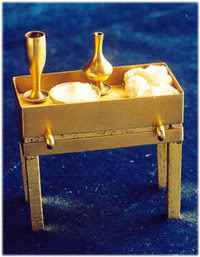
I am reading a fascinating book on the Eucharist by Dr. Brant Pitre, Jesus and the Jewish Roots of the Eucharist.  In one section of the book, Dr. Pitre illustrates the connection between the Eucharist and the Bread of the Presence  from the Temple.  God had commanded the Israelites to keep twelve loaves of bread on a golden table in the Holy Place. “And you shall make a table of acacia wood . . . You shall overlay it with pure gold, and make a molding of gold around it.  And you shall make its plates and dishes for incense, and its flagons and bowls with which to pour libations; of pure gold you shall make them.  And you shall set the Bread of the Presence on the table before me always.” (Ex 25:23-24)

Later in the chapter, Dr. Pitre explains the custom of the priests bringing this table out from the Holy Place three times a year (the feasts of Passover, Pentecost, and Tabernacles) so that the pilgrims might see it:  “They [the priests] used to lift it [the Golden Table] up and exhibit the Bread of the Presence on it to those who came up for the festivals, saying to them, “Behold, God’s Love for you!”

What an amazing foreshadowing of God’s love made manifest in the Eucharist. . . .

The artist’s task

Life can throw us many curve balls, as they say.  Some are big and some are small, but all are important in the formation of how we handle life.  Sydney Eddison recounts (in Gardening for a Lifetime) a story “of the violinist Itzhak Perlman, who as a boy was struck with polio and who as a man must walk with the aid of leg braces and crutches.

At a concert on the night of November 18, 1995, at Avery Fisher Hall in New York City, one of the strings of his violin suddenly snapped during the performance.  Stunned, the audience held their collective breath, expecting Perlman to stop and leave the stage.  Instead, he paused, then continued playing–adjusting, creating, compensating as he went along, and when he put down his bow at the end of the concert, a mighty roar of applause filled the hall.  When it had died down, he spoke to the audience: “You know, sometimes it is the artist’s task to find out how much music you can still make with what you have left.”

Listen to him playing the theme from Schindler’s List.  Our lives can also sound as beautiful if we continue to respond as best we can in God’s grace to all that life brings us.

“This is eternal life . . .”

What do you think when you hear the words: “eternal life”?  Life after death, I presume.  That’s what I thought until I read this thought-provoking piece by Pope Benedict (from his new book, Jesus of Nazareth, Holy Week).  I have to say I kept thinking of Bl. John Paul as I read it . . .

“Eternal life” is not–as the modern reader might immediately assume–life after death, in contrast to this present life, which is transient and not eternal.  “Eternal life” is life itself, real life, which can also be lived in the present age and is no longer challenged by physical death.  This is the point: to seize “life” here and now, real life that can no longer be destroyed by anything or anyone.

This meaning of “eternal life” appears very clearly in the account of the raising of Lazarus: “He who believes in me, though he die, yet shall he live, and whoever lives and believes in me shall never die” (Jn 11:25-26).  “because I live, you will live also”, says Jesus to his disciples at the Last Supper (Jn 14.19), and he thereby reveals once again that a distinguishing feature of the disciple of Jesus is that he “lives”: beyond the mere fact of existing, he has found and embraced the real life that everyone is seeking.  On the basis of such texts, the early Christians called themselves simply “the living” (hoi zōntes).  They had found what all are seeking–life itself, full and, hence, indestructible life.

Pope Benedict then goes on to describe how, in fact, we obtain this life:

The high-priestly prayer gives an answer that may surprise us, even though in the context of biblical thought it was already present.  “eternal life” is gained through “recognition”, presupposing here the Old Testament concept of recognition: recognizing creates communion; it is union of being with the one recognized.  But of course the key to life is not any kind of recognition, but to “know you the only true God, and Jesus Christ whom you have sent” (17.3). . . .

“Eternal life” is thus a relational event. . . .

Man has found life because he adheres to him who is himself Life.  Then much that pertains to him can be destroyed.  Death may remove him from the biosphere, but the life that reaches beyond it–real life–remains.  This life, which John calls zōē as opposed to bios, is man’s goal.  The relationship to God in Jesus Christ is the source of a life that no death can take away.

Isn’t this what we witnessed in Bl. John Paul in his latter days, this zōē that so clearly sprang from his relationship with the living Christ?

Another footnote

[Note: the first time I tried to post this this morning, it crashed.  I’ve never had that happen with Word Press.  Makes me wonder how important this post may be for one of you . . .]

I recently posted about a footnote that had grabbed me.  The other night–the eve of Divine Mercy Sunday–some of us were talking about another footnote–no. 52 to be exact, in Blessed (!) John Paul II’s encyclical, Rich in Mercy–and its impact on each of us.  I remember exactly where I was when I first read it and how profound I found it.  May his insights into the Old Testament use of the words for mercy shape your minds and hearts:

“In describing mercy, the books of the Old Testament use two expressions in particular, each having a different semantic nuance. First there is the term hesed, which indicates a profound attitude of “goodness.” When this is established between two individuals, they do not just wish each other well; they are also faithful to each other by virtue of an interior commitment, and therefore also by virtue of a faithfulness to themselves. Since hesed also means “grace” or “love,” this occurs precisely on the basis of this fidelity. The fact that the commitment in question has not only a moral character but almost a juridical one makes no difference. When in the Old Testament the word hesed is used of the Lord, this always occurs in connection with the covenant that God established with Israel. This covenant was, on God’s part, a gift and a grace for Israel. Nevertheless, since, in harmony with the covenant entered into, God had made a commitment to respect it, hesed also acquired in a certain sense a legal content. The juridical commitment on God’s part ceased to oblige whenever Israel broke the covenant and did not respect its conditions. But precisely at this point, hesed, in ceasing to be a juridical obligation, revealed its deeper aspect: it showed itself as what it was at the beginning, that is, as love that gives, love more powerful than betrayal, grace stronger than sin.

This fidelity vis-a-vis the unfaithful “daughter of my people”(cf. Lam. 4:3, 6) is, in brief, on God’s part, fidelity to Himself. This becomes obvious in the frequent recurrence together of the two terms hesed we’e met (= grace and fidelity), which could be considered a case of hendiadys (cf. e.g. Ex. 34:6; 2 Sm. 2:6; 15:20; Ps. 25[24]:10; 40[39]:11-12; 85[84]:11; 138[137]:2; Mi. 7:20). “It is not for your sake, O house of Israel, that I am about to act, but for the sake of my holy name” (Ez. 36:22). Therefore Israel, although burdened with guilt for having broken the covenant, cannot lay claim to God’s hesed on the basis of (legal) justice; yet it can and must go on hoping and trusting to obtain it, since the God of the covenant is really “responsible for his love.” The fruits of this love are forgiveness and restoration to grace, the reestablishment of the interior covenant.

“The second word which in the terminology of the Old Testament serves to define mercy is rahamim. This has a different nuance from that of hesed. While hesed highlights the marks of fidelity to self and of “responsibility for one’s own love” (which are in a certain sense masculine characteristics), rahamim, in its very root, denotes the love of a mother (rehem = mother’s womb). From the deep and original bond-indeed the unity-that links a mother to her child there springs a particular relationship to the child, a particular love. Of this love one can say that it is completely gratuitous, not merited, and that in this aspect it constitutes an interior necessity: an exigency of the heart. It is, as it were, a “feminine” variation of the masculine fidelity to self expressed by hesed. Against this psychological background, rahamim generates a whole range of feelings, including goodness and tenderness, patience and understanding, that is, readiness to forgive.

The Old Testament attributes to the Lord precisely these characteristics when it uses the term rahamim in speaking of Him. We read in Isaiah: “Can a woman forget her suckling child, that she should have no compassion on the son of her womb? Even these may forget, yet I will not forget you” (Is. 49:15). This love, faithful and invincible thanks to the mysterious power of motherhood, is expressed in the Old Testament texts in various ways: as salvation from dangers, especially from enemies; also as forgiveness of sins-of individuals and also of the whole of Israel; and finally in readiness to fulfill the (eschatological) promise and hope, in spite of human infidelity, as we read in Hosea: “I will heal their faithlessness, I will love them freely” (Hos. 14:5).

“In the terminology of the Old Testament we also find other expressions, referring in different ways to the same basic content. But the two terms mentioned above deserve special attention. They clearly show their original anthropomorphic aspect: in describing God’s mercy, the biblical authors use terms that correspond to the consciousness and experience of their contemporaries. The Greek terminology in the Septuagint translation does not show as great a wealth as the Hebrew: therefore it does not offer all the semantic nuances proper to the original text. At any rate, the New Testament builds upon the wealth and depth that already marked the Old.

In this way, we have inherited from the Old Testament-as it were in a special synthesis-not only the wealth of expressions used by those books in order to define God’s mercy, but also a specific and obviously anthropomorphic “psychology” of God: the image of His anxious love, which in contact with evil, and in particular with the sin of the individual and of the people, is manifested as mercy. This image is made up not only of the rather general content of the verb hanan but also of the content of hesed and rahamim. The term hanan expresses a wider concept: it means in fact the manifestation of grace, which involves, so to speak, a constant predisposition to be generous, benevolent and merciful.

“In addition to these basic semantic elements, the Old Testament concept of mercy is also made up of what is included in the verb hamal, which literally means “to spare” (a defeated enemy) but also “to show mercy and compassion,” and in consequence forgiveness and remission of guilt. There is also the term hus, which expresses pity and compassion, but especially in the affective sense. These terms appear more rarely in the biblical texts to denote mercy. In addition, one must note the word ‘emet already mentioned: it means primarily “solidity, security” (in the Greek of the Septuagint: “truth”) and then “fidelity,” land in this way it seems to link up with the semantic content proper to the term hesed.”

Even in our weeping

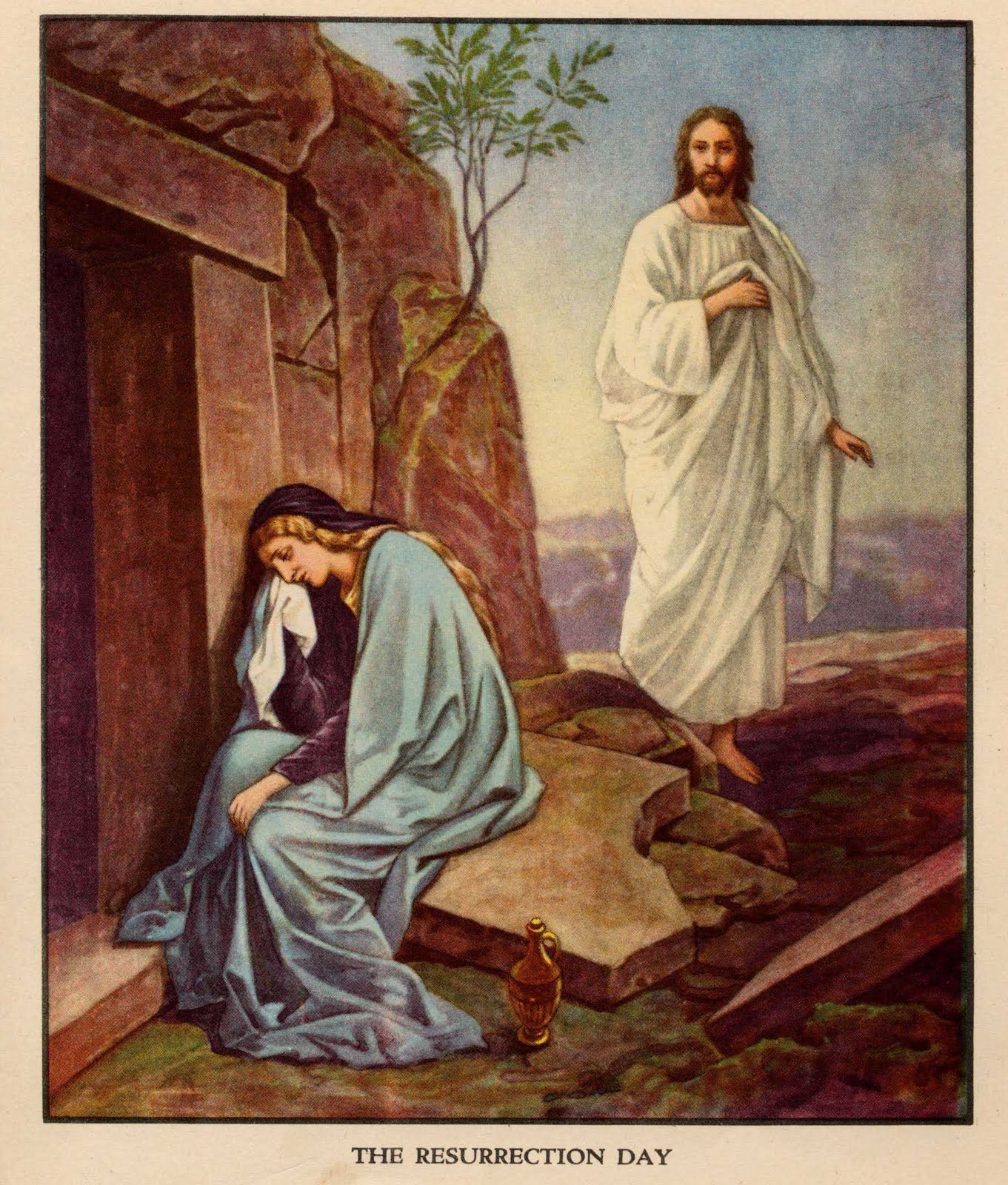
I have always been intrigued by the story of Mary Magdalene at the tomb.  Perhaps this is because I have spent too many hours of my life not recognizing the Lord even as He is standing there beside me.  I can get stuck in the mode of: “They have taken my Lord, and I don’t know where they laid him.”  I too easily focus on that, rather than on having faith that He will never, ever forsake me.  My prayer should instead be: “Lord, give me eyes to see.”

Needless to say, I was struck by this reflection in Magnificat on yesterday’s readings:

Despite the miraculous apparition of two angels sitting in the open tomb, “one at the head and one at the feet where the Body of Jesus had been,” Mary Magdalene remains unmoved, consumed only by her grief.  Two times heaven has to ask her (once via the angels, the second time by the risen Lord himself), “Woman, why are you weeping?” She has come to her own fatalistic conclusion about what happened to Christ–“They have taken my Lord, and I don’t know where they laid him”–and it is from this pessimism that she must be converted.  When the risen Jesus speaks her name–“Mary!”–the Magdalene, like the Jewish people on the day of Pentecost, was “cut to the heart.”  The risen Christ’s command to “stop holding on” pertains to our preconceptions and stubbornness as well.  Something Greater than our sorrow is now at work in the world.  It is the reason why, even in our weeping, we bend over and peer into the tomb, full of expectation.