Wrestling

This Sunday’s poem is one by Luci Shaw.  There is always risk in wrestling with God.

     With Jacob

Inexorably I cry
as I wrestle
for the blessing,
thirsty, straining
for the joining
till my desert throat
runs dry.
I must risk
the shrunken sinew
and the laming of
his naming
till I find
my final quenching
in the hollow
of his thigh.

Saturday morning

On Saturday mornings I play guitar for Morning Prayer and worship time, so usually the first prayer out of my mouth when I wake us is “Lord, I need your help.”  I need His help for inspiration for which songs to play, to be sensitive to His Holy Spirit.  This morning, however, what came out of my mouth was, “Lord, You need my help.”  And then I burst out laughing and immediately corrected myself.  As I thought about it later though, I realized that there is some truth to what I prayed.  God is always needing our help, our help to be His hands and His feet, His voice to others.  I’ve been pondering that the rest of this day . . .

Responding to Haiti

If you’re like me, you feel heartsick and helpless about Haiti.  I found a lot of consolation in this excerpt from a letter of Caryll Houselander’s:

It struck me last night that many people are increasing their fear by thinking in crowds, i.e. they think of hundreds and thousands suffering etc., whilst the fact is, God is thinking of each one of us separately; and when–say–a hundred or a million are suffering, it is God who has each one separately in His own hands and is Himself measuring what each one can take, and to each one He is giving His illimitable love.  This thought, though obvious, consoles me a lot.

May each suffering soul know that “illimitable love” of God.

“If he had leaned on Jonathan . . .”

Continuing from yesterday. . .  In this meditation, Amy writes about the importance of our not leaning so much on our friends for support to the point that we don’t lean on the Lord–especially in those times when our friends can’t be there for us.  David is in serious trouble–not just a slight emotional blip on the screen–and Jonathan is not there for him.

Next time we read of David being in serious trouble he had no Jonathan to strengthen his hands.  “And David was greatly distressed; for the people spoke of stoning him . . . .But David encouraged himself in the Lord his God.” [1 Samuel 30.6]  Long afterwards when he was delivered from Saul he sang one of his songs, “It is God who girded me with strength . . . You have girded me with strength . . . . The Lord lives.” [Ps 18.32, 39, 46]  (His dear Jonathan was dead, but he does not even speak of him, all that matters is, “The Lord lives; and blessed be my Rock.”.)
     If he had leaned on Jonathan, if Jonathan had made himself necessary to David, he would not have leaned on his Rock and proved the glorious strength of his Rock; his whole life would have been lived on a lower level, and who can tell how many of his songs would have been left unwritten, with great loss to the glory of God and to the Church of all ages?
     So let us not weaken those whom we love be weak sympathy, but let us love them enough to detach them from ourselves and strengthen their hands in God.

God knows what and whom we need in our distress, and first and foremost, He will gird us with strength and be our Rock.

“God make us all His Jonathans.”

I thought, over the next few days, I would share some meditations by Amy Carmichael.  Today’s focusses on those times when we can feel “hunted” and alone–or when a friend feels hunted and alone and how we can strengthen their hands.

1 Sam 23.16 And Jonathan, Saul’s son, arose, and went to David into the wood, and strengthened his hand in God.

God make us all His Jonathans.  There is a great hunter abroad in the world.  Like Saul who sought David every day, he seeks souls every day, never a day’s respite, always the hunt is on.  Although the words stand forever, “but God did not give him into his hands” [v. 14], yet sometimes souls tire of being hunted, and like David they are in a wilderness in a wood.  Then is Jonathan’s chance.  But notice what he does, he does not so comfort David that he becomes necessary to him.  “He strengthened his hand in God.”  He leaves his friend strong in God, resting in God, safe in God.  he detaches his dear David from himself and he attaches him to his “Very Present Help” [see Psalm 46.1].  Then Jonathan went to his house, and David abode in the wood–with God.

May God help us each to be Jonathans for each of the people in our lives.
We are just human

As you can imagine, with our good friend in the hospital and her family out-of-state, we have been very busy.  In addition, two of the four residents in one of our Emmanuel Houses were admitted to two different hospitals this week.  Saturday night during Evening Prayer I could hardly keep my eyes open.  (I had been at the hospital from 8:00 a.m. until 10:30 p.m. the day before and had not slept well that night.)  As a result of my temperament, I started thinking, “Lord, I wish I was serving you better.  I’m sorry that I’m so tired and don’t have more to give.”  Then I remembered–I am just a human.  I had given all I could give, and part of loving is bearing the cost of giving everything you have.  Feeling drained and empty does not necessarily mean that you are doing something wrong.  I remembered this piece by Caryll Houselander that has encouraged me in the past.  I hope it encourages you as well:

When you have done something really healing, it happens so often that the only way you know it at first is by your own feeling of emptiness.  Even our Lord experienced this; when the woman who touched the hem of His garment was healed, He knew it by the sense of something having gone out of Him, and emptying “[power] has gone out of Me.”  It is the same for His followers–we know the moment of healing, not yet evident, not by exaltation and triumph but by emptiness and a sense of failure.   (from Maise Ward, That Divine Eccentric,  p. 136)

Prayer request

I came home early from retreat because a very good friend was in a serious car accident.  Her entire family is out-of-state, so I am currently having to spend quite a bit of time at the hospital.  I will start posting again as soon as I have some breathing space.  Please keep her in your prayers. 

A blessed New Year!

“This is the night of the Humble One”

A sermon for the Feast of the Nativity by St. Isaac the Syrian.

This Christmas night bestowed peace on the whole world;
So let no one threaten;

This is the night of the Most Gentle One –
Let no one be cruel;

This is the night of the Humble One –
Let no one be proud.

Now is the day of joy –
Let us not revenge;

Now is the day of Good Will –
Let us not be mean.

In this Day of Peace –
Let us not be conquered by anger.

Today the Bountiful impoverished Himself for our sake;
So, rich one, invite the poor to your table.

Today we receive a Gift for which we did not ask;
So let us give alms to those who implore and beg us.

This present Day cast open the heavenly doors to our prayers;
Let us open our door to those who ask our forgiveness.

Today the Divine Being took upon Himself the seal of our humanity,
In order for humanity to be decorated by the Seal of Divinity.

St. Joseph and the Tempter . . . and us

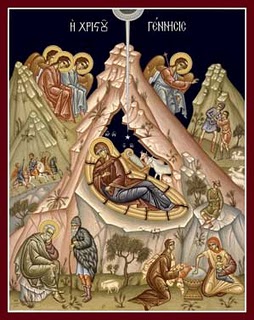
In this more lengthy reading, Pope Benedict explains part of the Christmas icon shown below:

The Christmas icon of the Eastern Orthodox Church developed its essential form as early as the fourth century and in it has captured the complete mystery of Christmas.  It represents the intimate connection between Christmas and Easter, between crib and Cross, the harmony between the Old and the New Testaments, the unity of heaven and earth in the song of the angels and the devotion of the shepherds.  Each figure in it has a profound underlying significance.  Remarkable in all this is the function reserved for St. Joseph.  He is sitting to the side, lost in deep reflection.  In front of him stands the Tempter, disguised as a shepherd, who addresses him, according to the text of the liturgy, in this way: “Just as your root cannot produce leaves, just as an old man cannot become a father anymore, so also the virgin cannot give birth.”  The liturgy then adds: In his heart there raged a storm of contradictory thoughts; he was confused; but enlightened by the Holy Spirit he sings Alleluia.  Through the figure of Saint Joseph the icon presents a drama that recurs time and again–the drama of ourselves.  It is always the same.  Time and again the Tempter tells us: There is nothing but the visible world, there is no Incarnation of God, and there is no birth of the Virgin.  This is the denial that God knows us, that he loves us, that he has the power to be active in the world.  And thus it is, in its core, the refusal to give God the honor.  It is the temptation of our time, which presents itself with so many clever and seemingly brand-new reasons as to appear utterly convincing.  Yet it is still the same old temptation.  We ought to pray to Almighty God that he may send into our hearts also the light of the Holy Spirit.  We ought to pray that he may grant to us also the grace to leave the stubbornness of our own reasoning behind, to gaze at his light with joy and to sing out, “Alleluia”–Christ is truly born, God has become man.  We ought to pray that in us also the words of the Easter liturgy may become reality: “We present to you a Virgin and Mother.  We present to you ourselves as well, more valuable than any gift of money: the wealth of true faith–to you, our God, and Savior of our souls.” Amen.  (Pope Benedict XVI, Lob der Weihnacht, p. 45)

The stars were brighter

Two short Christmas poems:

Starry, Starry Night

     The stars were brighter
         than ever before.
     The night was different,
crackling with new beginnings.
     Something was happening
          in the dark, smelly stable;
Gift of God was before us.      (Anonymous)

Wee One in a Manger

A Wee One in a manger
Praise Him where He lies,
Angels singing carols,
Listening winter skies!   (Hayashi)