How bright our souls should be

A few weeks ago I wrote about the custom we have in our house of leaving our Christmas lights up until today, the Presentation of the Lord (Candlemas), and the reasons for doing so. (See “God loves to light little lights”)  Well, today is the last day of our Christmas lights.  Even as I write this, I am facing two candles alit in my office windows that won’t be there tomorrow.  I was bemoaning all this to myself this morning until I read the Second Reading for the Office of Readings for today and realized anew that you and I are and will be the ongoing Christmas lights in this world, in season and out of season. (Note: the Eastern Church refers to this feast as The Meeting of the Lord.)

In honor of the divine mystery that we celebrate today, let us all hasten to meet Christ.  Everyone should be eager to join the procession and to carry a light.
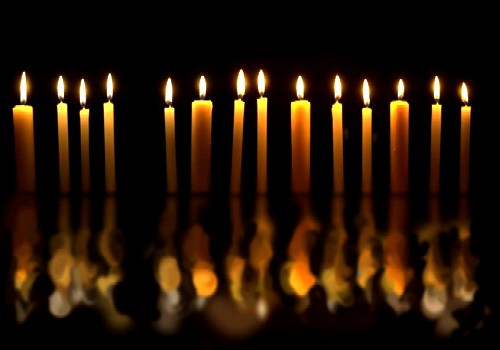
Our lighted candles are a sign of the divine splendor of the one who comes to expel the dark shadows of evil and to make the whole universe radiant with the brilliance of his eternal light.  Our candles also show how bright our souls should be when we go to meet Christ.
The Mother of God, the most pure Virgin, carried the true light in her arms and brought him to those who lay in darkness.  We too should carry a light for all to see and  reflect the radiance of the true light as we hasten to meet him.
The light has come and has shone upon a world enveloped in shadows; the Dayspring from on high has visited us and given light to those who lived in darkness.  This, then, is our feast, and we join in procession with lighted candles to reveal the light that has shone upon us and the glory that is yet to come to us through him.  So let us hasten all together to meet our God.
The true light has come, the light that enlightens every man who is born into this world. Let all of us, brethren, be enlightened and made radiant by this light.  Let all of us share in its splendor, and be so filled with it that no one remains in the darkness.  Let us be shining ourselves as we go together to meet and to receive with the aged Simeon the light whose brilliance is eternal.  (From a sermon by Saint Sophronius, bishop)

This evening we will begin Mass in our chapel with a procession, each of us carrying a lit candle.  I’m praying it will remind me of the true Light that dwells in me.  Tomorrow evening at Night Prayer when the lights are dimmed in our chapel for the singing of the Salve Regina, there will be only one lit candle (besides the sanctuary lamp) and that will be the one before the icon of the Mother of God.  “The Mother of God, the most pure Virgin, carried the true light in her arms and brought him to those who lay in darkness.  We too should carry a light for all to see and  reflect the radiance of the true light as we hasten to meet him.”  O sweet Mother of God, help us to do so.

God saw that it was beautiful

When God created the world, Genesis says He “saw that it was good” which also means “beautiful.”

Rate this:

I’m back pondering “beauty”–partly because I’m reading an excellent article, “Tolkien and St. Thomas on Beauty” from the current issue of StAR.  Lots to ponder there.  Then this morning I stumbled on this post from Conversion Diary about music and beauty.  Seems to be a theme for my day today.  Actually, the upshot of my pondering this morning was to ask God for more of His eyes, to be able to see the beauty in every soul I encounter today (including my own).  When God created the world, Genesis says He “saw that it was good” which also means “beautiful.”  This is how God sees us:

The Creator, like a divine poet, in bringing the world into being out of nothingness, composed his “Symphony in Six Days,” the Hexameron. After each one of his creative acts, he “saw that it was beautiful.”  The Greek text of the biblical story uses the word kalon–beautiful–and not agathon–good; the Hebrew word carries both meanings at the same time.  (Paul Evdokimov, The Art of the Icon: a Theology of Beauty, p. 2)

Hymn for the Purification

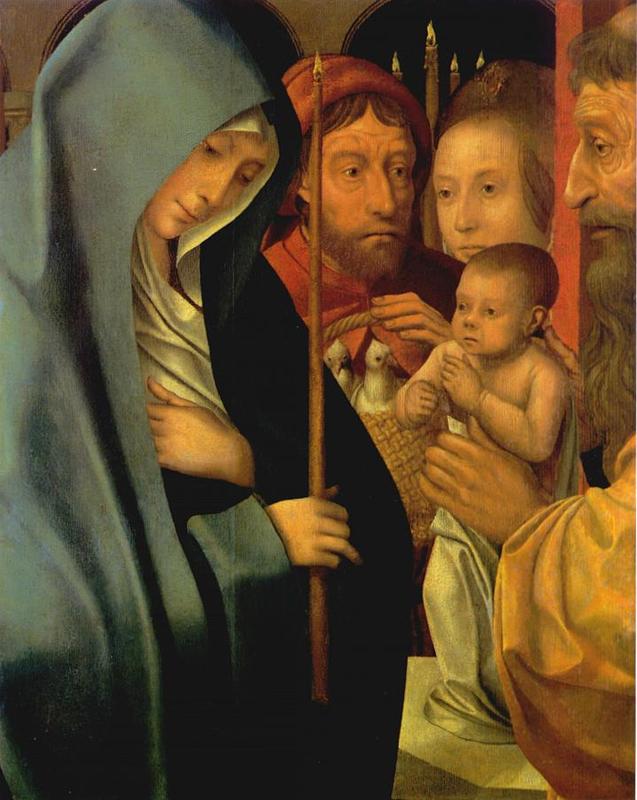
Since Tuesday is the Feast of the Presentation (and the Purification), I thought I would share a hymn from the Byzantine rite for this day as my “Sunday-poem”.

Today Simeon takes in his arms the Lord of glory
whom Moses saw on Sinai, in a cloud,
when he received the Tablets of the Law.

This is He whom the prophets spoke!
This is the Author of the Law!
This is He whom David long foretold, saying:
he is fearful in all things
and yet is rich in mercy beyond measure!

He who rides upon the cherubim,
hymned in songs by seraphim,
is carried now in Mary’s arms–
God’s Virgin Mother from whom He was born.

Him, Lawgiver who fulfills
the mandate of His Law,
she gives unto the aged priest
Who, clasping Life, prays to be loosed from life,
saying:
Now, O Lord, dismiss me
that I may tell to Adam
how I have seen the changeless God,
who is before all ages,
become a little child,
and Savior of the world.

The Difficult Love (5)

So, as I said yesterday, for many of us, the most difficult love is to love ourselves, to love ourselves as Christ loves us. to let ourselves be loved by Christ.  It is the easiest thing to do, but it is the hardest thing to do.  It is the easiest because God always loves us no matter what, always, always.  It is the hardest thing for us to do because we simply don’t believe it and always find excuses to not make ourselves vulnerable to Him.  We think we need to prove ourselves, we’re afraid of being hurt and disappointed, we just don’t believe it.  Some of the best things in life–in fact, the best thing–are free.

So, what to do?  Just simply turn towards that Love.  I know, easier said than done.  He is always turned toward you and will never turn away.  My prayer is that today, right at this moment, you can do this simple–but seeming difficult–thing.

Lastly, there is the difficulty of remembering that, in this necessarily interior language of self and heart, the first and last words are the God who loves us, ‘a Divine Love who is always seeking the human heart.’ It is easy to evade this, to transfer focus too quickly to what we think we must do next, to those obligations  to others to which we never seem to measure up.  And this is competing against a standard which surreptitiously we are in fact setting for ourselves.  There may not be a malicious vanity here, but there is a vanity all the same.  isn’t one of the big barriers to prayer our inhibition about accepting the love Jesus has for each one of us as we are?  (Mark Allen, quoted in Ruth Burrows, Letters on Prayer, p. 21)

The Difficult Love (4)

I want to propose to you that for many of you the “difficult love” is not so much loving those God has placed in your life (although they may indeed be difficult to love), but the “difficult love” is loving yourself.   Christ’s new commandment is that we love others as He has loved us.  If we don’t have that part straight–knowing His love for us–it is very, very difficult to love others.  (Not that we can use that for an excuse for not loving others.  It just makes it much more difficult.)

Deacon Steve and I were praying with a friend recently who experiences a tremendous amount of self-hatred.  While we were praying, he shared this image that was coming to mind.  He saw my friend in the midst of a crowd of people on a road.  There was a person lying by the side of the road, and everyone was walking by her.  (Sound familiar?)  My friend went over to the person who was in such distress and pain and gently turned her over–only to discover that the person was herself.  Her immediate response was to run away, but she overcame herself and picked “herself” up and cared for her with gentleness and mercy.”

I will leave you with that story to think upon.

More on this tomorrow.

The Difficult Love (3)

(Continuing on from the last couple of days . . . )

And, as we know, the Lord calls us to not just put up with the people around us, those who are difficult to love, but to love them as He loves them.  “To love one whom others despise is to demonstrate God’s love for that person, for one who is more precious than the whole world.  It is perhaps to save that person from self-hatred.” (Clément, p. 283)

The spiritual person hides the faults of others, as God protects the world, as Christ washes our sins in his blood, as the Mother of God stretches the veil of her tears over the human race. “It was said of Abba Macarius the Great that he became, according to the writings, a god on earth, because in the way God protects the world, so Abba Macarius would hide the faults he saw as though he had not seen them, and the faults he heard about as though he had not heard of them.” (ibid., p. 284)

Isaac of Nineveh said: “Spread your cloak over anyone who falls into sin and shield him.  And if you cannot take his fault on yourself and accept punishment in his place, do not destroy his character.”

More on all this tomorrow, but think on this today: this is how Christ loves you.

The Difficult Love (2)

What really stopped me in my tracks while reading this chapter (see yesterday’s post) was this that he wrote:

For the person who has begun to tread the spiritual path, nothing is more important than the Gospel command: ‘Do not judge.’ Greed and vanity are passions that belong to those who are novices on the way or who have only just begun to advance along it.  But for the more advanced, the breakdown always comes from judgment pronounced on others. . . . according to spiritual teachers, the whole of virtue is comprised in the refusal to despise. (p. 281)

I guess, in reading this, I felt it was kind of a back-handed compliment.  I struggle with judgmental thinking so much.  Somehow that means I’m further along on the spiritual path?

Then he goes on to quote from John Climacus and a desert father:

John Climacus: : “The failures of beginners result almost always from greed. In those who are making progress the failures come also from too high an opinion of themselves.  In those nearing perfection they come solely from judging their neighbor.”

Abba Theodore of Pherme said, “There is no other virtue than that of not despising anyone.”

And back to Clement: “To justify ourselves by condemning others is our permanent tendency, in private as in public life.”

So is there hope for us who struggle with this?  Of course, but more on all of this tomorrow.

The Difficult Love (1)

So this morning I have been thinking about a chapter in the book, The Roots of Christian Mysticism (Fr. Olivier Clement), entitled “The Difficult Love” which I read a few years ago.  I ended up re-reading it a few times, and I would like to blog about it for a couple of days (at least).   The first sentence in the chapter gave me pause: “Spiritual progress has no other test in the end, nor any better expression, than our ability to love.”  And so went the rest of the chapter.  Interestingly enough, the chapter is situated in a section entitled: “Approaches to Contemplation.”  It is also the last chapter in the book, which says something in itself.  Clement laces the chapter with quotes from many and various ancient writers.  Here is a sampling:

Pseudo Macarius: “Those who have been judged worthy to become children of God and to be born from on high of the Holy Spirit. . .not infrequently weep and distress themselves for the whole human race; they pray for the ‘whole Adam’ with tears, inflamed as they are with spiritual love for all humanity.  At times also their spirit is kindled with such joy and such love that, if it were possible, they would take every human being into their heart without distinguishing between good and bad.  Sometimes too in humility of spirit they so humble themselves before every human being that they consider themselves to be the last and least important of all.  After which the Spirit makes them live afresh in ineffable joy.”

St. Isaac of Syria: “This shall be for you a luminous sign of the serenity of your soul: when, on examining yourself, you find yourself full of compassion for all humanity, and your heart is afflicted with pity for them, burning as though with fire, without making distinction between one person and another.”

Okay.  So far so good, but more on this tomorrow.  (If you don’t want to wait, I did give a talk on this in 2005 which is available here with a handout.)

Little words (7)

In October I did a series of posts on “little words” in Scripture that are really “big” words.  I wanted to share another with you today.  

Psalm 73.26: But God

These words have been like strong hands lifting up, bearing up, countless thousands of souls. “My flesh and my heart faileth: but God is the strength of my heart and my portion for ever.”  Many who will read this note are well and strong and joyful in their work, thank God for that.  Sooner or later, however, to most who follow the Crucified, there comes a time when flesh and heart fail, and if it were not for that “But God”, we should go under. . . .   (Amy Carmichael, Edges of His Ways, p. 12)

It’s evident to me what it means to have your flesh fail, but I have been pondering what it may mean to have your heart fail: sorrow, doubts, hopelessness, discouragement, etc.  It comforts me to hear those words: but God even in the midst of those failings.  He will be for us all times–another very important little word.  🙂

(For the other “little words” posts, go to the first one here and move on from there.)