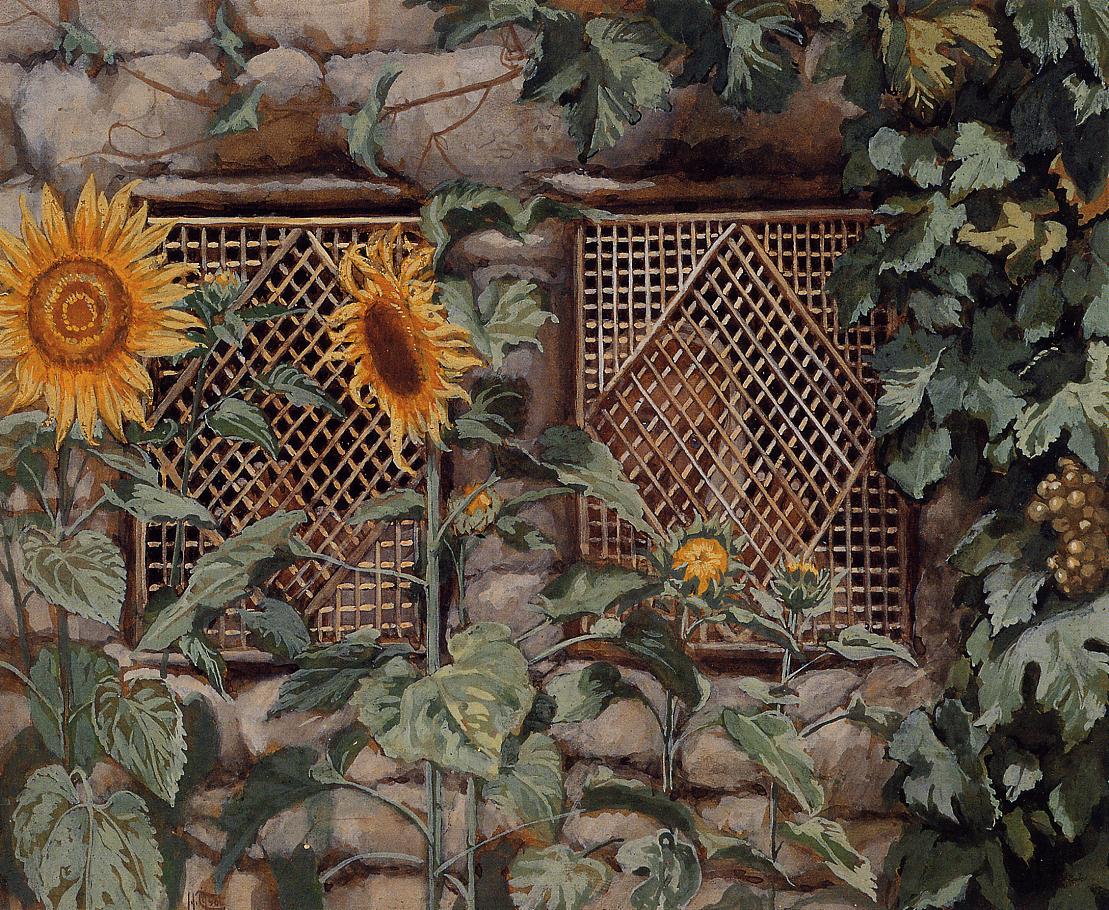
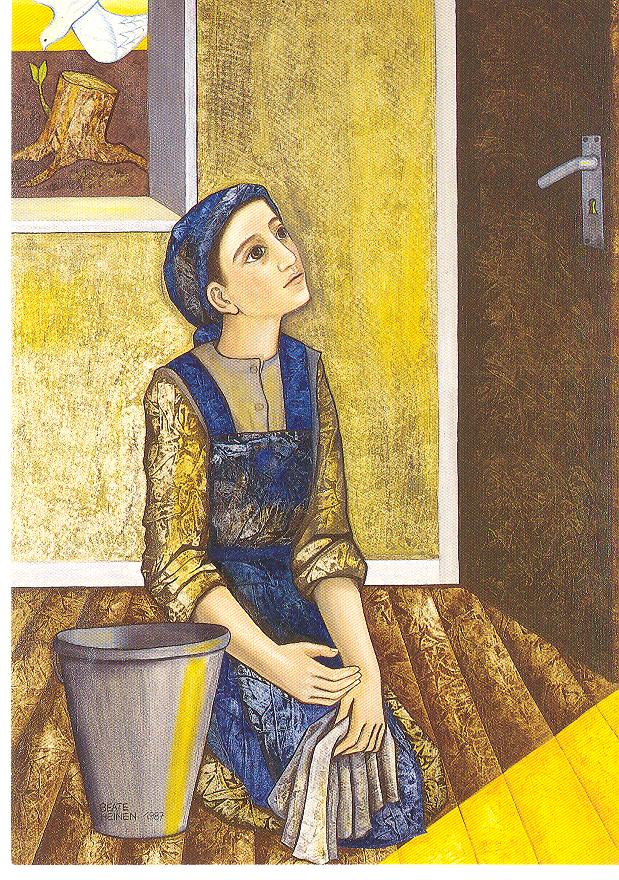
He follows us into our own darkness

232d18bcad3b096f6645381dd2c797ceAnother picture that our Lord loves to use is that of the shepherd who goes out to look for the sheep that is lost.  So long as we imagine that it is we who look for God, then we must often lose heart.  But it is the other way about: he is looking for us.  And so we can afford to recognize that very often we are not looking for God; far from it, we are in full flight from him, in high rebellion against him.  And he knows that and has taken it into account.  He has followed us into our own darkness; there where we thought finally to escape from him, we run straight into his arms.
So we do not have to erect a false piety for ourselves, to give us hope of salvation.  Our hope is in his determination to save us.  And he will not give in!
     This should free us from that crippling anxiety which prevents any real growth, giving us room to do whatever we can do, to accept the small but genuine responsibilities that we do have.  Our part is not to shoulder the whole burden of salvation, the initiative and the program are not in our hands: our part is to consent, to learn how to love him in return whose love came to us so freely while we were quite uninterested in him.        (Simon Tugwell, O.P.)

A good way to start

Sometimes we just get fixated on the wrong things during Lent.  Or perhaps a better way to say it is: distracted by things different than God wants us to focus on.  Or we just get discouraged.  I found this advice by Marge Fenelon to be excellent and very helpful for me.  Hopefully for you as well.

Relaxing into Lent

As a little girl, I was extremely melancholic, to the point of finding myself every so often sinking into bouts of sadness or loneliness. Sometimes, I’d just feel “lost” for seemingly no reason at all. Nothing was ever truly wrong but at the same time, nothing was ever truly right, either.

Sure, there were things that could have had me down – my dad’s heart condition, the occasions of family discord, or the solitariness of being the youngest child who trails her siblings by several years. Our house certainly could get quiet and lonely at times. Yet, there was never anything I could directly relate it to. In fact, all these years later, I still can’t figure out the cause of those sensations. They were sudden, and they were strong. That’s all I know.

Read the rest here.


Jesus, help me!

Is it just me, or do temptations increase during Lent?  And what to do with them?  I think we all can be afraid of temptations.  Our Pope Emeritus suggests a simple way to deal with them:

“. . . to a disciple who expressed the desire to discover ‘the causes of the different temptations that had assailed him’, Barsanufius replied: ‘Brother John, do not be afraid of the temptations that arise against you to put you to the test, do not be determined in trying to understand what it is about; rather cry out the name of Jesus: “Jesus, help me!”  And he will hear you because ‘the Lord is near to all who call upon him.’ Do not be discouraged, run with ardor and you will reach your end in Christ Jesus, our Lord!”

And these words of the ancient Father are also valid for us.  In our difficulties, problems, temptations, we must not simply engage in a theoretical reflection from whence do they come? — but must react positively, invoking the Lord, maintaining a living contact with the Lord.  Beyond that, we must cry out the name of Jesus: ‘Jesus, help me!’  ANd we may be sure that he listens to us, as he is near to those who seek him.  Let us not be discouraged; rather let us run with ardor–as this Father says–and we too will reach life, Jesus, the Lord.”  (Benedict XVI)

“Faith is a country of darkness”

I frequently turn to Catherine Doherty’s writings when I am struggling.  This is one of my favorites of hers.  May reading it bring you hope.

Faith is a country of darkness into which we venture because we love and believe in the Beloved, who is beyond all reasoning, all understanding, all comprehension.  And at the same time, paradoxically, is enclosed within us: the Father, the Son, and the Holy Spirit.  Faith must go through this strange dark land, following him whom it loves.

Christ, our Beloved, becomes the door, the way into and through this darkness.  And suddenly our heart knows that if we will pass through the door and walk along that way, we will see the Father.

What does it mean to see the Father?  It means to assuage that hunger that has been put in man’s heart by God himself, the hunger of finally meeting absolute love.  We yearn for it.  All of us do.  We arise and go on a pilgrimage, guided only by faith that we must journey toward the face of perfect Love–because for this we were created, to be one with the Love.

If we embark upon this quest, into the land where we may not be able to hear, may not be able to see, may not be able even to speak, suddenly we will be mysteriously visited.  A hand will touch our ears and they will be opened, not only to the speech of man but to the speech of God.  A hand will touch our eyes and we will see, not only with our eyes, but with the sight of God.  A hand will touch our tongue, and we will speak, not only as men do, but as God speaks, and we will become prophets of the Lord.

True, on the road to the Father we shall fall, for we shall sin.  We may turn away from God, we may leave the Church, we may think that we have left everything.  But faith being a gift of God, it does not desert us; we desert it, but it follows us.  We leave the Church, but the Church–which is part of faith, for it is part of Christs–does not leave us.  We turn away from God, but God never turns away from us.

10 little steps with Mary

Found this excellent article on walking through Lent with Mary:

In the wee hours of the morning, shivering from the cold, damp interior of the darkened Church of the Holy Sepulcher in Jerusalem, I lingered in prayer at the rock of Calvary. Resting my hand on the cold rock where the noble cross of Jesus Christ stood upright on the first Good Friday, I prayed. Oh, how I poured my heart out! I was in a spiritual place of desolation when I arrived on retreat in the Holy Land having just gone through a big upheaval in my life. Doors closed, paths turned, and the future seemed unclear to me. I was searching and completely open, available and docile to the next phase of God’s plan for my life.

Read the rest here.

Is success the point of Lent?

Some surprising thoughts from a gal who is not Catholic, but observing Lent this year:  Ann Voskamp on “Why Failing at Lent–May be Succeeding at Lent?”

I can’t seem to follow through in giving up for Lent.

Which makes me want to just give up Lent.

Which makes me question Who I am following.

Which may precisely be the point of Lent.

You can read the rest here.  (She has some pretty nice freebies on her site as well.)

“As to your Lent . . . I can only tell you my own experience.”

Wonderful Caryll Houselander writes:

As to your Lent . . . I can only tell you my own experience.  A mass of good resolutions, I think, are apt to end up in disappointment and to make one depressed.  Also direct fault-uprooting: it makes one concentrate too much on self, and that can be so depressing.  The only resolution I have ever found that works is: “Whenever I want to think of myself, I will think of God.”  Now, this does not mean, “I will make a long meditation on God,” but just some short sharp answer, so to speak, to my thought of self, in God.  For example:

“I am lonely, misunderstood, etc.”
“The loneliness of Christ at his trial; the misunderstanding even of his closest friends.”
Or:
“I have made a fool of myself.”
“Christ mocked–he felt it; he put the mocking first in foretelling his Passion–‘The Son of Man shall be mocked, etc.’–made a fool of, before all whom he loved.”
Or:
“I can’t go on, unhelped.”
“Christ couldn’t.  He couldn’t carry the cross without help; he was grateful for human sympathy–Mary Magdalene–his words on that occasion–other examples as they suggest themselves–just pictures that flash through the mind.”  This practice becomes a habit, and it is the habit which has saved me from despair! . . .

Different people have different approaches to Christ.  He has become all things–infant, child, man–so that we all can approach him in the way easiest for us.  The best is to use that way to our heart’s content, and not to trouble about any other.

Lenten Grace — The Uses of Sorrow

barnstormingblog's avatarBarnstorming

photo by Josh Scholten photo by Josh Scholten

Someone I loved once gave me
a box full of darkness.

It took me years to understand
that this, too, was a gift.
~Mary Oliver, “The Uses of Sorrow”

The bright sadness of Lent
is a box full of darkness
given to us by someone who loves us.

It takes a lifetime to understand,
if we ever do,
this gift with which we are entrusted
is meant to
hand off to another and another
whom we love just as well.

Opening the box
allows light in
where none was before.
Sorrow shines bright
reaching up
from the deep well
of our loving
and being loved.

View original post

The happiest of beings

Friday: from the archives.

Sr. Dorcee, beloved's avatarWonder and Beauty

“I do not know when I have had happier times in my soul, than when I have been sitting at work, with nothing before me but a candle and a white cloth, and hearing no sound but that of my own breath, with God in my soul and heaven in my eye . . . . I rejoice in being exactly what I am,—a creature capable of loving God, and who, as long as God lives, must be happy.  I get up and look for a while out of the window, and gaze at the moon and stars, the work of the Almighty hand.  I think of the grandeur of the universe, and then sit down, and think myself one of the happiest beings in it.”  ~a poor Methodist woman, 18th century

View original post