I haven’t posted in the past two days because life has been full of more important things. As many of you know, we run two Emmanuel Houses: homes for older adults who are no longer capable of living alone and have limited support and no resources. This week three of the residents have been in the hospital and one at home passed on to be with the Lord. Two of our Sisters who work there are on vacation. It’s times like these when life can feel like it’s a bit too much. Yet we know that all is in God’s Providence. I meditate often on these words from Bl. Elizabeth of the Trinity: “Everything that happens is for me a message of the excessive love of God for my soul.” And as Amy Carmichael would say: “Everything means everything.”
Author: Sr. Dorcee, beloved
I am the one whom Jesus loves.
Patient waiting
The sisters in my house had an exercise in patient waiting this weekend. We lost power on Thursday night due to a strong thunderstorm. The projected time for restoration of power was this Tuesday night. When we lose power, we lose everything including water. We do have a generator–thanks to a very generous donor last year, but, of course, we can’t plug everything into it . . . and the water pump is one of those things. This means a lot of water hauling, manual flushing of toilets, heating water on the stove. (Like the good old days, heh?) The good news is that everyone pitched in and maintained a good attitude. The other good news is that the power came on last night at midnight–two days before the estimated time!!!
“Be patient, therefore, brethren, until the coming of the Lord. . . . You also must be patient. Establish your hearts for the coming of the Lord is at hand. Do not grumble . . . .” (James 5.7a, 8-9a)
Bowing down before the Lord
 The whole story of the Canaanite woman who implored Jesus to heal her daughter (cf. Mt. 15.21 ff) is absolutely fascinating to me. Jesus seems to rebuff her more than once, yet she tenaciously perseveres in her request. What particularly moves me is her response after 1) he first seemingly ignores her and 2) says that His mission is to the lost sheep of the House of Israel (of which she is not a part). She responds by coming to Him, kneeling at His feet and worshiping (15.25).
Worship is an act of bowing before the Lordship of God and completely surrendering to His will. How often is our response one of worship when we experience silence and non-answers from the Lord? May the Spirit of the Lord prompt us to turn our disappointments into occasions of worship of our God who is only and always Love.
Lodged in His Heart
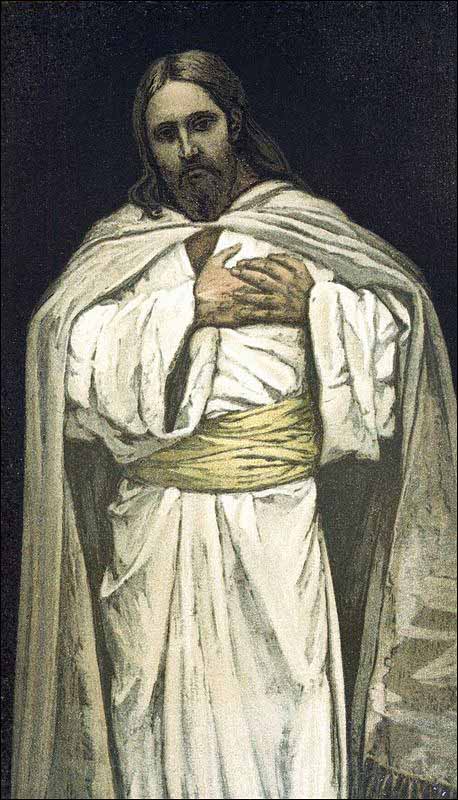
I’m getting ready to leave town tomorrow, and I almost forgot to post today! I can’t help re-posting my favorite picture portraying Jesus and His Sacred Heart, done by James Tissot.
We are all in the Heart of Jesus Christ, since He loves us all, for the way of love is for the lover to lodge the beloved in his heart. (Fr. Timothée de Raynier)
The end of the year for priests
Tomorrow is the last day of this year that has been dedicated to praying for priests. This morning we asked the priest who said Mass for us to stay for breakfast and then took some time to pray over him before he left. He said, “I’m a bit afraid now that this year is ending that people will stop praying for us. Please pray for priests.” I pass on his appeal.
Here’s an inspiring excerpt from He Leadeth Me, by Fr. Walter Ciszek about his time of imprisonment in Russia during the communist era:
The moment a priest appeared on the camp grounds by himself or with a fellow priest, he would be joined by passing prisoners. The moment it became known in a new brigade or new barracks or a new camp that a man was a priest, he would be sought out. He didn’t have to make friends; they came to him instead. It was a very humbling experience, because you quickly came to appreciate that it was God’s grace at work and had little to do with your own efforts. People came to you because you were a priest, not because of what you were personally. They didn’t always come, either, expecting wise counsel or spiritual wisdom or an answer to their every difficulty; they came expecting absolution form their sins, the power of the sacrament. To realize this was a matter of joy and of humility. You realized that they came to you as a man of God, a representative of God, a man chosen from among men and ordained for men in the things that are of God; you realized, too, that this imposed upon you an obligation of service, of ministry, with no thought of personal inconvenience, no matter how tired you might be physically or what risks you might be running in the face of official threats. For my part, I could not help but see in every encounter with every prisoner the will of God for me, now, at this time and in this place, and the hand of providence that had brought me here by strange and tortuous paths . . . The things that are of God are all the joys and works and sufferings of each day, however burdensome and boring, routine and insignificant they may seem. It is the priest’s function to offer these things back to God for his fellow men and to serve as an example, a witness, a martyr, a testimony before the men around him of God’s providence and purpose.
Don’t stop praying for priests.
All for the good
Here’s a story I just read about one way God worked all things for the good:
In the devotional book Voices of the Faithful, a missionary couple in South America tells of a local pastor in Uberaba who bought a van to transport people to church. To help make payments on the van, he removed the backseats and did delivery work through the week. But the van needed four new tires, and the pastor had no way of paying for them.
One night the van was stolen from the church property. Some of the church members tried to console their pastor by saying that perhaps it wasn’t God’s will for him to have the van. But he knew he needed the vehicle for God’s work, so he trusted the Lord to work it all for the good.
A few days later, police officers from a nearby town called on him, saying the van had been located and the thief caught. Arriving at the police station, the pastor was surprised to find his vehicle sporting a new set of tires, new backseats, and a radio! He claimed the van, but told the police that the tires, seats, and radio were not his. They must have been installed by the thief.
“Well, I guess that is the thief’s loss and your gain,” replied the police officer. The pastor now has a good van, fully equipped and freshly shod.
(from Robert J. Morgan, The Promise, pp. 95-6)

Red Sea Rule 8
Jumping ahead in the book I referred to yesterday, Rule #8 is “Trust God to deliver in His own unique way.”
God will deliver His children from every evil work, from every peril and problem, from tribulation, even from death itself. But there are no cookie cutters in heaven. God doesn’t have standardized, same-size-fits-all solutions to our various problems. He treats every situation as singular and special, and He designs a unique, tailor-made deliverance to every trial and trouble.
He goes on to write about how God can indeed deliver in miraculous ways and does, but other times, in His providence, He works in mysterious ways that we cannot always understand.
When God does not deliver overtly (through a miracle) or covertly (through providence), He will deliver mysteriously, with a deeper level of intervention than we can discern; in the end it will be better for us, though for a time we may be perplexed.
When Vance Havner, the wry North Carolina evangelist, lost his wife to disease, he was disconsolate. But out of the experience he later wrote:
When before the throne we stand in Him complete, all the riddles that puzzle us here will fall into place and we shall know in fulfillment what we now believe in faith–that all things work together for good in His eternal purpose. No longer will we cry “My God, why?” Instead, “alas” will become “Alleluia,” all question marks will be straightened into exclamation points, sorrow will change to singing, and pain will be lost in praise.
“What I am doing you do not know now, but afterward you will understand.” (Jn 13.7)
The Red Sea Rules
I just finished a book I wanted to recommend to you all: The Red Sea Rules by Robert J. Morgan. It’s a short book (just over 100 pages) based on Exodus 14–when God leads the Israelites to the Red Sea and they are chased by Pharaoh’s army. Pastor Morgan draws out 10 “rules” based on this episode in the life of God’s chosen people. He illustrates each rule with real-life stories. And, lest you wonder if this is an easy, fix-it-quick book, in his preface he writes: “These aren’t ten quick-and-easy steps to instant solutions, In my case, it took quite a while to work through the anguish and achieve a positive result.”
The subtitle of the book is: The Same God who Led You In Will Lead You Out. Rule #1 is “Realise that God means for you to be where you are.” An excerpt from that chapter:
Some circumstances are beyond our control, and something as simple as the ringing of a phone, a card in the mail, or a knock on the door can push us off the wire. We fall into a world of worry. Someone defined worry as a small trickle of fear that meanders through the mind, cutting a channel into which all other thoughts flow.
The preacher John R. Rice said, “Worry is putting question marks where God has put periods.”
Bishop Fulton J. Sheen called worry “a form of atheism, for it betrays a lack of faith and trust in God.”
But for some of us, worry seems as inherent as breathing.
Sound familiar? Morgan ends this section with this:
In the story of the Red Sea, the Israelites followed the pillar of cloud and fire as carefully as possible, thrilled with their new freedom, full of excitement about the future. Yet as they followed Him, God deliberately led them into a cul-de-sac between hostile hills, to the edge of a sea too deep to be forded and too wide to be crossed.
The unmistakable implication of Exodus 14:1-2 is that the Lord took responsibility for leading them into peril. He gave them specific, step-by-step instructions, leading them down a route to apparent ruin: Turn and camp. Camp there. There, before the entrapping sea. Yes, right there in that impossible place.
The Lord occasionally does the same with us, testing our faith, leading us into hardship, teaching us wisdom, showing us His ways. Our first reaction may be a surge of panic and a sense of alarm, but we must learn to consult the Scriptures for guidance.
So, take a deep breath and recall this deeper secret of the Christian life: when you are in a difficult place, realize that the Lord either placed you there or allowed you to be there, for reasons perhaps known for now only to Himself.
The same God who led you in will lead you out.
Adore te devote
The Sunday-poem for this Feast of the Body and Blood of Jesus is the beautiful classic by St. Thomas Aquinas, translated by Gerard Manley Hopkins:
Adore te devote
Godhead here in hiding, whom I do adore
masked by these bare shadows, shape and nothing more,
See, Lord, at thy service low lies here a heart
Lost, all lost in the wonder at the God thou art.Seeing, touching, tasting are in thee deceived;
How says trusty hearing? That shall be believed;
What God’s Son has told me, take for truth I do;
Truth himself speaks truly or there’s nothing true.On the cross thy godhead made no sign to men;
Here thy very manhood steals from human ken:
Both are my confession, both are my belief,
And I pray the prayer of the dying thief.I am not like Thomas, wounds I cannot see,
But can plainly call The Lord and God as he:
This faith each day deeper be my holding of,
Daily make me harder hope and dearer love.O thou our reminder of Christ crucified,
Living Bread the life of us for whom he died,
Lend the life to me then: feed and feast my mind,
There be thou the sweetness man was meant to find.Bring the tender tale true of the Pelican;
Bathe me, Jesu Lord, in what they bosom ran–
Blood that but one drop of has the worth to win
All the world forgiveness of its world of sin.Jesu whom I look at shrouded here below,
I beseech thee send me what I thirst for so,
Some day to gaze on thee face to face in light
And be blest for ever with thy glory’s sight.
The best promise of this life
“Everything that happens to you is for your own good. If the waves roll against you, it only speeds your ship toward the port. If lightning and thunder comes, it clears the atmosphere and promotes your soul’s health. You gain by loss, you grow healthy in sickness, you live by dying, and you are made rich in losses. Could you ask for a better promise? It is better that all things should work for my good than all things should be as I would wish to have them. All things might work for my pleasure and yet might all work my ruin. If all things do not always please me, they will always benefit me. This is the best promise of this life.” (Charles Haddon Spurgeon)

