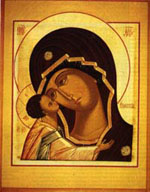
“A clean and shining beauty of soul”

Mary has “a clean and shining beauty of soul.”

Rate this:

I can’t write about beauty without, of course, saying something about Mary, the Mother of God, who as John Saward says: “In face and grace, Mary is like Jesus.”

umilen3St. Cyril of Alexandria calls our Lady kallitokos as well as theotokos, “bearer of Him who is true beauty” as well as “bearer of Him who is true God.”

Grace, as the poet [Hopkins] says, is “God’s better beauty,” the splendor of the soul . . . “O pure Theotokos”, sings the Byzantine Church on the feast of the Entry of the Mother of God into the Temple, “thou hast a clean and shining beauty of soul, and art filled from Heaven with the grace of God” (the Festal Menaion).  Grace conforms the soul into the likeness of Christ.  So it is with Mary.

       (John Saward, The Holiness of Beauty and the Beauty of Holiness, p. 122)

We praise Thee, O God

This Sunday’s poem is by T.S. Eliot:

We praise Thee, O God, for Thy glory displayed in all the creatures of the earth,
In the snow, in the rain, in the wind, in the storm; in all of Thy creatures, both the hunters and the hunted.
For all things exist only as seen by Thee, only as known by Thee, all things exist
Only in Thy light, and Thy glory is declared even in that which denies Thee; the darkness declares the glory of light.
Those who deny Thee could not deny, if Thou didst not exist; and their denial is never complete, for if it were so, they would not exist.
They affirm Thee in living; all things affirm Thee in living; the bird in the air, both the hawk and the finch: the beast on the earth, both the wolf and the lamb; the worm in the soil and the worm in the belly.
Therefore, man, whom THou hast made to be conscious of Thee, must consciously praise Thee, in thought and in word, and in deed.
Even with the hand to the broom, the back bent in laying the fire, the knee bent in cleaning the hearth, we, the scrubbers and sweepers of Canterbury,
The back bent under toil, the knee bent under sin, the hands to the face under fear, the head bent under grief,
Even in us the voices of seasons, the snuffle of winter, the song of spring, the drone of summer, the voices of beasts and of birds, praise Thee.
We thank Thee for the mercies of blood, for Thy redemption by blood.  For the blood of Thy martyrs and saings
Shall enrich the earth, shall create holy places.
For wherever a saint has dwelt, wherever a martyr has given his blood for the blood of Christ,
There is holy ground, and the sanctity shall not depart from it
Though armies trample over it, though sightseers come with guidebooks looking over it;
From where the western seas gnaw at the coast of Iona,
To the death in the desert, the prayer in forgotten places, by the broken imperial column,
From such ground springs that which forever renews the earth
Though it is forever denied.  Therefore, O God, we thank Thee
Who has given such blessing in Canterbury.

                                                      – T.S. Eliot

O Beauty Ancient, O Beauty So New

If any of you are interested in listening to a talk I gave several years ago on beauty, O Beauty Ancient, O Beauty So New, you can click here.  (Then click on “Click here to start download.”  You can then choose to either 1) open it–which takes about five minutes and will then start playing on your media player–or 2) save it to your IPod or some other file.)

“. . . where all the beauty came from”

Last night as I walked out of the chapel at the end of our time of adoration, this phrase from C.S. Lewis was running through my head: “The sweetest thing in all my life has been the longing . . . to find the place where all the beauty came from.”  Those of us who know Him know that place–the where that is a Who.

There is not and cannot be anything more beautiful and more perfect than Christ.  (Dostoevsky)

He alone is ravishing in the full strength of the term . . . beauty itself.  (St. Therese, Letter 76)

Yes, the Face of Jesus is luminous, but if in the midst of wounds and tears it is already so beautiful, what will it be, then, when we shall see it in heaven?  Oh heaven . . . heaven.  Yes, to contemplate the marvelous beauty of Jesus [. . . ] (St. Therese, Letter 195)

The face of Christ is the human face of God.  The Holy Spirit rests upon him and reveals to us absolute Beauty, a divine-human Beauty that no art can ever properly and fully make visible.  Only the icon can suggest such Beauty by means fo the Taboric light.  (Paul Evdokimov, The Art of the Icon, p. 13.)

Christ is beautiful, and He comes to restore us to beauty.  (John Saward, The Beauty of Holiness and the Holiness of Beauty, p. 56)

Make time today to turn your face towards this place–Him from Whom all the beauty comes from.

“Nothing is lost in Him.”

“The personal history of each one of us is precious to him. . . . Nothing is lost in him.” (Maria Boulding)

Rate this:

I’m still thinking about that 20 minute movie I recommended yesterday.  (I had a chance to watch it again last night with Sr. Sarah.)  This extract from a book by Maria Boulding is another attempt at expressing the point of the movie:

The personal history of each one of us is precious to him.  He is more willing to forgive our sins than we are to ask forgiveness, and he is well able to redeem our deficiencies too.  We shall not spend eternity kicking ourselves for opportunities lost, grace wasted and love refused. How he can make these things good is beyond our understanding, but in some way the whole of it will be taken up into Christ.  Some lines scribbled in the margin of a fourteenth-century manuscript convey an unknown scribe’s insight into this mystery:
                           He abideth patiently,
                           he understandeth mercifully,
                           he forgiveth easily,
                           he forgetteth utterly.
All the positive things will be taken up into Christ, to be saved in all their reality and transfigured in him: the love that we have given and received, the moments of aching beauty, the longing and the pain, the laughter and surprise, the plain plodding on . . . . Nothing is lost in him.  All the great loves, all the heroism, all the struggle to make life more human, all the wrong turnings people have taken in their search, the times when a light more than human seemed for a while to play over human lives and those lives became legend, the poetry of the particular, the unrepeatable beauty, the fidelity to a vision that demanded all.  In Christ all these things will be affirmed and redeemed, to become part of our shared joy, and his.  (Maria Boulding, The Coming of God, p. 161)

The Butterfly Circus

One of the sisters called my attention to this beautiful short film, that you can view here: The Butterfly Circus.  I’d love to read your comments.

A message of the movie is this:

     No one has been born by chance and no one was consulted before being brought into the world.  The essence and existence of each person is something of extraordinary value, something very important . . . And if no one exists by chance, there is no chance involved in his particular physical and psychological make-up.  There is also a reason for the fact that everyone has his own individual temperament, qualities, a particular degree of intelligence, sensitivity and even particular features . . . Everything has a reason for being and existing and each creature has been appropriately gifted for the end which it is to fulfill in the universe.  (Frederico Suarez, Mary of Nazareth)

The lady of fair weeping

Mary is beautiful, even in her sorrow.

Rate this:

Today is the Feast of the Sorrowful Mother.  Recalling Cardinal Ratzinger’s words from yesterday’s post, we can see that Mary is beautiful even in her sorrow:

The Blessed Virgin is the lady of fair weeping.  Her tears were beautiful.  These are the sorrows of one who is all beautiful, full free from the deformity of sin. . . No lamentation has been lovelier, no compassion purer . . . .  The sinless Spirit-filled heart of Mary is beautifully centred on the will of the Father and on His and her Son and those for whom He suffers.  (John Saward, The Beauty of Holiness and the Holiness of Beauty)

Our Lady of Sorrows

And a little consoling excerpt from Magnificat today: “As the Savior’s dying gift to us, Jesus leads us back to Mary.  For we need the maternal closeness of the Sorrowful Mother to sustain us when overcome by the terrifying trials of life.”

“The arrow of His paradoxical beauty”

Today is one of our community feasts, the Triumph of the Cross.  Many things could be said about this day, but what is coming to mind–since I’ve been thinking about beauty so much these days–is another excerpt from the then Cardinal Ratzinger’s address to the Communion and Liberation community in Rimini.  He started his address by speaking about how on the Monday of Holy Week the Liturgy of the Hours juxtaposes two seemingly contradictory antipons: You are the fairest of the children of men and grace is poured upon your lips (Ps 45.3)and He had neither beauty, no majest, nothing to attract our eyes, no grace to make us delight in him (Is 53.2). He says, “How can we reconcile this?”  and then goes on to talk about true beauty: a love that loves “to the end” (Jn 13.1). 

The One who is the Beauty itself let himself be slapped in the face, spat upon, crowned with thorns; the Shroud of Turin can help us imagine this in a realistic way.  However, in his Face that is so disfigured, there appears the genuine, extreme beauty: the beauty of love that goes “to the very end” . . . Is there anyone who does not konw Dostoyevsky’s often quoted sentence, “The Beautiful will save us”?  However, people usually forget that Dostoyevsky is referring here to the redeeming Beauty of Christ.  We must learn to see Him.  If we know Him, not only in words, but if we are struck by the arrow of His paradoxical beauty, then we will truly know Him, and know Him not only because we have heard others speak about Him.  Then we will have found the beauty of Truth . . .

You can find his entire address here and it is worth reading in its entirety.

And let us let ourselves be wounded by the arrow of Christ’s paradoxical beauty. . .

Invitatory for a Wedding Anniversary

Yesterday one of our sisters, Sr. Katie, made her Final Profession of Vows.  It was a wonderful day for all of us.  Today another sister, Sr. Christina, is celebrating her first anniversary of Final Vows, and tomorrow on one of our major feasts, the Triumph of the Cross, three other sisters are celebrating anniversaries.  This poem, by Mother Mary Francis, seems so appropriate:

Invitatory for a Wedding Anniversary

“We recount your marvelous deeds” (Psalm 75)

Come, let us marvel at God confecting dawn
Out of a pastelled fluff of fancy, then
Unbfolding night from velvet bolt of mystery, arranging
Moons halved, then quartered, then plumped full
To serve our recreation.

          But marvel more that He has brided me.

Here is tall marvel: twirled by hand Divine
All birds’ propellers dancing circled grace
Down boulevarded space and all trees waving
For such performance, fans of jubilation.
Sun stoked and skies spread and clouds lit
With virgin light or pregnant with the rain
Are marvels that demand high recounting.

          But marvel more that He has brided me.

Come, let us kneel before th Lord devising
Day from the night and marshalling the stars,
Flattering peaches pink, and then gone off surprising
Carrots to gold with glance Divine
And us to exaltation.

          But marvel more that He has brided me.

All the long aeons God has lightly laid
Across our history call: Marvel! and
We gladly tell it, call for cosmic chorus to proclaim it:
God great, God mighty, God beyond
Our power small to marvel.

          But marvel more that He has brided me. 

DSC_2001