You are my favorite

I used to tell all my students, each of them, “You’re my favorite.”

Rate this:

I taught sixth graders for around eleven years–hey, eleven years of teaching eleven-year-olds!  And I loved every minute of it.  One of the ways God graced me was by giving me a unique love for each child.  I could truthfully say–and often did–to each one, “You are my favorite student.”  Sometimes I would walk around the class while they were doing silent reading and whisper, in all sincerity, in each ear, “You are my favorite student.”  Of course, they would ask, “How can that be true? How can we all be your favorite students?!”  Then, I would pull out a pile of my favorite books.  I would pick each one up and say, “This is my favorite book”, and so on.    I’d talk about how each book was a favorite for a different reason from the others. Then I would ask them, “How many favorite movies do you have?”  And then I would go on to explain how each of them could be my favorite student–and how to God, we are all His favorites.  Even to this day, I’ll have former students say, “Hi, Sr. Dorcee, am I still your favorite student?” and, of course, I’ll say, “Yes!!”

One day, on a Feast of Our Lady–I can’t remember which one–I was at Mass, and I looked up and saw one of my former favorite students across the way, and started thinking about her.  And, out of the blue, a thought passed through my head–which I’m sure was from Our Lady–“You’re my favorite.”  All I could do was smile . . . because I know she says that to each one of us.

Mary Magdalene

A Jessica Powers’ poem on Mary Magdalen.

Rate this:

I’ve done a lot of meditating over the years on today’s gospel.  For many long seasons of my life, I have felt that I have been with Mary weeping outside the tomb, Jesus calling my name, but I keep failing to recognize Him.  Learning to trust Him when I think He’s gone and I can’t recognize Him. (See “While it was still dark”)

Two paintings here of Mary before and after her conversion:

The Magdalene before her conversion (Tissot)
The Magdalene before her conversion (James Tissot)
The repentant Mary Magdalen (James Tissot)


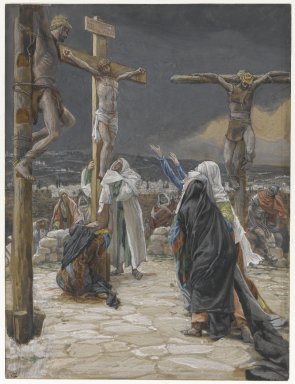
On another note, this poem by Jessica Powers came to mind today.  In this poem, she writes about Mary’s encounter with Christ on the Cross and then her later life, where she lived as a contemplative hermit:

The death of Jesus (James Tissot)

The Blood’s Mystic

Grace guards that moment when the spirit halts
to watch the Magdalen
in the mad turbulence that was her love.
Light hallows those who think about her when
she broke through crowds to the Master’s feet
or ran on Easter morning,
her hair wind-tumbled and cloak awry.
What to her need were the restrictions of
earth’s vain formalities?
She sought, as love so often seeks and finds,
a Radiance that died or seemed to die.

One can surmise she went to Calvary
distraught and weeping, and with loud lament
clung to the cross and beat upon its wood
till Christ’s torn veins spread a soft covering
over her hair and face and colored gown.
She took her First Communion in His Blood.

O the tumultuous Magdalen!  But those
who come upon her in the hush of love
claim the last graces.  A wild parakeet
ceded its being to a mourning dove,
as Bethany had prophesied.  We give
to Old Provence that solitude’s location
where her love brooded, too contemplative
to lift the brief distraction of a wing.
There she became a living consecration
to one remembering.
Magdalen, first to drink the fountained Christ
Whose crimson-signing stills our creature stir,
is the Blood’s mystic.  Was it not the weight
of the warm Blood that slowed and silenced her?

The hands of love

The man born blind

Rate this:

Some things in life are hard to understand and to deal with–especially those terrible  things that happen to the innocent, especially when it’s our own children.  In his ninth chapter, John tells the story of the man born blind.  My brother, Rod, is legally blind as a result of his diabetes, and it has proved a great challenge to him.  I am currently reading the letters of Bede Jarrett, a provincial of the English Province of Dominicans from 1916-1932.  He has a thought-provoking reflection on John 9:

Think what it means to be born blind.  He could do nothing for himself, except what he had learned with great labour and trouble.  It must have seemed the worst possible thing to him.  Think of him as a child, a boy with all his strength for, as far as we know, he was otherwise perfectly healthy, his pent-up energy, and he couldn’t walk, ride or swim without someone coming to help and guide him, and tell him which way to go.  If you described the beauty of a flower, or the bloom of a fruit, to him, it meant nothing; he was born blind.  Horrible, hideous–and yet, what does our Lord say?  The apostles, seeing him, said, ‘Lord, who has sinned, this man or his parents that he should be born blind?’ Of course they put it down to sin (the Pharisees had a doctrine that a man could sin even in his mother’s womb), and our Lord said, ‘Neither hath this man sinned, nor his parents, but that the works of God should be made manifest in him.’ It was just the fact of his being born blind that made the glory of God so manifest.  ‘It has never been heard of since the world began that  man born blind hath received his sight.’ Others, yes, but never one born blind.  So just what seemed so cruel to him turned out to be this wonderful miracle, making manifest the glory of God.
     So we see that all circumstances, however adverse they seem to be to us, are always favorable to God’s plan, always, always, as to the blind man, the best thing for us.
     His hands are strong and powerful hands and we can confidently rest there.  Can we not sometimes see in the hands of a clever artist, or surgeon, the strength and deftness expressive of the mind that directs their action?  But with God, they are not only the hands of power, and not only the hands of wisdom, but of love, and it is only when we leave all things in his hands that we find complete serenity; and then a great peace shall come into our souls.

The blind man washes in the pool of Siloam (James Tissot)

The gift of life

Donating a kidney to my brother gave me a glimpse into God’s desire to give us life.

Rate this:

My brother, Rod, and his wife stopped by for a couple of hours this past Friday on their annual trip to New York to watch a Yankees game.  Three and a half years ago I was able to save his life by donating one of my kidneys to him.  I have to be honest–it didn’t even occur to me to offer when he first told me that he was either going to have to have a transplant or go on dialysis.  (He’s diabetic.)  I got off the phone from that conversation, and then it occurred to me that I could possibly give him one of my kidneys.   So I called him back and offered.  He still tears up when it comes up in conversation.
      You have to go through quite a few tests to determine if you can be a donor–all paid for by the recipient’s insurance.  They want to make sure that you are in good health in order to donate.  I remember before each test begging God that they would just say “yes”.   My desire to save my brother’s life was very great.  It was about half way through the testing process that I realized that the Lord was giving me just a small glimpse into His love for us, His desire to give life to us, to give us His own Son at whatever cost–and because He wanted so badly to do so.
      Well, the doctors kept saying yes, and I was able to donate.  The human body is amazing.  When you donate one, the remaining kidney adjusts to take over for the removed kidney.  Most of the time I forget that I only have one kidney, and when I do remember, I just thank God that I was able to donate.  I’d do it again in a heartbeat.
      My brother wrote me a letter right before surgery.    It’s a treasure I will always keep. I would keep it in that zippered part of my Bible, but it doesn’t really fit.  (See “Courage.”)  I pulled it out today to reread.   It starts: “As we embark on our journey tomorrow, I’d like to say a few things about what you’re doing for me.  I might not have said thank you enough for your gift but I feel you know how I love you for saving my life.”  As I said, he still tears up when we talk about it.  Thinking about that–his continued gratitude to me–convicted me in a new way of how much, much more grateful I should be to the Lord for the gift of life He’s given me, at much more of a cost to Himself than I experienced in order to donate a kidney.  It wouldn’t hurt me to tear up about His gift of life more often . . . .  
     And as I said, I’d do it again in a heartbeat.  And so, I’m sure, would God.

Reluctant prophet

Luci Shaw’s poem, “Reluctant Prophet.”

Rate this:

Continuing in my share-a-poem-with-you-on-Sunday tradition, here’s another one by Luci Shaw:

Reluctant Prophet

Both were dwellers
in deep places
(one in the dark
bowels of ships
and great fish
and wounded pride.
The other–
in the silvery belly
of the seas).

Both heard God saying
“Go!”
but the whale
did as he was told.

God loves ordinary people

“God loves ordinary people. That is why he made so many of us.” (Anthony Esolen)

Rate this:

This is a follow up to “Is my life of any account?” I’ve read this piece by Anthony Esolen in this month’s Magnificat twice now (and will reread it again, I assure you) and thought I would share part of it with you.  It’s from his comments on Gerard Manley Hopkins’ poem, “In Honour of Saint Alphonsus Rodriguez.

    . . . God loves ordinary people.  That is why he made so many of us.  Nor is there any shame in it.  The word suggests order,  the providential design built into our natures as men and women, and into the time and place and created world wherein we dwell.  The Church wisely blesses this order in what we call “ordinary time,” those times of the year when we are not celebrating a great feast such as Christmas or Easter, but cutting the wheat, watering the livestock, mending a fence, baking a loaf of bread, and otherwise merely living with one another with forbearance, a few good fights, some better forgiveness afterwards, and charity above all.  Anyone who does not find the wonder in such a life would probably also not see the beauty of a creek, or the gentle strength of a father’s hand as he rests there, fishing.
     It’s true that we are each of us called to be saints.  But if we suppose that we are all called to be loud and bustling saints, regular Sons (and Daughters!) of Thunder, we do not understand the wonder of the ordinary, and we are probably mistaking vanity for holiness, too.  Gerard Manley Hopkins, priest and poet, made no such mistake.  The man who could see the lush glory of weeds in April, or the shine of good soil after the farmer has tilled it, celebrated also a saint who reached the heights of holiness by being no one important at all.  Saint Alphonsus Rodriguez, a Jesuit, lived at the College of Palma in Majorca for forty years.  His job at that house was simple.  He opened the door to the main hall.  That’s what he did, faithfully and obediently.

Reminds one of Fr. Solanus Casey and Blessed Andre Bessette.  I wonder which one will be opening the door when we get to heaven?

There really is hope for us all. . .

More Figures of the True

Anna’s and Renee’s fairy doors.

Rate this:

I promised in my post, “Figures of the True”, to post the pictures of Anna’s and Renee’s “fairy doors”–as well as a friend of theirs, Carrie’s.  So here they are.   (L to R: Anna’s, Carrie’s, Renee’s) Anna’s has cloth curtains and a rainbow behind the window.  Carrie’s has changeable wreaths.  Renee has “Welcome” over her door.  It makes me wonder what mysteries lie behind the little doors of their souls. . .

Fairy doors

And nothing shall hurt you (2)

Sometimes we do not feel in the least like treading down scorpions and serpents and all the power of the enemy.

Rate this:

Here are the rest of Amy Carmichael’s thoughts on Luke 10:19:

     Sometimes we do not feel in the least like treading down scorpions and serpents and all the power of the enemy.  Perhaps we are allowed to feel our nothingness, so that we may in the depths of our heart understand these other words “Without Me you can do nothing” (John 15.5).  I think there was something of this in our Lord Jesus’ mind, when He told the story of one who had nothing to set before his friend–not a crumb–and it was midnight.  [Cf. Luke 11.5-8] When we do not feel victorious and have nothing to give to others, it is in truth “midnight” in our soul, “the dark night of the soul”, old writers called it.
     But we have  God to Whom we can go at any minute, the weakest minute, the darkest minute, “at midnight”.  “Be Thou my strong habitation, whereunto I may continually resort: Thou hast given commandment to save me; for Thou art my Rock and my Fortress” (Ps 71.3).  And if it be victory over the power of the enemy in our own hearts that we need, He will give us not just crumbs, but loaves–“He will rise and give him as many as he needs” (Luke 11.8).

[For a related link, see “When you feel like you have nothing left to give . . . “]

And nothing shall hurt you (1)

Today and tomorrow I’d like to share a couple reflections from Amy Carmichael (Edges of His Ways).  (Can you tell that I love her writings?)  They both have to do with this passage: “Behold, I have given you authority to tread upon serpents and scorpions, and over all the power of hte enemy; and nothing shall hurt you” (Luke 10:19)

     Our Lord Jesus said this to the seventy: and yet we know that all downthe ages His servants have been hurt in a thousand ways.  So the words must mean, and we know they do mean, something that goes far deeper than bodily hurt, deeper even than disappointment–that hardest hurt the mind can be asked to bear.
     It must mean that our spirits shall tread on serpents and scorpions, and have power over all the enemy.  Nothing shall be able to sting our spirit, poison it, or paralyse it.  It is one of the magnificent promises of the Bible.  We cannot take it too literally.  There is no need to be overcome, whatever happens. “O my soul, thou hast trodden down strength” (Judges 5.21).