You are an icon of Jesus

“Nothing more closely resembles the face of Jesus and of God than the face of a human being, from the most famous to the most miserable.” (Andre Louf)

Rate this:

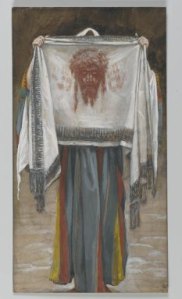
The Holy Face
The Holy Face (James Tissot)

Many of our sisters work with the poor and the marginalized.  Often I hear one or the other of them talking about seeing Jesus “in the distressing disguise of the poor” (Mother Teresa).  This morning I was reading a chapter from Andre Louf’s book, Mercy in Weakness, and came across this: “Nothing more closely resembles the face of Jesus and of God than the face of a human being, from the most famous to the most miserable.”   As I pondered that sentence,  I began to think about how, at the same time as looking for the face of Jesus in others, we need to look for His face in ourselves.  You are I are each an icon of Christ.  As I continued to read the chapter, I came across these confirming words:

The Holy Spirit, from the moment of our baptism, day after day, resculpts in our heart the features of Jesus’ face, not only his physical face but also his ‘spiritual’ face.  Every believer bears the glorious features of Jesus’ face, the holy face of our beloved Saviour, as though it were engraved in his or her heart, usually–sadly enough–without knowing it. 

As we strive to see Christ in others, let’s not miss His beauty in us.  You are an icon of Christ.

Desire to be thoroughly what you are

“Don’t long to be other than what you are, but desire to be thoroughly what you are.” (St. Francis de Sales)

Rate this:

For years I struggled with feeling that I just wasn’t good enough, that who I was wasn’t very likable.  I wasn’t content with just being “me” with the personality and temperament God gave me.  I have often gone back to these three quotes:

Perfection consists in doing His will, in being what He wills us to be.  (St. Therese)

Don’t long to be other than what you are, but desire to be thoroughly what you are.  (St. Francis de Sales)

Most people don’t achieve holiness because they’re fighting who they’re meant to be.  (attr. to Thomas Merton)

(emphasis added)

God made you to be you.  Don’t rob Him of the treasure that you are.  Be fully who He made you to be.

The Garments of God

“The Garments of God”, a poem by Jessica Powers.

Rate this:

The poem I have to share with you this Sunday is another by Jessica Powers:

The Garments of God

God sits on a chair of darkness in my soul.
He is God alone, supreme in His majesty.
I sit at His feet, a child in the dark beside Him;
my joy is aware of His glance and my sorrow is tempted
to nest on the thought that His face is turned from me.
He is clothed in the robes of His mercy, voluminous garments–
not velvet or silk and affable to the touch,
but fabric strong for a frantic hand to clutch,
and I hold to it fast with the fingers of my will.
Here is my cry of faith, my deep avowal
to the Divinity that I am but dust.
Here is the loud profession of my trust.
I need not go abroad
to the hills of speech or the hinterlands of music
for a crier to walk in my soul where all is still.
I have this potent prayer through good or ill:
here in the dark I clutch the garments of God.

Ancient prayer to Mary

Ancient Egyptian prayer to Mary.

Rate this:

On this, our Lady’s day, I thought I would share an ancient prayer to Mary, found on papyrus in Egypt.  (Theotokos means God-bearer.)

Under your
compassion
we take refuge,
Theotokos; do not
overlook our prayers
in the midst of tribulation,
but deliver us
from danger,
O only pure,
only blessed one.

I am nothing but obstacle

“For myself, I am convinced that I am nothing but obstacle.” (St. Ignatius of Loyola)

Rate this:

Ignatius of LoyolaLast year, on All Saints Day, our house began the custom of each sister drawing the name of a saint, one to get to know more and pray to during the year.  I prefaced our drawing of the slips on which were written the saints’ names with the comment that someone once made to me on a bus in Rome: “We often think that it’s our idea to learn more about a particular saint that then becomes our favorite, but in reality the saint is seeking us out and drawing us to him/herself.”  The saint’s name I drew was St. Ignatius of Loyola. 

Today being his feast day, I thought I would look through my two 600 page journals which are mostly made of quotes I have copied into them. (I have them indexed for obvious reasons. 🙂  The only quote I could find by St. Ignatius was:  “For myself, I am convinced that I am nothing but obstacle.”  (Must have struck home when I read it. 🙂  But what I have written next in my journal is this: “But does that put God off?  Absolutely not!  His love pursues me.  ‘The voice of my beloved!  Behold, he comes, leaping over the mountains, bounding over the hills‘ (Song of Songs 2:8).”  He can leap over any obstacle.  What can separate us from the love of Christ? “I am sure that neither death, nor life . . .” (Rom. 8.38).

Those whom He Himself wanted

Jesus calls each of us because He loves us.

Rate this:

Today is the anniversary of my final vows to our community, The Servants of God’s Love.  This morning before Mass I picked up a book I am reading–for the second or third time–Mercy in Weakness, by Andre Louf.  This is what I read: “Jesus called to him those whom he himself wanted” (Mk 3:13).  Of course, this refers to Jesus’ calling of the twelve apostles, but isn’t it just as true for us, each of us–for, yes, He called me to religious life, but it is just as true that He called you to whatever you said yes to in your own lives.  The RSV says: “those whom he desired”.  Think about that today: God called you, and me, out of desire for you.

A person was simply selected because Jesus preferred him, without any further motives.  Jesus chooses the rich and the poor, Jewish nationalists and collaborators, ordinary people and fishermen.  At the moment of selection what matters is not what these people are.  He simply prefers them because he loves them, each one individually.  Nothing other than Jesus’ love and preference explains this selection.

Calling of St. Peter and St. Andrew (James Tissot)

He prefers you because He loves you, short and simple.  And not just when He called you.  Even now.

The heart of God in the words of God

The Hand that holds the seven churches also is laid upon each one of us individually.

Rate this:

One of the things Amy Carmichael has taught me to do is to pay more attention to things like what verse follows a verse, or to the little words in scripture, like “but”.  Here’s an example of a verse following upon a verse:

In the Bible we have ‘the heart of God in the words of God’, as someone said hundreds of years ago; and now here is something for you from the heart of God in the words of God:

                    In His right hand were seven stars.  Rev. 1.16
                   But He laid His right hand upon me, saying, “Fear not.”  Rev. 1.17

Did you ever fear a little as you thought of difficulties ahead?  Did you ever think, ‘The Lord Jesus has so many to take care of, how will He have time to think of me”?  We have the answer to such thoughts here.  It is the Hand that holds the seven stars (the seven churches, all the worlds and the Heaven of heavens), it is that Hand that is laid upon each one of us, and to each one the word is the same, ‘Fear not’.”
     This does not mean that there will not be difficulties and hard fights, and (if we are real soldiers) battle-wounds.  Look at the next ‘Fear not’. ‘Do not fear what you are about to suffer’ (Rev. 2.10).  In the day when those words were written, the things that true Christians were about to suffer were terrific.  But even though we have not to go through torture of the body, we shall all have to endure something which is really suffering, and which God knows is suffering; and so we have the glorious word at the outset, ‘Fear none of these things . . .; be faithful unto death, and I will give you the crown of life.’

Loneliness

Loneliness, along with fear and weakness, is the greatest cause of human suffering.

Rate this:

All of us experience loneliness at different times, and sometimes we experience long seasons of loneliness: when someone we dearly love dies, when we’re going through an illness, when we take on a new responsibility, when we age and are facing death.  I’ve come across some good reflections on loneliness that I thought I would share with you:

I think that part of being human is being alone.  And being lonely.  I think that one of the stresses on a lot of our friendships is that we require the people we love to take away that loneliness.  And they really can’t.  And so, when we still feel lonely, even in the company of people we love, we become angry with them because they don’t do what we think they’re supposed to do.  Which is really something they can’t do for us.  (Rich Mullins)

The grace of loneliness is one of the most precious gifts that God gives to us in our path to sanctity.  (S.C. Biela)

Loneliness is the place of encounter with God.  At the same time, it is a difficult trial of faith.  Therefore, we should never face it by relying on our own strength.  (S.C. Biela)

The Holy Spirit is the answer to our loneliness, which along with fear and weakness, is the greatest cause of human suffering.  What really overcomes loneliness? . . . having a friend, someone to share thoughts with, a companion.  If we are open to him, this is what the Holy Spirit wants to be to us.  It is again St. Basil who says that the Holy Spirit was ‘the inseparable companion’ of Jesus during his life on earth, and that the Spirit wants to be the same for us . . . .
     If it is possible for weakness to provide an occasion for us to experience the strength of the Spirit, it is possible for loneliness to be the occasion and also the stimulus for us to experience the Spirit as ‘sweet guest.’ (Fr. R. Cantalamessa)

Comments?

Thousands of stars

Seeing the stars at night requires deep darkness.

Rate this:

I can across this piece by Fr. Garrigou-Lagrange when I was going through a very dark time of prayer.  What he has to say applies also, of course, to any times of darkness in our lives–times when we can’t see the ending, wondering if it will be good or bad.  (Of course, God works everything for the good, but sometimes it’s hard to even see that, isn’t it?)  Fr. Garrigou-Lagrange writes: “If we are saddened at the approach of twilight, God could well answer us by saying: How can I otherwise reveal to you all those thousands of stars which can only be seen at night?”  Isn’t that the truth–we can only see stars if there is darkness–and a deep darkness at that.  And we can only see certain spiritual things (of just as much beauty as the stars on a clear, clear night) if we walk through certain darknesses that God allows.  “To You I lift up my eyes, O You who are enthroned in the heavens!” (Ps 123.1)  Lift up your eyes!

Stars at night

We conquer by His song

Amy Carmichael’s poem, “We Conquer By His Song”.

Rate this:

My share-a-poem-with-you this Sunday is from Amy Carmichael.

We Conquer By His Song

We see not yet all things put under Thee,
We see not yet the glory that shall be,
We see not yet, and yet by faith we see,
     Alleluia, Alleluia.

We see the shadows gathering for flight,
The powers of dawn dispel the brooding night,
The stedfast march of the triumphant light,
     Alleluia.

Be we in East, or West, or North, or South,
By wells of water, or in land of drouth,
Lo, Thou hast put a new song in our mouth,
     Alleluia.

Therefore we triumph, therefore we are strong,
Thou vision tarry, and the night be long,
For lifted up, we conquer by Thy song,
     Alleluia.

For more on singing, see Never be afraid of singing too much and Come, Christians, Join to Sing.