The passion of patiences

The poem I selected for this Sunday is by Venerable Madeleine Delbrêl, a fascinating woman, a mystic, a missionary, a poet. Not surprising, she took inspiration from St. Charles de Foucauld. Her mysticism led her out to the “little people”.

“He’s with me among the people I encounter today. … All of them will be people he’s come looking for — those he’s come to save. … Through the brothers and sisters who are close to us, whom he will make us to serve, love, and save, waves of his love will go out to the end of the world and the end of time.”
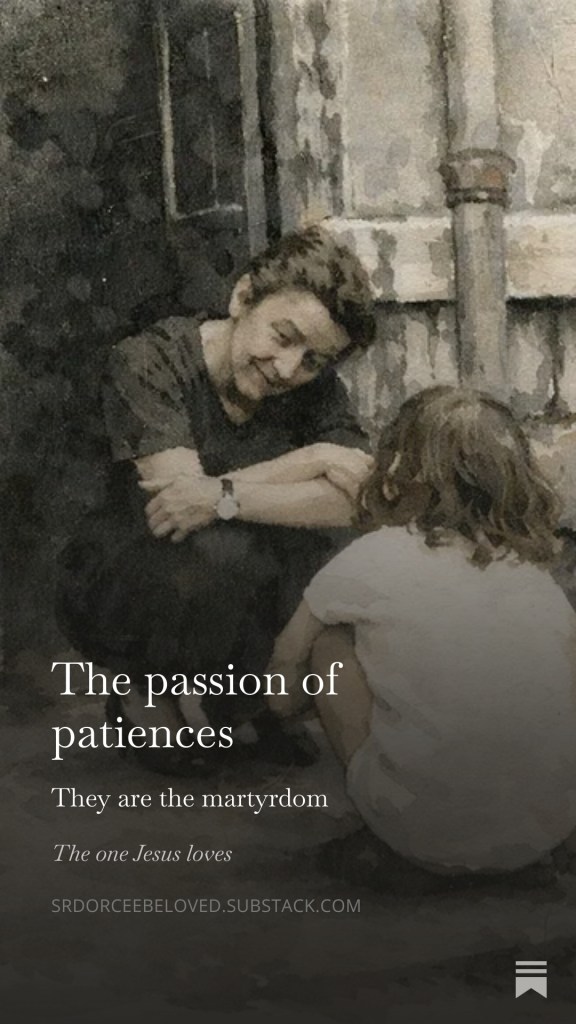
I’ve always loved her writing, her down-to-earth, stab-you-through-the-heart writing. In this poem, she writes about the passion—a most apt topic for Lent—one that we can so easily think about in grandiose terms—how we’re going to lay down our lives for Christ. But Madeleine stabs-us-in-the-heart with what it really means for each of us and challenges us to embrace that reality with the same ardor that we embrace our own self-satisfying ideas of self-denial.

Pray for us, Madeleine.


The passion, our passion, sure we are waiting for it.
We know it must come and of course
we intend to live it with a certain grandeur.
We are waiting for the bell to ring that will inform us
that the time has come for us to sacrifice ourselves.
Like a log in the fireplace,
we know that we have to be consumed.
Like a piece of wool cut with scissors,
we have to be separated.
Like young animals that are sent to slaughter,
we have to be destroyed.
We are waiting for our passion but it does not come.
In its place there come small patiences.
Patiences, those small pieces of the passion whose job it is
to kill us gently for your glory, to kill us without
our getting the glory.

From dawn they come to greet us:
our nerves, either too much on edge or too numb….
It is our disgust with our daily ration of life
and the neurotic desire for all that is not ours.

This is the way our patiences come,
in serried ranks or in single file,
and they always forget to remind us of the fact
that they are the martyrdom for which we were preparing.
And scornfully we let them pass by,
as we wait for a cause that would be worth dying for.
If every redemption is a martyrdom,
not every martyrdom involves the spilling of blood.
From the beginning of our lives to the very end,
one by one,
grapes may be picked from the bunch.
This is the passion of patiences.

Madeleine Delbrêl
Is it time to sit down for lunch?

Each tiny act is an extraordinary event, in which heaven is given to us, in which we are able to give heaven to others.

It makes no difference what we do, whether we take in hand a broom or a pen.  Whether we speak or keep silent.  Whether we are sewing or holding a meeting, caring for a sick person or tapping away at a typewriter.

Whatever it is, it’s just the outer shell of an amazing inner reality: the soul’s encounter, renewed at each moment, in which, at each moment, the soul grows in grace and becomes ever more beautiful for her God.

Is the doorbell ringing?  Quick, open the door!  It’s God coming to love us.  Is someone asking us to do something?  Here you are!  . . . it’s God coming to love us.  Is it time to sit down for lunch?  Let’s go–it’s God coming to love us!

(Madeleine Delbrêl)

“Is the doorbell ringing?”

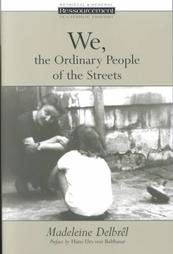
If you have clicked on the “What I’m Reading” tab, you know that one of the books I’m currently reading is We, the Ordinary People of the Streets, the writings of Madeleine Delbrêl, a French woman who lived from 1904-1964.  Similar to Dorothy Day, she converted from atheism to Catholicism which “led her to a life of social work in the atheistic, Communist-dominated city of Ivry-sur-Seine, France.”  Many of her insights are applicable to us who live in a secular-dominated world.  Here’s some of what I read this morning:

We, the ordinary people of the streets, are certain we can love God as much as he might desire to be loved by us.
We don’t regard love as something extraordinary but as something that consumes.  We believe that doing little things for God is as much a way of loving him as doing great deeds.  Besides, we’re not very well informed about the greatness of our acts.  There are nevertheless two things we know for sure: first, whatever we do can’t help but be small; and second, whatever God does is great.
And so we go about our activities with a sense of great peace.
. . . .
Each tiny act is an extraordinary event, in which heaven is given to us, in which we are able to give heaven to others.
It makes no difference what we do, whether we take in hand a broom or a pen.  Whether we speak or keep silent.  Whether we are sewing or holding a meeting, caring for a sick person or tapping away at a typewriter.
Whatever it is, it’s just the outer shell of an amazing inner reality: the soul’s encounter, renewed at each moment, in which, at each moment, the soul grows in grace and becomes ever more beautiful for her God.
Is the doorbell ringing?  Quick, open the door!  It’s God coming to love us.  Is someone asking us to do something?  Here you are!  . . . it’s God coming to love us.  Is it time to sit down for lunch?  Let’s go–it’s God coming to love us!

Let’s let him.