Ancient icons

Sharing two poems this Sunday about icons. I love icons. The first is by Anne Porter. I believe this was one of the first of her poems I ever read and made me fall in love with her poetry.
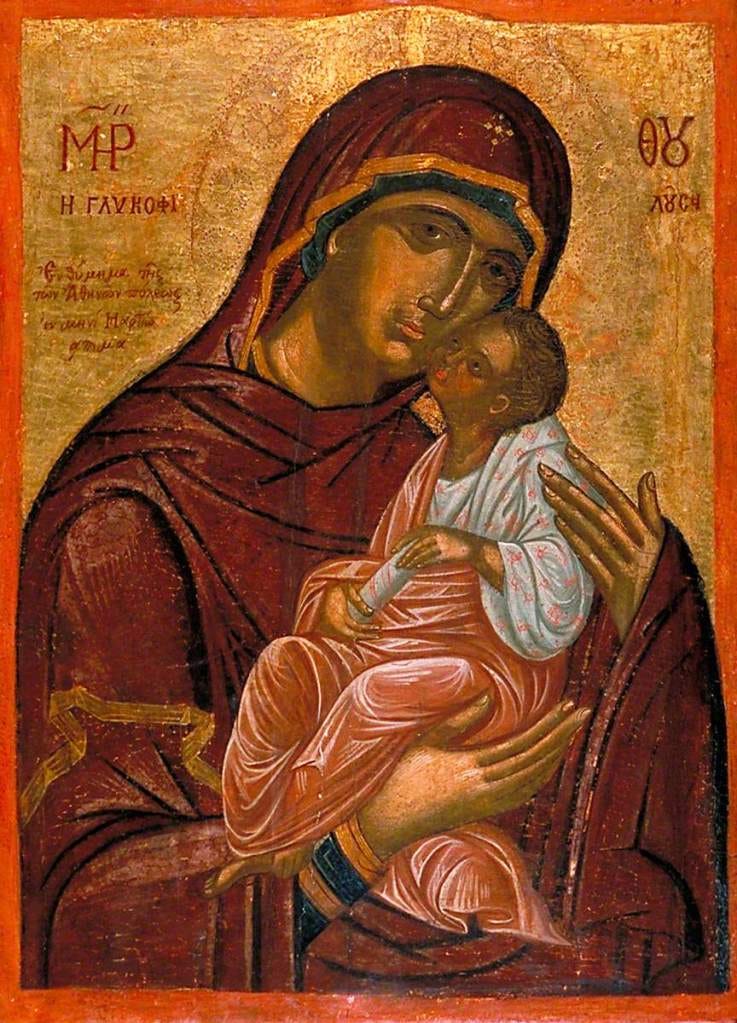
Cretan School; Madonna and Child (Icon of Panagia Glykofilousa): Virgin of Tenderness; Government Art Collection; http://www.artuk.org/artworks/madonna-and-child-icon-of-panagia-glykofilousa-virgin-of-tenderness-28000

The Icon

Here in this icon out of ancient Russia
Brown as amber the little Mother of God
Holding her infant to her cheek
Is present to us
In all her wise
And peaceful sorrow

A forest hermit painted this
They say at night his face
Lit up the snow

He befriended robbers
And often gave
The bears his bread.

Anne Porter

Saint Silouan

This second is by Scott Cairns. I have read his book, Short Trip to the Edge: A Pilgrimage to Prayer, twice now and will probably read it again. Here Scott brings us into the very atmosphere created by icons and candles and incense and poses the question about how we are to bring this beautiful and prayerful culture into the dark world we inhabit.

Orthodoxy

—after Kapouzos [ΝΙΚΟΣ ΚΑΠΟΥΖΟΣ]

Yes, sweet, and very sweet the darkness 
of the nave, and also very sweet 
the observant surround, these icons 
of our ancient fathers and our mothers, 
whose images have acquired a warm 
chiaroscuro from centuries 
of fragrant smoke—incense, beeswax wafting 
for centuries attended by seamless 
petition and praise. Such prayers as these 
yet fill the air with yet another 
palpable sweetness. 
                                    So often, the world 
appears wretched, choked by a broken, 
angry and willfully cruel people. 
So often, the world proves wretched indeed, 
and its darkness is bitter. How then 
to mitigate the assault waiting 
just beyond the narthex? How to carry 
at least some distance into the world 
this fragrance, this sweetness, these images?


Orthodoxy

Last week I listened to a marvelous interview with Scott Cairns whose poetry (and autobiography) I love. I have thought back on it several times since then. I was especially caught by this poem of his and share it as a gift to you this Sunday.

Orthodoxy

by Scott Cairns in the June 2024 issue

—after Kapouzos [ΝΙΚΟΣ ΚΑΠΟΥΖΟΣ]

Yes, sweet, and very sweet the darkness 
of the nave, and also very sweet 
the observant surround, these icons 
of our ancient fathers and our mothers, 
whose images have acquired a warm 
chiaroscuro from centuries 
of fragrant smoke—incense, beeswax wafting 
for centuries attended by seamless 
petition and praise. Such prayers as these 
yet fill the air with yet another 
palpable sweetness. 
                                    So often, the world 
appears wretched, choked by a broken, 
angry and willfully cruel people. 
So often, the world proves wretched indeed, 
and its darkness is bitter. How then 
to mitigate the assault waiting 
just beyond the narthex? How to carry 
at least some distance into the world 
this fragrance, this sweetness, these images?

This poem appears in the June 2024 issue.

Obliged to Sing

I was introduced to Scott Cairns through reading his book, Short Trip to the Edge, a Pilgrimage to Prayer. I put that book in the category of books that not only are about beautiful things but are also beautiful to read.  One I have reread and certainly will again.  Here is a poem of his on poetry and how it serves us.

They Open Us

Scott Cairns

—After Pappas [ΝΙΚΟΣ ΠΑΠΠΑΣ]

Because of this poetry, which, like the Gospel
opens us to waves of unexpected dangers
and elations, which bids the condemned to loosen
his tie as he ambles to the wall to be shot,
and woos meandering millions yet to notice
the brother or sister teetering on the cliff,
compelling that we reach out a hand, deliver
those wretched, belovéd ones to safety, at least,
to momentary safety and, in that moment,
a passing sense that they are not alone; because
of poetry’s vertiginous capacity
to center one’s attention on what might make us
whole, and what might break us, spanning the desolate
hours as well as the blessed, and laving with honey
both corpses and the morning toast, even as it
raps upon the door, unrelenting in its claims;
because of this poetry, rising from the souls,
the ancients of every land, the generations
thereafter, all the radiant host, both famous
and obscure, offering their breath to the flowing
chorus circling the spheres, giving voice to every
exultation, every desolation, ever,
we raise our heads, and do not shirk, obliged to sing.