“But Not Without Wine”

A Sunday-poem from Jessica Powers about our God who is a God of prodigality:

But Not Without Wine

“You are drunk, but not with wine.”  (Isaiah 51.21)

O God of too much giving, whence is this
inebriation that possesses me,
that the staid road now wanders all amiss
and that the wind walks much too giddily,
clutching a bush for balance or a tree?
How then can dignity and pride endure
with such inordinate mirth upon the land,
when steps and speech are somewhat insecure
and the light heart is wholly out of hand?

If there be indecorum in my songs,
fasten the blame where rightly it belongs:
on Him who offered me too many cups
of His most potent goodness–not on me,
a peasant who, because a king was host,
drank out of courtesy.

Adore te devote

The Sunday-poem for this Feast of the Body and Blood of Jesus is the beautiful classic by St. Thomas Aquinas, translated by Gerard Manley Hopkins:

Adore te devote

Godhead here in hiding, whom I do adore
masked by these bare shadows, shape and nothing more,
See, Lord, at thy service low lies here a heart
Lost, all lost in the wonder at the God thou art.

Seeing, touching, tasting are in thee deceived;
How says trusty hearing? That shall be believed;
What God’s Son has told me, take for truth I do;
Truth himself speaks truly or there’s nothing true.

On the cross thy godhead made no sign to men;
Here thy very manhood steals from human ken:
Both are my confession, both are my belief,
And I pray the prayer of the dying thief.

I am not like Thomas, wounds I cannot see,
But can plainly call The Lord and God as he:
This faith each day deeper be my holding of,
Daily make me harder hope and dearer love.

O thou our reminder of Christ crucified,
Living Bread the life of us for whom he died,
Lend the life to me then: feed and feast my mind,
There be thou the sweetness man was meant to find.

Bring the tender tale true of the Pelican;
Bathe me, Jesu Lord, in what they bosom ran–
Blood that but one drop of has the worth to win
All the world forgiveness of its world of sin.

Jesu whom I look at shrouded here below,
I beseech thee send me what I thirst for so,
Some day to gaze on thee face to face in light
And be blest for ever with thy glory’s sight.

The Most Holy Trinity

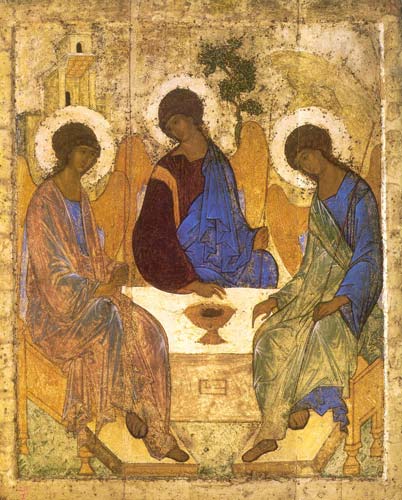
Today is the Feast of the Most Holy Trinity.  How can one use any words to describe this mystery.  The icon above is considered the pre-eminent icon in the Eastern Church written by Rublev to depict the Holy Trinity.  It is based on the visit of the three angels to Abraham. You can read more about it here (which ends with a short meditation by Henri Nouwen).

And here is the poem I chose for this Sunday:

Mute

Must we use words for everything?
Can there not be
A silent, flaming leap of heart
Toward Thee?

Elizabeth Rooney

Power made perfect in infirmity

What is a more powerful expression of the power of the Holy Spirit than His work in our personal lives, especially in our areas of weakness?  This Sunday’s poem is by Mother Mary Francis about that very thing.

A Scriptural Commentary

“For power is made perfect in infirmity” (2 Corinthians 12.9)

Predictable Your power, God,
Who shake the heavens into thunderous roar
And split the skies with lightning at Your glance.

You gaze at oceans and they leap
To speak response in crash of waves
And then subside in wonder at Your feet.

Only to think on seed need You
To see a thousand forests rise to praise You,
Hear treble of small blossoms find their voice.

Wave of Your raised almighty hand’s
Enough to call the sun to rise or set,
To light the sky-dome with ten million stars.

Never will skies impediment Your power
Nor oceans strain Your energies, nor earth
Challenge Your might, stand stubborn before Your gaze.

I do applaud Your power, God.
How effortless Your cosmic sovereignty!
Your easy might is something to admire.

Power is wondrous for no need
Of labor, power issued without threat.
But shall unthreatened power be best praise

Of You, O God? Could greater be
Praise of Your laboring omnipotence
To bend a stubborn heart, to tame a will?

I weep to see You strain to win
So small a prize, tense to achieve
Your purpose, and with all the odds against You.

O God, dear God, what wondrous might
Is Yours displayed in me!
Your power made perfect in my infirmity!

Envoi:  Take, God, the scope I bring You
For play of power. See!
And my own power found at last
In my infirmity.

May 20: Very Early Morning

It’s Sunday and time for me to share a poem.  I love this poem by Luci Shaw.  I think it’s one of the first I ever read of hers and always comes back to mind this time of year.   I hope you enjoy it as much as I do.  I think it’s one that benefits greatly from being read aloud.  (There are shades of Hopkins in this poem.)

May 20: Very Early Morning

All the field praises him/all
dandelions are his glory/gold
and silver all trilliums unfold
white flames above their trinities
of leaves all wild strawberries
and massed wood violets   reflect his skies–
clean blue and white
all brambles/all oxeyes
all stalks and stems lift to this light
all young windflower bells
tremble on hair
springs for his air’s
carillon touch/last year’s yarrow (raising
brittle star skeletons) tells
age is not past praising
all small low unknown
unnamed weeds show his impossible greens
all grasses sing
tone on clear tone
all mosses spread a spring–
soft velvet for his feet
and by all means
all leaves/buds/all flowers cup
jewels of fire and ice
holding up
to his kind morning heat
a silver sacrifice

now
make of our hearts a field
to raise your praise

~Luci Shaw

“. . . for they shall see God”

It’s still the time, the season, of remembering Christ’s appearances to those He loved.  Let us not move too quickly back into ordinary time.  (Is there ever an “ordinary” time with Christ in our lives?)  Luci Shaw captures this need to learn to recognized Him in this Sunday-poem.  We, too, need to “get beyond the way he looks” in our everyday lives:

He who has seen Me has seen the Father (James Tissot)

“. . . for they shall see God”

Matthew 5.8

Christ risen was rarely
recognized by sight.
They had to get beyond the way he looked.
Evidence strong than his voice and face and footstep
waited to grow in them, to guide
their groping from despair,
their stretching beyond belief.

We are as blind as they
until the opening of our deeper eyes
shows us the hands that bless
and break our bread,
until we finger
wounds that tell our healing,
or witness a miracle of fish
dawn-caught after our long night
of empty nets.  Handling
his Word, we feel his flesh,
his bones, and hear his voice
calling our early-morning name.

~Luci Shaw

“He was one of us, no stranger . . .”

The poem for this Sunday describes the experience of the two disciples on the road to Emmaus:

Companion

When first He joined us, coming, it seemed from nowhere,
and yet, somehow, as if he had followed us a long, long time,
immediately, He was one of us, no stranger, but
a close companion, speaking softly, familiar with our lives,
these days, the answers to our doubts.

And when we moved Him to at least partake of food,
he stood there at the table, not as guest, but host,
and broke the bread to portions, one for each,
then poured the wine, His dark-marked hands
blessing the wine and us.  Was it that act,

His broken hands raised up against the wooden walls,
the prayer-bowed head, the gently spoken word
or some reflection trembling in the wine,
a thickening of air, a luminosity not of wavering light,
that pierced our hearts with joy,

that filled our mouths with praise?  O praise!
O joy!  Then suddenly the light withdrawn,
no longer form and lifted hands above the bread.
Stumbling, we found the road to town,
knowing that never, never would we walk alone again.

~Marie J. Post (all rights reserved)

All the doors being shut

A Sunday-poem along yesterday’s lines:

Open

Doubt padlocked one door and
Memory put her back to the other.
Still the damp draught seeped in, though
Fear chinked all the cracks and
Blindness boarded up the window.
In the darkness that was left
Defeat crouched, shivering,
In his cold corner.

Then Jesus came
(all the doors being shut)
and stood among them.

~Luci Shaw

A golden moment

There are so many artistic depictions of the Annunciation, but one of my all-time favorites is one that a good friend of mine gave me a few years ago.  You can see it below.  Not too long afterward I came across a poem by Luci Shaw that seemed to have been written for it.  I share that with you as well.  Thank you, Mary, for your earth-changing yes. . .

Annunciation (golden) 001Virgin

As if until that moment
nothing real
had happened since Creation

As if outside the world were empty
so that she and he were all
there was–he mover, she moved upon

As if her submission were the most
dynamic of all works; as if
no one had ever said Yes like that

As if that day the sun had no place
in all the universe to pour its gold
but her small room

(Luci Shaw)

Royalty

Today’s Sunday-poem is by Luci Shaw:

Royalty

He was a plain man
and learned no latin.

Having left all gold behind
he dealt out peace
to all us wild ones
and the weather.

He ate fish, bread,
country wine and God’s will.

Dust sandaled his feet.

He wore purple only once
and that was an irony.