Room in this inn

A Sunday-poem from Mother Mary Francis, from a longer poem entitled “The Mysteries of the Rosary”:

XIII. The Descent of the Holy Spirit

Fiat!  there’s room in this inn
Of huddled community, Mary,
For you and your telling of Jesus
Over and over again
Until there’s a splitting of heavens
And fire comes and Spirit, and souls

Are drenched with the wine of that Fiat!
That suits men for martyrs.  Is there
Space for us, too, in that upper
Room of your love where first Fiat!
Let God be Man, where first Fireing
Of Spirit enkindled Redeemer?

“Our Lady of the Ascension”

A singular poem about what it was like for our Lady after the Ascension.  How could she stand this separation?

Our Lady of the Assumption

Fold your love like hands around the moment.
Keep it for conference with your heart, that exit
Caught on clocks, by dutiful scribes recorded
Less truly than in archives of yor soul.

Turn back from His going, be His still-remaining.
Lift the familiar latch on cottage door . . .
Discover His voice in corners, hear His footfalls
Run down the porches of your thoughts.  No powers

However hoarse with joy, no Dominations
Curved with adoration guess what whispers
Of “Mother, look!” and “Mother, hurry!”
Glance off the cottage walls in shafts of glory.

How shall your heart keep swinging longer, Mary?
Quickly, quickly, take the sturdy needle
Before your soul crowds through your flesh!  the needle
And stout black thread will save you.  Take the sandal

Peter left for mending.  After that,
The time is short, with bread to bake for John.

Mother Mary Francis

He comes without waiting for us to ask him

Mary arose and went to Elizabeth without Elizabeth having asked her.  This is the way Christ is always with us.  He comes to us without waiting for us to ask Him. May this Feast remind us of that:

The visit that so honored and overwhelmed Elizabeth had not been sought by her: part of the very honor consisted int he fact that Mary had paid it of her own accord. . . . Our God treats us His poor creatures, in the same way. Whether the sinner who needs converting, or the just who is called to a higher life and the way of perfection, be concerned, He alike comes without waiting for us to ask Him.  We are often not thinking of Him specifically at all–we may have forgotten Him; but He seeks us out–goes before us–or as sacred language has it, “prevents” us: we feel and know His grace, suddenly present with us, as the Baptist knew it in his mother’s womb, when we have done absolutely nothing to call it down.  (Jacques Benigne Bossuet)

“. . . when we have done absolutely nothing to call it down.”  What hope-filled words.  A blessed Feast!

“Night is not dark where she shines bright”

That line, taken from the line of a song about Mary, reminds me of a poem by Jessica Powers that Iwould like to share with you this Sunday:

And in her morning

The Virgin Mary cannot enter into
my soul for an indwelling.  God alone
has sealed this land as secretly His own;
but being mother and implored, she comes
to stand along my eastern sky and be
a drift of sunrise over God and me.

God is a light and genitor of light.
Yet for our weakness and our punishment
He hides Himself in midnights that prevent
all save the least awarenesses of Him.
We strain with dimmed eyes inward and perceive
no stir of what we clamored to believe.
Yet I say: God (if one may jest with God),
Your hiding has not reckoned with our Lady
who holds my east horizon and whose glow
lights up my inner landscape, high and low.
All my soul’s acres shine and shine with her!
You are discovered, God; awake, rise
out of the dark of Your Divine surprise!
You own reflection has revealed Your place,
for she is utter light by Your own grace.
And in her light I find You hid within me,
and in her morning I can see Your Face.

“And he who had only a Father now had a Mother too”

I would like to share with you today an excerpt from St. John of the Cross’s “Romances”.  In this poem, John reveals the Heart of God behind the Annunciation and the Incarnation:

7. The Incarnation

Now that the time had come
when it would be good
to ransom the bride
serving under the hard yoke
of that law
which Moses had given her,
the Father, with tender love,
spoke in this way:
“Now you see, Son, that your bride
was made in your image,
and so far as she is like you
she will suit you well;
yet she is different, in her flesh,
which your simple being does not have.
In perfect love
this law holds:
that the lover become
like the one he loves;
for the greater their likeness
the greater their delight.
Surely your bride’s delight
would greatly increase
were she to see you like her,
in her own flesh.”
“My will is yours,”
the Son replied,
“and my glory is
that your will be mine.
This is fitting, Father,
what you, the Most High say;
for in this way
your goodness will be more evident,
your great power will be seen
and your justice and wisdom.
I will go and tell the world,
spreading the word
of your beauty and sweetness
and of your sovereignty.
I will go seek my bride
and take upon myself
her weariness and labors
in which she suffers so;
and that she may have life,
I will die for her,
and lifting her out of that deep,
I will restore her to you.”

8. Continues

Then he called
the archangel Gabriel
and sent him to
the virgin Mary,
at whose consent
the mystery was wrought,
in whom the Trinity
clothed the Word with flesh
and through Three work this,
it is wrought in the One;
and the Word lived incarnate
in the womb of Mary.
And he would had only a Father
now had a Mother too,
but she was not like others
who conceive by man.
From her own flesh
he received the flesh,
so he is called
Son of God and of man.

Revisiting past posts (#3)

I haven’t been feeling well this past week, so I’m behind in posting–as some of you may have noticed.

Today is the feast of St. Juan Diego, and Sunday is the Feast of Our Lady of Guadalupe (which is pre-empted this year by the Third Sunday of Advent), and I hate to see them “lost in the shuffle” so here’s a link to last year’s post: “Let it penetrate your heart”.

My heart, where have you gone?

A poem for this feast of Our Lady of Sorrows:

Christ and His Mother at the Cross

Christ:
Mother, take my broken heart
For your own to share apart.
John, beloved as you are
Shall be to you a son.

John, my mother here behold;
Take her tenderly and hold
her in your love.  For she is cold,
her heart has come undone.

Mary:
Son, your spirit has gone forth.
Son of all surpassing worth.
My eyes are in their vision dark
And dying is my heart.

Hear me, Son, so innocent,
Son of light magnificent
Spending and now spent,
and only darkness for my part.
Son of whiteness and of rose,
Son unrivaled as the snows,
Son my bosom held so close,
My heart, where have you gone?

John, disciple whom he loved,
your brother must be dead,
for I feel the sword through me
as prophesied.

Jacopone da Todi

“O what it must have cost the angels”

Today we celebrate the birth of Mary.  I have to say that this morning when I woke up, I felt like breaking into a little song to her, at least “Happy birthday to you . . .”–which sounds so trite–but I knew in my heart that that would be dear to her . . . because she is that kind of Mother.

I want to share the first verse of a poem by Rilke because I think it conveys the sense of joy in the heavens at the birth of this great gift of God to us.

Birth of Mary

O what must it have cost the angels
not suddenly to burst into song, as one bursts into tears,
since indeed they knew: on this night the mother is being
born to the boy, the One, who shall soon appear.

(Rainer Maria Rilke, translated from the German by M.D. Herter Norton)

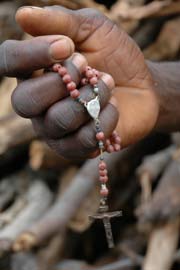
Just holding on to a rosary

On this Saturday, Mary’s day, I want to share this beautiful excerpt from one of Caryll Houselander’s letters (quoted in Magnificat today):

Your own troubles are really very sad indeed; I do feel very deeply for you.  It certainly seems that prayer is the only help–that and taking each trial separately, trying not to look miles ahead with the overwhelming picture of years of succeeding crises to weigh you down.  Prayer does bring such amazing answers that it is reasonable to hope that every separate crisis may be the last: and happiness may come very suddenly, when you least expect it . . .

Do you find help from the rosary?  I find just holding on to it, even, helps.  Of course, some would say that is mere superstition, but it isn’t if it symbolizes holding on to God, as it does for me.  I have been visiting a girl once a week for a doctor; the girl was a baffling nerve case.  She used to have about three attacks a day resembling acute attacks of Saint Vitus’ dance, and followed by palpitations of so violent a nature that the doctors marveled that her heart could stand up to it . . . She had been previously two years in hospital and had seen every specialist, but no one could diagnose her case and she just went on getting worse.  She had no religion, and her only reaction to God–a very vague idea to her–was fear and aversion.

I gave her a rosary and told her to try to say something with it in her hand–her own prayer–or say nothing, but mean to hold on to God.  From the hour she took the rosary into her hand she has been better, and is now almost cured. . . . Her mind has flowered too, literally changed from a narrow self-obsessed mind to a big, objective, clever and loving one.

“I have nothing to offer you.”

On today, Mary’s day, here are some thoughts from Paul Claudel:

Midday.  I see the open church.
It draws me within.
I did not come, Mother of Jesus Christ,
to pray.
I have nothing to offer you.
Nor to ask of you.
I only come, O my Mother,
To gaze at you,
To see you, to cry simply out of joy.
Because I know that I am your child,
And that you are there.
~ Paul Claudel