The cross we bear from others

Sally Read, a poet herself, shared this poem by Sarah Law about Thérèse in her dying, her complete abandonment to God, even to the love of her sisters who were, in fact, inhibiting her dying–and that becomes part of the cross that she embraces.

The Cross

Because she couldn’t breathe–
was wracked with breath’s lack,
too weak to raise herself,

Marie and Céline have lifted her 
half-up from the bed, her
hurting arms spread and held

about their robed shoulders.
Tipped forward, she hangs
on the cross of herself,

as the night light flickers;
the last speck of sand has run
from the hourglass’s lung.

She is heavy as a world,
a dying sun. But Céline–
unready still–flings out her hand

to force the air to move again;
force the sickroom’s minutes back
into their fragile cycle,

and so they ease her down,
and she offers up their love. 

I feel so blessed to have discovered this poet who has an entire book (!) of poems dedicated to Thérèse.
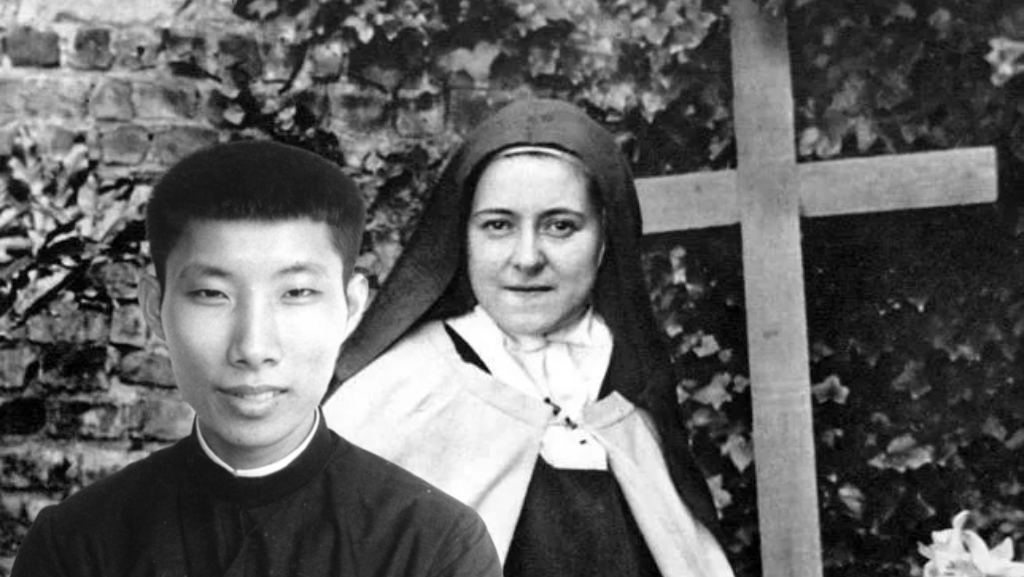
“Oh my God, I am really unhappy!”

It’s been a bit of a rough week for me. This week is bookended by the anniversaries of two of my brothers’ passings, one who died just a year ago and the other many years ago from suicide. Also, another brother (closest to me in age) is currently homeless.

Not too long ago, after having read so much about him at Benjamin Embley’s blog, Contemplative in the Mud, I read Marcel Văn’s Autobiography. Văn had an incredible relationship with St. Thérèse who appeared to him and spoke with him often. I’ve been going back again and again to something she first said to him:

“If on the other hand, you are invaded by sadness, say to him again with an open heart: ‘O my God, I am really unhappy!’ And ask him to help you to accept this sadness with patience. Really believe this: nothing gives as much pleasure to the good God than to see on this earth a heart which loves him, who is sincere with him with each step, with each smile, as well with tears as with little momentary pleasures.”

“So when you speak to the good God, do so quite naturally as if you were talking to those around you.  You can speak to him of anything you wish: of your game of marbles . . . God takes pleasure in listening to you; in fact, he thirsts to hear these little stories which people are too sparing with him.” 

This has been the form of my prayer this week, a little child bringing all to her Father because that is the kind of Father that he is.

Photo from Contemplative in the Mud

And, if I may, could you say a prayer for all of my brothers? Thank you.

It is bliss

I am re-reading Ida Friederike Görres’s book on St. Thérèse, The Hidden Face.  I read the sentence below this morning, a general statement about a happy childhood.  What struck me is that it is, in fact, the description of the experience God means for all of us to have as we grow into the stature of being His child.  It is such an excellent description of the love of God for us:

It is bliss simply to be someone’s child, child of a father, of a mother, living, moving and having its being in a love which is unmerited, unmeritable, anticipatory, unconditional and immutable.

No matter what our own experiences of our parents, this is still absolutely and unequivocally  true for each of us as a child of God the Father.   If you have a minute, read the sentence again slowly, pondering each of those words: “unmerited, unmeritable, anticipatory, unconditional and immutable.”  There is a lifetime of meditation there.  Let yourself taste a bit of the bliss.

We don’t choose our favorite saints; they choose us.

Someone said to me a few years ago: “We don’t choose our favorite saints; they choose us.”  I feel just that way about St. Thérèse of Lisieux.  She’s been a good friend for a long time.  I’ll let her speak for herself:

therese2Perfection seems easy to reach.  I realize that it is sufficient to recognize one’s own nothingness and to abandon oneself as a child in the arms of God. (LT 226)

The poorer you are the more Jesus will love you.  He will go far, very far, in search of you, if at times you wander off a little.  (LT 211)

Keep in mind the method used to make copper objects shine.  You smear them all over with mud, with things that make them dirty and dull; after this operation, they will shine again like gold.   Okay!  Temptations are like this mud for the soul: they serve for nothing less than to make the virtues which are opposed to these same temptations to shine forth.  (CRM 51)

Love knows how to draw profit from everything: from the good and from the bad that is found in us. (LT 142)

O, Mary, if I were Queen of Heaven, and you were Thérèse, I would wish to be Thérèse so that you could be Queen of Heaven.

More quotes from St. Thérèse can be found here.

Fears and emotional wounds as the context for holiness

from Marc Foley’s book on St. Therese of Lisieux, The Context of Holiness (ICS Publications)

“Becoming an adult does not mean that the deep emotional wounds of childhood disappear. Rather, being an adult means choosing to make courageous decisions in the face of powerful emotions.” (p.13)

“When she [Therese] was assigned a job [novice mistress] that she thought was too much for her to handle, she felt overwhelmed, incompetent, unqualified, and inadequate . . . However, Therese does not apologize for her fears. She does not berate herself for feeling like a child; rather her fears and insecurities are the context within which she places her trust in God. It is as if Therese is saying to all of us: ‘There are many situations in life that trigger the deep-seated fears of childhood. I have come to see that this is a normal part of daily life. I have also come to see that our childhood wounds are not obstacles to our spiritual growth but are in some mysterious manner the path on which we find our way back to God. The deep-seated fears of my life have forced me to abandon my self-sufficiency and to rely upon the grace of God.'” (p. 14)

“Therese did not make it a goal to get beyond the effects of her childhood but to do the will of God in the midst of them. Therese understood that the emotional wounds of her childhood were not obstacles to spiritual growth but the context of growing in holiness.” (P. 96)

“Acts of faith are expressed in two ways. The first is our willingness to jump into the darkness, that is, choosing to trust in God’s guidance as we venture into the unknown. The second is our willingness to sit in the darkness, which is continuing to do God’s will when our emotional resources are depleted and life seems hollow, meaningless, and absurd. Therese was willing to sit in this darkness as long as God willed.
“These are the worst times in our life of faith when viewed from a psychological and emotional perspective. But from a spiritual vantage point, they are potentially the best of times. For when we continue to do God’s will without emotional support, our love for God and neighbor grows and is purified.” (pp. 136-7)