Hope is a visor

Some random thoughts about hope:

Hope is a long patience! (Conrad deMeester)

Christ is held by the hand of hope.  We hold him and are held.  But it is a greater good that we are held by Christ than that we hold him.  For we can hold him only so long as we are held by him.  (Paschasius Radbert)

Moaning is connected with hope . . .  (John of the Cross)

Hope allows the soul only a visor that it may look toward heavenly things, and no more.  This is the ordinary task of hope in the soul; it raises the eyes to look only at God.  (John of the Cross)

I have meditated on that last quote quite often. God often narrows our perspective so that we will look only to Him. In St. John’s time, a visor was defined as “on a close helmet, a piece having slits or holes for vision”.   “St. Paul calls hope the helmet of salvation.  A helmet is a piece of armor that protects the entire head and covers it so there is no opening except for a visor through which to see.” (John of the Cross, N.2.21.7) That is what hope should be for us–that slit in our life that narrows our vision to look toward God.   If we could only remember when life seems to be closing in, that it could very well be the hand of God:

I lift my eyes to you,
    to you who have your home in heaven,
eyes like the eyes of slaves
    fixed on their master’s hand;
like the eyes of a slave girl
    fixed on the hand of her mistress,
so our eyes are fixed on the Lord our God,
    for him to take pity on us.  (Ps 123.1-2)

My eyes are always on the Lord . . . . (Ps 25.15a)
Lord, have you forgotten me?

“Lord, have you forgotten me?”

Rate this:

Psalm 77 is another of the psalms that express pain and distress (see yesterday’s post for another).  “My soul refuses to be comforted . . . I am so troubled that I cannot speak. . . . Will the Lord spurn for ever, and never again be favorable?  Has his steadfast love for ever ceased?  Has God forgotten to be gracious?” 

I can recall being on retreat quite a few years ago at a Trappistine monastery in Dubuque.  Our Lady of the Mississippi Abbey is a wonderful and beautiful place to spend a retreat.  It is located on top of a bluff overlooking the Mississippi Valley.  Nonetheless, it had been a long season of dry, dry prayer in my life, and at one point that week I prayed my own version of Psalm 77: “Lord, have you forgotten me?”  (Short and to the point. 🙂  And I heard no answer at the time.

Psalm 77, with all its wonderful and clear expressions of anguish–yes, wonderful, because it is so important to find scriptures that actually express all the movements in our hearts–also includes a few lines of instruction for us when we find ourselves in those places of distress: “I will call to mind the deeds of the Lord; yea, I will remember thy wonders of old.  I will meditate on all thy work, and muse on thy mighty deeds” (vv. 11-12).  If we can only stop to remember at least one thing the Lord has done for us–and there are easily more than one, aren’t there?–then we may experience at least a slight lifting up of our hearts. 

Take time today to remember, to call to mind, at least one way the Lord has blessed you in your life, and let your heart be lifted up, at least a little.

The saddest prayer in the psalter

What do we make of Psalm 88, the saddest prayer in the psalter?

Rate this:

I have always found it a comfort that Night Prayer in the Liturgy of the Hours is primarily made up of psalms for the sick, the lonely, and the distressed.  The Church includes Ps 88 for Friday night, a psalm Derek Kidner refers to in these words: “There is no sadder prayer in the psalter.”  It is a psalm I have prayed myself in true earnest.  It begins: “O Lord, my God, I call for help by day; I cry out in the night before thee. . . . For my soul is full of troubles, and my life draws near to Sheol.  I am reckoned among those who go down to the Pit; I am a man who has no strength. . .” and ends with this verse, “You have turned my friends and neighbors against me, no darkness is my one companion left.” (JB) 
      I appreciate the honesty of the pray-er of this psalm, for we all have days or seasons during which we can identify with him.  What is most important is that it is a prayer.  It is always better to pray out of the honesty of our hearts than to feel that we cannot pray, that what we have to say is too sad or anguished or distressing and thus not acceptable to our God.  What father would not want to hear the anguish of his child? 
      Some final comments from Kidner:

With darkness as its final word, what is the role of this psalm in Scripture?  For the beginning of an answer we may note, first, its witness to the possibility of unrelieved suffering as a believer’s earthly lot.  The happy ending of most psalms of this kind is seen to be a bonus, not a due; its withholding is not a proof of either God’s displeasure or His defeat.  Secondly, the psalm adds its voice to the ‘groaning in travail’ which forbids us to accept the present order as final.  It is a sharp reminder that ‘we wait for adoption as sons, the redemption of our bodies’ (Rom 8.22f).  Thirdly, the author, like Job, does not give up.  He completes his prayer, still in the dark and totally unrewarded.

Kidner goes on to point out that, in fact, the author’s rejection was only apparent:

This supposedly God-forsaken author seems to have been one of the pioneers of the singing guilds set up by David, to which we owe the Korahite psalms (42-49; 84f.; 87f.), one of the richest veins in the Psalter.  Burdened and despondent as we was, his existence was far from pointless.  If it was a living death, in God’s hands it was to bear much fruit.

Let your anguish be a prayer.  In His hands it will bear much fruit.

I am nothing but obstacle

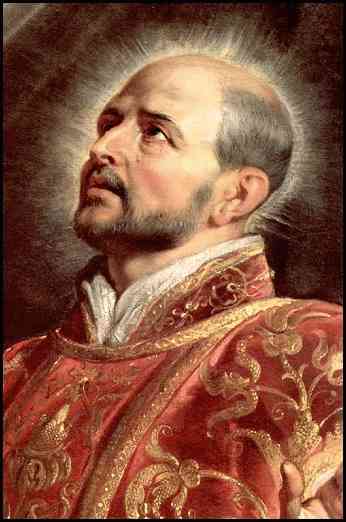
“For myself, I am convinced that I am nothing but obstacle.” (St. Ignatius of Loyola)

Rate this:

Ignatius of LoyolaLast year, on All Saints Day, our house began the custom of each sister drawing the name of a saint, one to get to know more and pray to during the year.  I prefaced our drawing of the slips on which were written the saints’ names with the comment that someone once made to me on a bus in Rome: “We often think that it’s our idea to learn more about a particular saint that then becomes our favorite, but in reality the saint is seeking us out and drawing us to him/herself.”  The saint’s name I drew was St. Ignatius of Loyola. 

Today being his feast day, I thought I would look through my two 600 page journals which are mostly made of quotes I have copied into them. (I have them indexed for obvious reasons. 🙂  The only quote I could find by St. Ignatius was:  “For myself, I am convinced that I am nothing but obstacle.”  (Must have struck home when I read it. 🙂  But what I have written next in my journal is this: “But does that put God off?  Absolutely not!  His love pursues me.  ‘The voice of my beloved!  Behold, he comes, leaping over the mountains, bounding over the hills‘ (Song of Songs 2:8).”  He can leap over any obstacle.  What can separate us from the love of Christ? “I am sure that neither death, nor life . . .” (Rom. 8.38).

Those whom He Himself wanted

Jesus calls each of us because He loves us.

Rate this:

Today is the anniversary of my final vows to our community, The Servants of God’s Love.  This morning before Mass I picked up a book I am reading–for the second or third time–Mercy in Weakness, by Andre Louf.  This is what I read: “Jesus called to him those whom he himself wanted” (Mk 3:13).  Of course, this refers to Jesus’ calling of the twelve apostles, but isn’t it just as true for us, each of us–for, yes, He called me to religious life, but it is just as true that He called you to whatever you said yes to in your own lives.  The RSV says: “those whom he desired”.  Think about that today: God called you, and me, out of desire for you.

A person was simply selected because Jesus preferred him, without any further motives.  Jesus chooses the rich and the poor, Jewish nationalists and collaborators, ordinary people and fishermen.  At the moment of selection what matters is not what these people are.  He simply prefers them because he loves them, each one individually.  Nothing other than Jesus’ love and preference explains this selection.

Calling of St. Peter and St. Andrew (James Tissot)

He prefers you because He loves you, short and simple.  And not just when He called you.  Even now.

The heart of God in the words of God

The Hand that holds the seven churches also is laid upon each one of us individually.

Rate this:

One of the things Amy Carmichael has taught me to do is to pay more attention to things like what verse follows a verse, or to the little words in scripture, like “but”.  Here’s an example of a verse following upon a verse:

In the Bible we have ‘the heart of God in the words of God’, as someone said hundreds of years ago; and now here is something for you from the heart of God in the words of God:

                    In His right hand were seven stars.  Rev. 1.16
                   But He laid His right hand upon me, saying, “Fear not.”  Rev. 1.17

Did you ever fear a little as you thought of difficulties ahead?  Did you ever think, ‘The Lord Jesus has so many to take care of, how will He have time to think of me”?  We have the answer to such thoughts here.  It is the Hand that holds the seven stars (the seven churches, all the worlds and the Heaven of heavens), it is that Hand that is laid upon each one of us, and to each one the word is the same, ‘Fear not’.”
     This does not mean that there will not be difficulties and hard fights, and (if we are real soldiers) battle-wounds.  Look at the next ‘Fear not’. ‘Do not fear what you are about to suffer’ (Rev. 2.10).  In the day when those words were written, the things that true Christians were about to suffer were terrific.  But even though we have not to go through torture of the body, we shall all have to endure something which is really suffering, and which God knows is suffering; and so we have the glorious word at the outset, ‘Fear none of these things . . .; be faithful unto death, and I will give you the crown of life.’

The hands of love

The man born blind

Rate this:

Some things in life are hard to understand and to deal with–especially those terrible  things that happen to the innocent, especially when it’s our own children.  In his ninth chapter, John tells the story of the man born blind.  My brother, Rod, is legally blind as a result of his diabetes, and it has proved a great challenge to him.  I am currently reading the letters of Bede Jarrett, a provincial of the English Province of Dominicans from 1916-1932.  He has a thought-provoking reflection on John 9:

Think what it means to be born blind.  He could do nothing for himself, except what he had learned with great labour and trouble.  It must have seemed the worst possible thing to him.  Think of him as a child, a boy with all his strength for, as far as we know, he was otherwise perfectly healthy, his pent-up energy, and he couldn’t walk, ride or swim without someone coming to help and guide him, and tell him which way to go.  If you described the beauty of a flower, or the bloom of a fruit, to him, it meant nothing; he was born blind.  Horrible, hideous–and yet, what does our Lord say?  The apostles, seeing him, said, ‘Lord, who has sinned, this man or his parents that he should be born blind?’ Of course they put it down to sin (the Pharisees had a doctrine that a man could sin even in his mother’s womb), and our Lord said, ‘Neither hath this man sinned, nor his parents, but that the works of God should be made manifest in him.’ It was just the fact of his being born blind that made the glory of God so manifest.  ‘It has never been heard of since the world began that  man born blind hath received his sight.’ Others, yes, but never one born blind.  So just what seemed so cruel to him turned out to be this wonderful miracle, making manifest the glory of God.
     So we see that all circumstances, however adverse they seem to be to us, are always favorable to God’s plan, always, always, as to the blind man, the best thing for us.
     His hands are strong and powerful hands and we can confidently rest there.  Can we not sometimes see in the hands of a clever artist, or surgeon, the strength and deftness expressive of the mind that directs their action?  But with God, they are not only the hands of power, and not only the hands of wisdom, but of love, and it is only when we leave all things in his hands that we find complete serenity; and then a great peace shall come into our souls.

The blind man washes in the pool of Siloam (James Tissot)

Reluctant prophet

Luci Shaw’s poem, “Reluctant Prophet.”

Rate this:

Continuing in my share-a-poem-with-you-on-Sunday tradition, here’s another one by Luci Shaw:

Reluctant Prophet

Both were dwellers
in deep places
(one in the dark
bowels of ships
and great fish
and wounded pride.
The other–
in the silvery belly
of the seas).

Both heard God saying
“Go!”
but the whale
did as he was told.

The pharisee became the publican

The parable of the Pharisee and the publican applied with a new twist.

Rate this:

The Pharisee and the Publican (James Tissot)Another thing that can cause me discouragement sometimes is dealing with besetting sin–you know that thing you keep taking back to confession over and over.  One of mine is critical thinking.  A few years ago I read Sr. Ruth Burrow’s autobiography, and in it she spoke about this being one of her ongoing faults as well.  However, she found what I think is a very clever way to deal with it:

Perceptive, quick to see the flaws in another, I was prone to criticism, finding a certain satisfaction in seeing another at fault as though this, in some way, raised me up.  I knew that no fault would so displease our Lord or stop his grace as this harsh judgment on his children.  I realized I had the mentality of a pharisee but, I thought to myself, if a pharisee had turned to our Lord and admitted his hardness of heart, his crabbed, mean spirit and asked for help, our Lord would have helped him.  So I did the same.  The pharisee became the publican.  I came to realize that temptations to pride, the sin of the pharisee, could make one a publican.  The stone which the builders rejected could become head of the corner.  I tried to use these bad tendencies to grow in humility.

And the Angels danced, don’t you think?

Parable of the Talents (3)

“Everything that happens is for me a message of the excessive love of God for my soul.”

Rate this:

Continuing from The Gift of Faith:

Only a person who has faith is able to be grateful for everything.  This gratitude will be visible on your face as joy; for everything may be changed into good.  This reflection about talents refers to the teaching of St. Paul and to the famous thesis of St. Augustine: ‘For the ones who love God, all things work for good, even sin’ (Rom 8:28).  Therefore, even a fall, which is a great misfortune, can be an opportunity within which is hidden some kind of talent given to you in that situation, from which you can profit.  You only need your faith or your conversion towards such faith which will enable you to look through the eyes of Jesus.

Thinking along these lines can be transformational.  I can’t help but think of a quote of Bl. Elizabeth of the Trinity: “Everything that happens is for me a message of the excessive love of God for my soul.”  And as Amy Carmichael would say: “Everything means everything.”  There’s a lot to be meditated on in just the word “excessive” . . .  I can remember many times when I’ve said this quote out loud to myself in the midst of something that didn’t feel like His excessive love.  Sometimes it’s big things–like being elected superior–but most of the time it’s little things, like those interruptions that I don’t like or changes of plans.  (You can see where my self-centeredness lies . . .)   Yet if I can just remember that my self-centeredness is indeed also a “talent” . . .