Don’t just bump into Jesus

The Gospel reading for today tells the story of Christ healing the woman who had been hemorrhaging for twelve years.  Many people were bumping up against Him, but she alone reached out to Him in faith.  Dr. Mary Healy challenges each of us: “The afflicted woman in this episode is a model for approaching Jesus.  While crowd of people were bumping into him as he walked along, she touched him.  Her faith brought her into living contact with Jesus, and as a result she experienced a dramatic healing.  The difference between the crowds and the woman prompts the question: How often do we merely bump against Jesus—for instance, when we receive Him in the Eucharist?”

“You shall have grace sufficient . . . “

Last week, in his Wednesday audience, Pope Benedict spoke of St. Paul and his ability to find the strength of God in his weakness.  Commenting on Paul’s petition to be delivered from the thorn in his flesh, Pope Benedict said:

Let us reflect a moment more on this event, which occurred during the years when St. Paul lived in silence and contemplation before commencing his journeys across the West to proclaim Christ, for this attitude of profound humility and trust before God’s self-revelation is also fundamental for our prayer and for our lives, for the way we relate to God and to our own weakness.

First, what is the weakness of which St. Paul speaks? What is this “thorn” in his flesh? We don’t know, and he doesn’t say, but his attitude makes us understand that all the difficulties we meet in following Christ and witnessing to his Gospel can be overcome by opening ourselves in faith to the Lord’s action. St. Paul is well aware of being a “useless servant” (2 Corinthians 4:7) in whom God places the riches and power of his grace. In this moment of intense contemplative prayer, St. Paul understands clearly how to face and live every event, especially suffering, difficulty and persecution: when he experiences his own weakness, the power of God is manifested, which neither abandons us nor leaves us alone but which becomes our support and strength.

Certainly, Paul would have preferred to be delivered from this “thorn”, from this suffering; but God says: “No, this is necessary for you. You shall have grace sufficient to resist and to do what must be done”. This is true also for us. The Lord may not deliver us from evil, but he helps us to mature through suffering, difficulty and persecution. Faith, then, tells us that if we remain in God, “though our outer nature is wasting away, our inner nature is being renewed every day” (cf. Verse 16). The Apostle communicates to the Christians of Corinth and also to us that “this slight momentary affliction is preparing for us an eternal weight of glory beyond all comparison” (Verse 17). In reality, humanly speaking, the weight of difficulty was not light, it was exceedingly heavy; but compared with God’s love, with the grandeur of being loved by God, it seemed light in knowing that the weight of glory will be without measure.

Therefore, as our union with the Lord grows and our prayer intensifies, we too come to focus on the essential, and we understand that it is not through the power of our resources, our virtue, or our abilities that the Kingdom of God shall come; rather, it is God who works marvels precisely through our weakness, through our inadequacy for the task at hand. We must therefore have the humility not to trust in ourselves alone but to work — with the Lord’s help — in the Lord’s vineyard, entrusting ourselves to Him as fragile “earthen vessels”.

These are words for us all and should give us each hope.  You can read his entire address here.

“for you loved them . . .”

This morning I opened my Liturgy of the Hours to the Office of Readings for today (Tuesday, Week II, Ordinary Time).  The first psalm to be prayed is Psalm 44.  In the American Liturgy of the Hours, before each psalm there are two subheadings.  The first is a summary of the psalm.  The second is a Scripture verse or a saying of the Fathers that situates the psalm in the context of its New Testament fulfillment in Christ.    “… the Fathers of the Church saw the whole psalter as a prophecy of Christ and the Church and explained it in this sense…” (Bl. John Paul II).  I try to make it a habit of pausing before I pray each psalm to reflect on the two subheadings, especially so I can pray them remembering how they are fulfilled in Christ.

The first subheading for Psalm 44 is “The misfortune of God’s people”.  An apt summary.  The psalm describes national disaster and a search for God in the midst of it.  “Awake, O Lord, why do you sleep?  Why do you hide your face from us and forget our oppression and our misery?”

From that first subheading to the second, I have drawn an arrow in my book.  The reason is to draw my attention to the wonderful news that we have in Christ.  The second subheading is this from Romans 8.37: “We triumph over all these things through him who loved us.”  What a wonderful word!

Open all your windows

Something from Amy Carmichael:

1 John 4:18  There is no fear in love, but perfect love casts out fear.  For fear has to do with punishment, and he who fears is not perfected in love.

Let us take time today to consider the love of God.

Some of us are tempted to fear about ourselves.  What about tomorrow?  Shall we be able to go on?  Perfect love casts out fear.  Love God and there will be no room for fear, for to love is to trust and if we trust we do not fear.

Some of us are tempted to fear the future.  There again perfect love casts out fear.  He who has led will lead.  It quickens love and encourages faith to think of all that God has done.  He has not brought us so far, to leave us now.

So let us open all our windows and our doors to the great love of God.  Love is like light.  It will flood our rooms if only we open to it.  Let us take time today to open more fully than ever before to the blessed love of God.

Now we know in part

Most of the time we walk around thinking we know what’s going on and forgetting that we only “know in part” (1 Cor 13.12), but every once in awhile God gives us a peek into what is really going on.  Here is a delightful story of someone to whom that happened: “When You Get to Turn the Chair Around.”  May it strengthen your hope for those days when you do know that you can’t understand and need to hold on in faith.

Friday: from the archives

(First posted October 7, 2009)

The Age Long Minute

The title of this post comes from a meditation by Amy Carmichael on Ps 107.29-30: He made the storm be still, and the waves of the sea were hushed.  Then they were glad because they had quiet, and he brought them to their desired haven.  I have to say that my first thought after reading Then they were glad because they had quiet, was: “This verse must mean a lot to parents of toddlers and teenagers!”  Amy’s reflection was other–and deeper–than mine.

jesus-walking-on-the-water“Then they were glad because they had quiet;” the words were music to me.  Then in reading the different stories of the Lord calming the sea, I found this: “He came to them . . . and meant to pass by them” [Mk 6.48].  The more literal the translation the more startling it is.  As I pondered the matter I saw that this “age-long minute” was part of the spiritual preparation of these men for a life that at that time was unimagined by them–a life of dauntless faith and witness in the absence of any manifestation of the power of the Lord; and it must be the same today.  Such minutes must be in our lives, unless our training is to be unlike that of ever saint and warrior who ever lived.  Our “minute” may seem endless–”How long wilt Thou forget me,” cried David out of the depths of his–but perhaps looking back we shall in such an experience a great and shining opportunity.  Words are spoken then that are spoken at no other time . . .  We have a chance to prove our glorious God, to prove that His joy is strength and that His peace passeth all understanding, and to know the love of Christ that passeth knowledge.And the “minute” always ends in one way, there is no other ending recorded anywhere: “But immediately he spoke to them, and said, ‘Take heart, it is I; have no fear” . . . and the wind ceased” [Mk 6.50].
“Then they were glad because they had quiet; and he brought them to their desired haven.”
(Edges of His Ways, pp. 143-44)

If you feel that you are in “an age-long minute”, have hope–He is coming to you and will bring you to your desired haven.

Our high calling

Luke 6:28  Pray for those who abuse you.

In these days where we find ourselves unliked as Catholics for our stance on so many things, we would do well to heed Amy Carmichael’s advice regarding this Scripture passage–actually this is good advice regarding anyone we may find difficult:

Are there any who are making your burdens heavier than they need be?  Sometimes very small things can make our burdens feel heavier.  The temptation always is to resent this, and feel ruffled.

The Lord Jesus says to us, “Pray for those who compel you to carry burdens.”  Don’t talk about them to others, unless that talk will bear the scrutiny of the Lord Jesus Christ.  Don’t talk about them to yourself.  Look up to your Father for them.  Pray that their burden may be lightened.  (Perhaps they have some of which you know nothing.)  Pray, and as you pray, love will flow into your heart for them.

And I did not know it.

In Genesis 28, Jacob, after his dream of the ladder, says a very profound thing: “Surely the Lord is in this place; and I did not know it.”  How many of us do not recognize that the Lord is in the very places of our lives.  We wonder: “Where are You?”  Or we shout: “Where are You?”  And like Jacob, we fail to see that He is surely in this place.

In a marvelous little book, Into Your Hands, Father, Fr. Wilfrid Stinissen writes:

“There is not a single moment when God is not communicating himself to us.  Most of what occurs in our lives seems to happen accidentally and at random.  Now and then God reveals his presence. At times we see the thread and we thank him, but he is always there; everything speaks of him.” There is an unbroken continuity in God’s action.  ‘He who keeps you will not slumber.  Behold, he who keeps Israel will neither slumber nor sleep’ (Ps 121.3-4).  We sleep for the most part.  Yes, our faith sleeps.  We do not notice anything extraordinary.  In reality, everything is extraordinary.”

May God bless each of you as you go about your extraordinary days!

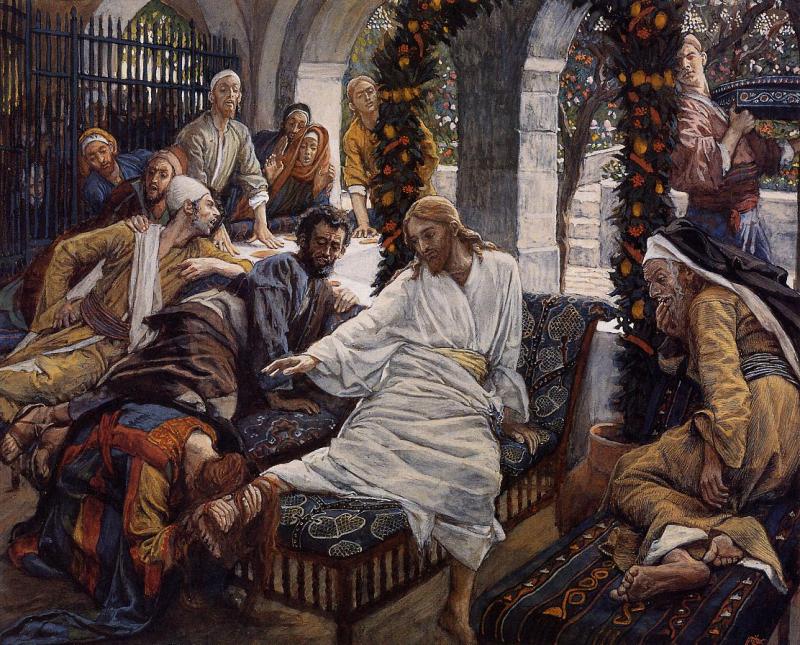
Put yourself in this woman’s place

Jesus does not want our sins, our weaknesses and faults, to keep us from coming to Him, to keep us from intimacy with Him.  I post again this painting by James Tissot.  Put yourself in this woman’s place, a great sinner.  Touch His feet, kiss His feet.  And see the Lord reaching out to you in His tender love.

He said to Simon the Pharisee, “You gave me no kiss . . . ” (Lk 7.45).  The Lord of Love will miss your kiss if you don’t draw near to Him . . .

The storehouse of our mind

When you find yourself in the middle of a trial, is there a verse from Scripture that wells up from your heart to sustain you?  I hope that is the case for you.  Amy Carmichael writes about the importance of filling the “storehouse of our mind” with the riches of the Scriptures so that we may find strength in time of need.

1 Cor 1.3  Blessed be God, even the Father of our Lord Jesus Christ, the Father of mercies, and the God of all comfort.

In one of his letters, Adolph Monod tells how he found in his hardest moments that it was enough to take firm hold on a single promise.  It sustained him the the sorest difficulties.  He loved the words Father of Compassions, as 2 Corinthians 1.3 has it in French.

When one is in great pain or trouble, or caught suddenly by fierce temptation, it is the word of strength or comfort that is set deep in the memory that takes life.  It speaks in a new tone, and becomes to us at that moment more than we could have ever believed it would be.  John 14.26 explains this: But the Comforter, which is the Holy Ghost . . . He shall teach you all things, and bring all things to your remembrance, whatsoever I have said unto you.

So let us fill the storehouse of our mind with the treasure of God’s word.  Every day offers opportunities.  When we go to bed tonight, let us think, “What treasure did I put in my storehouse today?”