Being willing to undertake the journey

I am reading a remarkable book by Chief Rabbi Jonathan Sacks, Covenant and Conversation, a Weekly Reading of the Jewish Bible.  This volume concerns the book of Genesis and contains many insights and reflections by this wonderful man, such as this one:

Faith is the ability to live with delay without losing trust in the promise; to experience disappointment without losing hope, to know that the road between the real and the ideal is long and yet be willing to undertake the journey.  That was Abraham’s and Sarah’s faith, and that of Moses and the prophets and those who came after them.  And surely it must be ours.  God delivers all He promises, but not always when we expect. . . . To wait without despair, to hope and keep on hoping: that is the faith of Abraham and Sarah’s children, the faith that they themselves lived.  And though it was shot through with disappointments, and though they themselves sometimes gave expression to their doubts and fears, it did not prove in vain.”

Why? Why? Why?

[I was out of town and then came down with a nasty head cold . . . thus, my absence this past week.]

Today’s reading from Amy Carmichael’s Whispers of Power:

Mt 11.6 And blessed is he, who shall not be offended in Me.

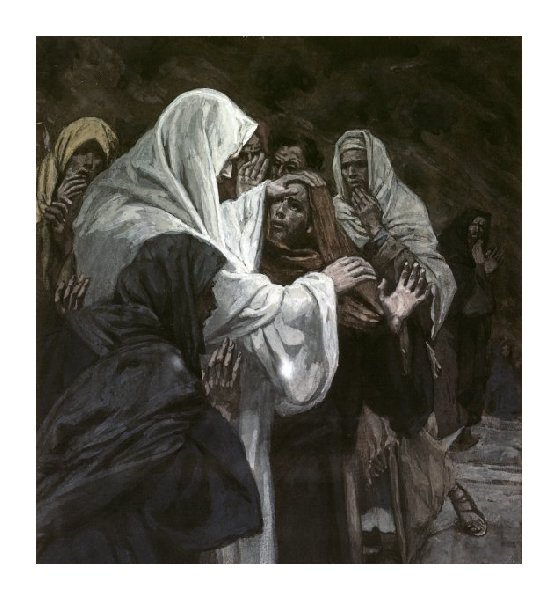
All of us are sometimes troubled by questions.  Why is the secret of healing not opened more fully?  Why is that key not put into wise and loving hands?  Why does He whose touch has not lost its ancient power not come immediately and touch and heal?  Why have the wicked such awful power?  Why are we ourselves sometimes like the little ship on the sea of Galilee beaten by the winds?  And even after we have heard our dear Lord’s Peace, be still, why is it that there is not always instantly a great calm, a lasting calm?  Why do the winds return again?

We could go on forever, piling question on question.  Why?  Why?  Why?

But faith is not “trusting God when we understand His ways”–there is no need for faith then.  Faith is trusting when nothing is explained.  Faith rests under the Unexplained.  Faith enters into the deep places of our Lord’s words.  And blessed is he, who shall not be offended in Me.  Faith, having entered into those deep places, stays there in peace.

The storehouse of our mind

When you find yourself in the middle of a trial, is there a verse from Scripture that wells up from your heart to sustain you?  I hope that is the case for you.  Amy Carmichael writes about the importance of filling the “storehouse of our mind” with the riches of the Scriptures so that we may find strength in time of need.

1 Cor 1.3  Blessed be God, even the Father of our Lord Jesus Christ, the Father of mercies, and the God of all comfort.

In one of his letters, Adolph Monod tells how he found in his hardest moments that it was enough to take firm hold on a single promise.  It sustained him the the sorest difficulties.  He loved the words Father of Compassions, as 2 Corinthians 1.3 has it in French.

When one is in great pain or trouble, or caught suddenly by fierce temptation, it is the word of strength or comfort that is set deep in the memory that takes life.  It speaks in a new tone, and becomes to us at that moment more than we could have ever believed it would be.  John 14.26 explains this: But the Comforter, which is the Holy Ghost . . . He shall teach you all things, and bring all things to your remembrance, whatsoever I have said unto you.

So let us fill the storehouse of our mind with the treasure of God’s word.  Every day offers opportunities.  When we go to bed tonight, let us think, “What treasure did I put in my storehouse today?”

“Strengthened by Faith”

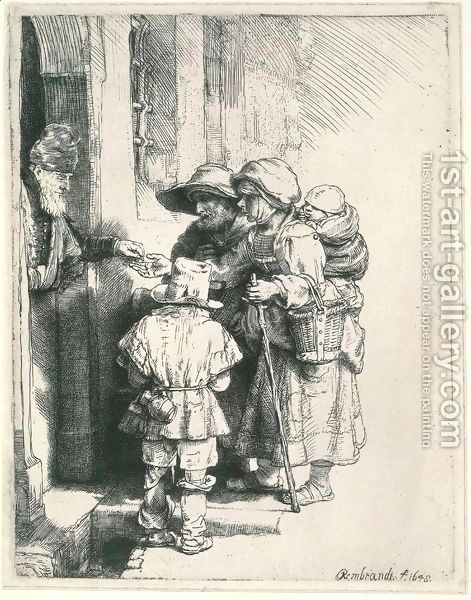
It may happen that for a certain time a man is illumined and refreshed by God’s grace, and then this grace is withdrawn.  This makes him inwardly confused and he starts to grumble; instead of seeking through steadfast prayer to recover his assurance of salvation, he loses patience and gives up.  He is like a beggar who receives alms from the palace, and feels put out because he is not asked inside to dine with the king.  “Blessed are those who have not seen and yet have come to believe” (John 20.29).  Blessed also are those who, when grace is withdrawn, find no consolation in themselves, but only continuing tribulation and thick darkness, and yet do not despair; but, strengthened by faith, they endure courageously, convinced that they do indeed see him who is invisible.  (St. John of Karpathos)

Advent journey

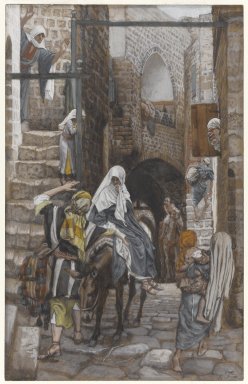
This morning I was meditating on Joseph and Mary’s Advent journey to Bethlehem.  So often, I think, we would like our own Advents to be peaceful and calm and balk interiorly–if not exteriorly as well–at inconveniences and grouchy children (and husbands), at interruptions and long lines, etc.  And then there are those even more serious situations that we may be facing: the death of a loved one, possible foreclosure on our house, unemployment . . .  When we think about what the journey to Bethlehem realistically consisted of, we might do well to join ourselves spiritually to Mary and Joseph in their journey, begging God to give us those same graces.

Here is an excerpt from Come, Lord Jesus–Meditations on the Art of Waiting, by Mother Mary Francis, published posthumously:

We think about our Lady on the way to Bethlehem.  Do we really think deeply enough about what she suffered?  And about Saint Joseph’s suffering?  How do we think he felt to take her off in her condition of expectancy, riding the mule to Bethlehem?  Her heart must have been tempted to question, “Why is this?”  And surely his heart was tempted to question.  Neither was supine; these were real people.

There are struggles asked of us, as were asked of them.  And the answer is faith.  We will see later on, of course, in the Scriptures, that it says very plainly that she didn’t understand what Jesus said to them after those three days’ loss.  And she asked him, “Why did you do that?”  Those words, in a sense, sum up her whole relationship with the Son of God, who was the Son of her womb.  And he gives her an answer that she doesn’t understand at all.  He says to all of us, in a different place in the Scriptures, “What I am doing you cannot understand now, but later you will understand.”  That is a precious thought to hold in our hearts.  How many times we say, “I just don’t understand this”, and he says, “One day you will understand.”

In the inevitable struggles of life–and the struggles of these special days–we don’t need to understand.  We just need to respond, and then to hear him say, “One day you will understand.  One day I will explain everything to you–except when that day comes, you won’t need to ask.”  (pp. 103-104)

Who would you rather listen to?

A  few weeks ago I posted a selection from Christopher de Vinck’s The Power of the Powerless. Since then I’ve been dipping into other books of his, including Finding Heaven, Stories of Going Home.  Here’s a selection from that book:

A Prediction to Believe In

We are inundated with predictions these days.  Political commentators predict the outcomes of elections before the final votes are tallied.  Meteorologists predict snowstorms before even a single flake floats down from the mercurial sky.  We rely on soothsayers and statisticians to determine the outcome of a football game and the behavior of the stock market.  Some people in Japan claim that they can detect an illness before it strikes by scrutinizing the soles of people’s feet.  There are those who fear that the world will end in 2012, because that’s when the Maya calendar runs out.  People in India visit the town of Kanchipuram and pay to have their lives predicted by people who read palm leaves.

Sometimes it’s entertaining to see whether or not predictions come true.  When I was fifteen years old, our black cat, Moses, deposited a wiggling, pink, four-legged newborn creature on the back porch.  No one knew what type of animal it was, but everyone had an idea.  My brother said it was a kitten.  My sister said it would grow up to be a pig.  “It’s a rat,” I announced with confidence.  My mother looked down with concern.  “Well, whatever it is,” she said, “it’s hungry.”

I quickly found a new eyedropper in the medicine cabinet, heated some milk on the stove, and tried feeding the mysterious animal.  “Whatever it is,” I said, “it sure can drink.”  We fed it day after day until, slowly, the hairless animal developed fur, wide eyes, and a long, full tail.  A squirrel.  Everyone’s guess was wrong.

Many predictions about the future are based on similar guesswork.  We look at something, see some future shape in our imaginations, and confidently make a prediction.  Often this imagined future is simply an extension of the past.  The stock market will go up next month because it’s gone up for the last three.  The Yankees will win the American League pennant because they’ve done so for th past three years.  Our news agencies try to report stories before they happen.

It can be great fun when predictions fail. Schools in New Jersey were closed one recent winter day because meteorologists on television and on the radio predicted that we would experience one of the worst snowstorms in fifty years.  They were wrong.  Several inches of snow fell.  I looked at my fifteen-year-old son as he entered the kitchen after sleeping until 8:30.  “Why don’t you call some of your friends and go sledding?  At least there is enough snow for that.”

Michael looked at me and said, “Hey, that’s a good idea.”

“I’ll pick everybody up,” I suggested, “and they can come back later for hot chocolate, and I’ll treat everyone to pizza.”

Michael logged on to AOL Instant Messenger and called friends on the phone at the same time.  Within ten minutes, seven high school sophomores were all set to be picked up at 12:30.  I predicted that they would have a great time.  The prediction was correct.

The prediction of a catastrophic blizzard followed the pattern of many common prognostications.  Something terrible is going to happen; evil will triumph as misfortune overtakes us.  I think there’s a difference between predictions based on what has happened in the past or on pessimistic outlooks and predictions based on faith, hope, and goodness.  I think predictions of evil are often wrong.  Surely they are wrong in an ultimate sense.

I am a person of faith.  My mother predicted that my brother Oliver would be the first person to greet me in heaven, and I can hold on to that prediction and believe in it because I have faith.

I say, listen carefully–and skeptically–to what the news organizations are telling you.  Listen to CNN, and then look at your children being good.  Read Newsweek, and then watch your loved ones live each day with stamina and courage.  Don’t believe that news programs and newspapers always project what is really happening in the world, or what might happen.  Do not be misled by their dire predictions.  Understand that the media experts are trying to grab our attention.  A fifteen year old who shoots thirteen people in a high school is terrible news.  Goodness, like a rich autumn crop, is not news at all.

I liked watching that hairless animal develop into a fat, gray squirrel.  I liked listening to my son’s teenage friends singing together over pizza and soda.  I like thinking about dancing with my brother in heaven.

Should I listen to Dan Rather’s view of the world or my mother’s?  That’s an easy choice.
“You don’t see Him, but He is there.”

You know, most of the time–as I freely admit in the sidebar–I am writing these posts mainly for myself.  This is a post I actually wrote quite awhile ago, but somehow never posted.  Again, we hear from Amy Carmichael.  This seems to be taken from a letter she wrote in response to someone else’s, someone who was experiencing dryness in prayer, and someone who had sent her some dried myrtle.

You are sitting on the well-side with your Lord who once was weary and sat thus on the well.  You don’t see Him, but He is there.  You are His honoured one: “Blessed are they that have not seen and yet have believed.”

bog myrtle

The bog myrtle you gave me is in my Daily Light, and every day its sweetness is a special little joy to me.  It knows nothing of that.  It only knows it is dried up, a withered thing.  I wonder if in its freshest days it was sweeter than it is now.

Times of dryness are times when we are meant to live in the middle line of Zephaniah 3.17 RV margin: “He will rejoice over thee with joy.  He will be silent in His love, He will joy over thee with singing.”  Our dear Lord does not misunderstand silence.  Offer Him your silence and accept His, “I will be silent in My love.”  Songs are not far away.  They are on either side of the Silence.  It is folded up in song.

Now be at rest.  he is not looking at your with dis-pleased eyes.  Oh now, I can all but see just the opposite.

God knows

Have you ever been called by God to do something, and then as you began to respond to that calling, thought: “What am I doing?  I don’t have what’s needed.  etc. ”  I can do that a lot. This morning, as I was reading the biography of Hudson Taylor (see yesterday’s post), I was convicted by this story from his younger days.  (One piece of biographical information: Hudson had a strong and clear call from God to be a missionary to China.)

Hudson met Mr. Lobscheid [a missionary to China], who after spending time with him concluded: “Why, you would never do for China,” he exclaimed, drawing attention to Hudson’s fair hair and blue-grey eyes.  They call me ‘Red-haired Devil,’ but would run from you in terror!  You could never get them to listen at all.”

“And yet,” replied Hudson Taylor quietly, “it is God who has called me, and He knows all about the color of my hair and eyes.”

(It is Not Death to Die, pp. 56-57)

He knows all about us before He calls us.

“. . . for they shall see God”

It’s still the time, the season, of remembering Christ’s appearances to those He loved.  Let us not move too quickly back into ordinary time.  (Is there ever an “ordinary” time with Christ in our lives?)  Luci Shaw captures this need to learn to recognized Him in this Sunday-poem.  We, too, need to “get beyond the way he looks” in our everyday lives:

He who has seen Me has seen the Father (James Tissot)

“. . . for they shall see God”

Matthew 5.8

Christ risen was rarely
recognized by sight.
They had to get beyond the way he looked.
Evidence strong than his voice and face and footstep
waited to grow in them, to guide
their groping from despair,
their stretching beyond belief.

We are as blind as they
until the opening of our deeper eyes
shows us the hands that bless
and break our bread,
until we finger
wounds that tell our healing,
or witness a miracle of fish
dawn-caught after our long night
of empty nets.  Handling
his Word, we feel his flesh,
his bones, and hear his voice
calling our early-morning name.

~Luci Shaw