A great word for us all

A selection from Amy Carmichael about hope, about continuing to hope when things are turning out the way we expect:

Rom 15.13 May the God of hope fill you with all joy and peace in believing, so that by the power of the Holy Spirit you may abound in hope.

This is a great word for us all.  We need to be continually renewed in hope because, although there are always happy things happening, the devil does not forget us.  Every now and then we are sharply reminded that he is either a roaring lion, walking about among us, seeking whom he may devour; or he is a serpent, the kind that does not shrink away when he hears us coming, but is quite ready to attack and shoot venom at us, as some snakes are said to do so.  I often thank God that He is a God of hope.

It is also a great word for all who love enough to suffer when those who were trusted have disappointed us.  Paul wrote it in one of his earlier letters.  About thirteen years later he wrote his last letter.  The space between those two letters was filled with experiences of joy and sorrow, most of which are unrecorded.  Among these is a story which comes very close to all of us who have had much to do with souls.

We know Paul loved and trusted his children in the faith who had become his fellow-workers.  Twice we find one of these mentioned in the loving list of names at the end of two of his letters [cf. Col. 4.14; Philem. 24].  Then there is silence.  What pangs, what strivings, what prayers, filled that silent space?  We are told nothing of them, but our hearts tell us what his heart went through before he wrote of that same one in his last letter, “Demas, in love with this present world, has deserted me” [2 Tim 4.10].

And yet–and it this that comes close to us–there is no weakening in that last letter, no discouragement, no whisper of loss of faith in others, no fear.  “For God did not give us a spirit of fear, but of power and of love and of a sound mind . . . . I know whom I have believed, the God, not of despondency, but of hope” [2 Tim 1.7, 12].
The Red Sea Rules

I just finished a book I wanted to recommend to you all: The Red Sea Rules by Robert J. Morgan.  It’s a short book (just over 100 pages) based on Exodus 14–when God leads the Israelites to the Red Sea and they are chased by Pharaoh’s army.  Pastor Morgan draws out 10 “rules” based on this episode in the life of God’s chosen people.  He illustrates each rule with real-life stories.  And, lest you wonder if this is an easy, fix-it-quick book, in his preface he writes: “These aren’t ten quick-and-easy steps to instant solutions, In my case, it took quite a while to work through the anguish and achieve a positive result.”

The subtitle of the book is: The Same God who Led You In Will Lead You Out. Rule #1 is “Realise that God means for you to be where you are.”  An excerpt from that chapter:

Some circumstances are beyond our control, and something as simple as the ringing of a phone, a card in the mail, or a knock on the door can push us off the wire.  We fall into a world of worry.  Someone defined worry as a small trickle of fear that meanders through the mind, cutting a channel into which all other thoughts flow.

The preacher John R. Rice said, “Worry is putting question marks where God has put periods.”

Bishop Fulton J. Sheen called worry “a form of atheism, for it betrays a lack of faith and trust in God.”

But for some of us, worry seems as inherent as breathing.

Sound familiar?  Morgan ends this section with this:

In the story of the Red Sea, the Israelites followed the pillar of cloud and fire as carefully as possible, thrilled with their new freedom, full of excitement about the future.  Yet as they followed Him, God deliberately led them into a cul-de-sac between hostile hills, to the edge of a sea too deep to be forded and too wide to be crossed.

The unmistakable implication of Exodus 14:1-2 is that the Lord took responsibility for leading them into peril.  He gave them specific, step-by-step instructions, leading them down a route to apparent ruin: Turn and camp.  Camp there. There, before the entrapping sea.  Yes, right there in that impossible place.

The Lord occasionally does the same with us, testing our faith, leading us into hardship, teaching us wisdom, showing us His ways.  Our first reaction may be a surge of panic and a sense of alarm, but we must learn to consult the Scriptures for guidance.

So, take a deep breath and recall this deeper secret of the Christian life: when you are in a difficult place, realize that the Lord either placed you there or allowed you to be there, for reasons perhaps known for now only to Himself.

The same God who led you in will lead you out.

What others say about us

Have you ever found yourself getting down or discouraged because of what someone else has said or even because of what you yourself are saying inside your own head?  Here’s a little perspective from Amy Carmichael:

Ps 3.2 Many are saying of me, there is no help from God.

Have you ever been discouraged and distressed because of something people said, or the voices inside you said?  Such people and such voices talk most when one is in trouble about something.  “Many are saying of me, there is no help from God.”  That was what the many said who were round about poor King David in a dark hour.  But he turned to his God and told Him just what they were saying, and then he affirmed his faith, “But thou, O Lord, art a shield about me, my glory, and the lifter of my head.” (v. 3)

We cannot use these words if we are pleasing ourselves in anything, and doing our own will, not our Lord’s.  In that case what the many say is only too true.  There is no help for us in God while we are walking in any way of our own choice.  But when all is clear between us and our Father, even if like David we are in trouble because of something we have done wrong in the past, then those words are not true.  There is help for us in God.  He is our shield, our glory, and the lifter up of our head, and we need not be afraid of ten thousands of people [v.6]–ten thousands of voices–for the Lord our God is our very present Help.

Twice in Psalms 3 and 4 we find David taking the unkind words of others and putting them into a prayer.  It was the wisest thing he could have done with them.  The alternative would have been either to brood over them, or to talk to others of them; but no, he turns like a child to his father, “Many are saying of me, there is no help for him in God.” “Many say, How can we experience good?” [Ps 4.6]

This last “many say” will come home to some of us, I think.  It was spoken, as the first was, in a difficult time, and it was a hopelessly discouraging word: Who will show us any good?  How can we experience good?  Everything is going wrong.  There is no comfort anywhere.  This is how those voices speak.

But David is not confounded.  He refuses to be cast down, let the many say what they will.  “Lord, lift up the light of Thy countenance upon us” [Ps4.6].  If only we can look up and meet His ungrieved countenance, what does anything matter?  And we shall experience good.  “The Lord is my light and my salvation; whom shall I fear?  The Lord is the stronghold of my life; of whom shall I be afraid?” [Ps 27.1]

Overcoming the world

The verse for the Canticle of Zechariah in Morning Prayer this morning is: “The world will persecute you, but have courage, I have overcome the world, alleluia.”  I began to think: “How are we to overcome the world?  How did Christ overcome the world?”  The answer that sprang immediately to my mind–and which I trust came from the Holy Spirit–was “By love.”  He, and we, conquere by love. So often, I think, other plans and ideas for overcoming the world spring to our minds, but we must carefully test from where they come, for if they are not underpinned and motivated by love, their source is probably not God.  Perhaps they come from ourselves or from our Enemy.  A story comes to mind from a book I am currently reading, Evidence Not Seen, A Woman’s Miraculous Faith in the Jungles of World War II.  It is the autobiography of Darlene Deibler Rose, a young American bride, who with her husband went as missionaries to Dutch New Guinea shortly before WWII.  She and her husband were interred in separate Japanese concentration camps.  She suffered under horrific conditions and oppressors.  Her husband died.  Yet her faith remained strong despite her suffering.  The story that came to mind has to do with her relationship with the Japanese commander of her camp who would beat the women savagely for any infraction.  Many days she had to struggle internally to obey Jesus’ command to love our enemies. One day she was called into his office.  She boldly asked if she could have permission to talk with him, which he granted.  She began to witness to him of Christ’s place in her life, ending with: “He died for you, Mr. Yamaji, and He puts love in our hearts–even for those who are our enemies.  That’s why I don’t hate you, Mr. Yamaji.  Maybe God brought me to this place and this time to tell you He loves you.”  She continues in her book, “With tears running down his cheeks, he rose hastily and went into his bedroom, closing the door.  I could hear him blowing his nose and knew he was still crying.”

This all brought to mind an excerpt from a letter written by Caryll Houselander, a contemporary of Darlene, at the beginning of World War II.  She, too, was dealing with the suffering of many.  She wrote:

When the first days of this agony [WWII] are over, it is going to lead on from suffering to suffering in every way, fear, loss, death–one can’t bear to think of it.  Our work is to keep alive, a deep constant awareness of the living love of God, to be, as never before contemplatives of Christ in ourselves and in one another. To keep His passion before us and to keep our faith in His love, never allowing the despair and pessimism which must sweep many hearts.

My ways are not your ways . . .

Sometimes I just have to repeat myself.  I was browsing through my journal last night and came across this quote from Caryll Houselander which I love.  I know I posted it awhile ago, but maybe your memory is like mine and you won’t mind reading–and pondering–it again.

I often think that the ideal of our perfection that we set up, and often go through torture to achieve, may not be God’s idea of how He wants us to be at all.  That may be something quite different that we never would have thought of, and what seems like a failure to us may really be something bringing us closer to His will for us.   (Caryll Houselander, quoted in Caryll Houselander, That Divine Eccentric by Maisie Ward)

Also . . . I just put up a new homily by Fr. Ken McKenna (at “Other Talks” at the “Talks” tab).  You can also listen to it here: “Pure Faith, Hope, and Love.” If you haven’t listened to him before, free up ten minutes and give yourself a little treat.

Look out your window

I really don’t feel inspired this morning  . . . so, when in doubt, turn to Amy Carmichael!

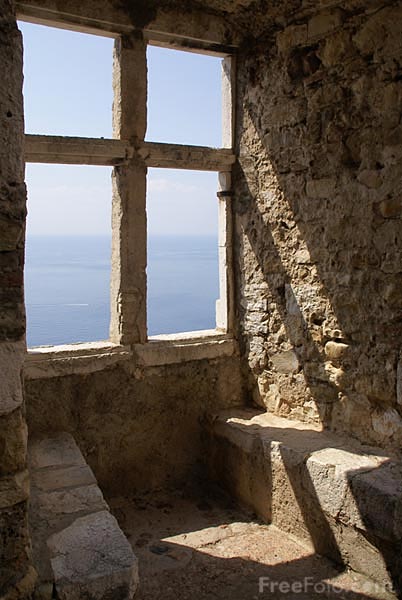
Dan 6.10 His windows being open in his chamber toward Jerusalem.

Daniel had only to kneel down upon his knees beside one of those windows, and at once he had access to the Father.  Daniel’s windows almost certainly were very small, set in a thick wall.  We often feel that the windows of are chamber are very small–we see so little, know so little of our Heavenly Jerusalem–but a bird can fly through a very small window out into the wide blue air, and if our windows be open toward Jerusalem, we shall in heart and mind thither ascend.

Where is He?

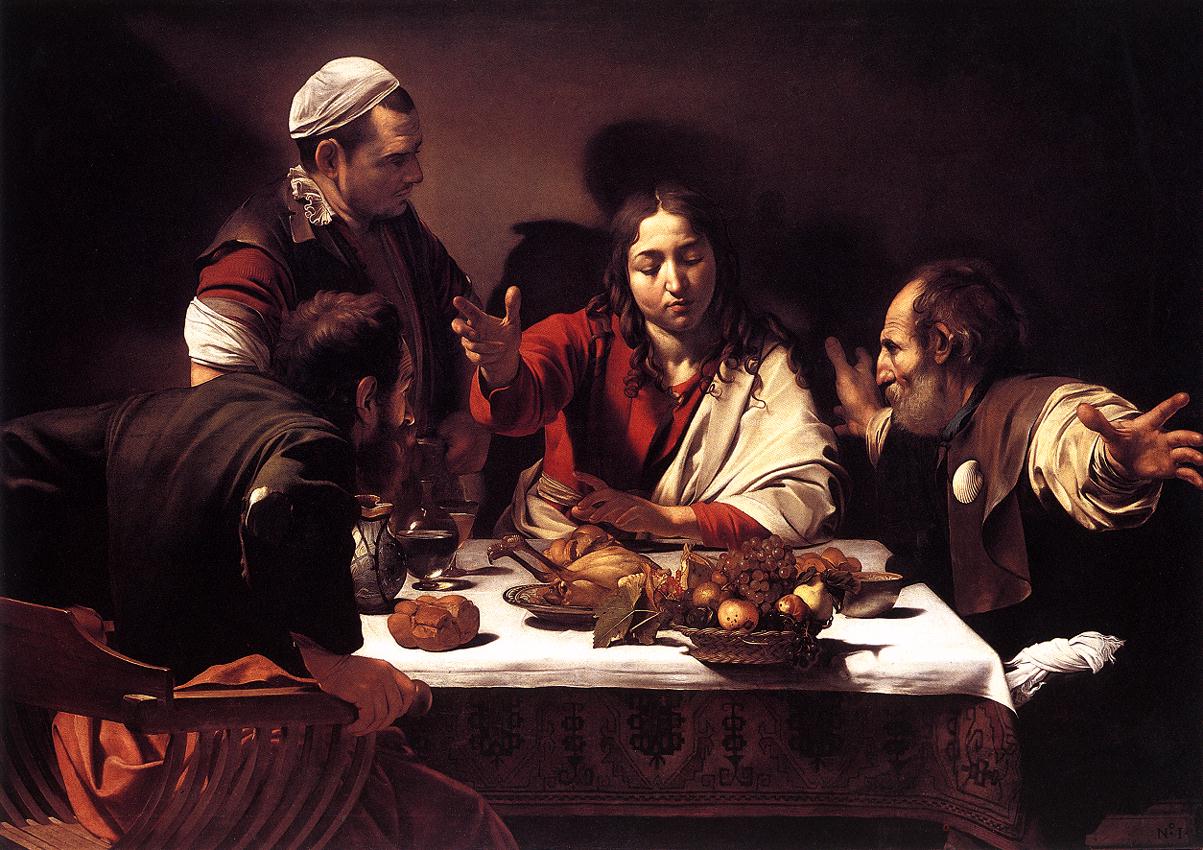
I’ve been trying to imagine what it was like for Jesus’ friends shortly after the Resurrection.  As word spread of His appearances to this one and that one, they must have wondered to whom and where He would appear next.  And would they recognize Him when He did–since so many of them failed to recognize Him at first glance?  Thinking about this led me to ponder my own life and take stock of how great my own expectation is of His “appearing” to me in my daily life.  How often do I not recognize Him when He is present to me?  Come, Holy Spirit, and open our eyes to recognize Christ where He is in our lives.

Supper at Emmaus (Caravaggio)

Locked doors

I always find this kind of reflection on the Easter appearances full of great hope for folks like me: “Jesus moves among men and women–even if it means passing through doors locked from within” (Jn 20.19-23). (Fr. William M. Joensen)  Many of us frequently–or continually–bolt the doors of our hearts from within, yet we long for Christ to come to us.  We can have great hope . . . for He is the One who can enter “through doors locked from within.”

While it is still dark

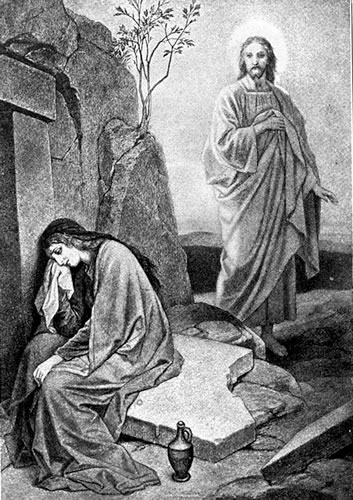
Some of us can wake up on Easter morning or Easter Monday or any other morning, for that matter, and wonder where the risen Christ is.  For one reason or another, we may feel like Mary Magdalene weeping outside the tomb wondering where they have taken Him.  I wrote this a few years back on Easter morning and thought I might share it with you:

“Now on the first day of the week Mary Magdalene came to the tomb early, while it was still dark . . . “ (Jn 20:1)

While it was still dark she came. She did not wait at home. She did not wait for Him or for others to come to her. And she expected to find what? Surely the stone still blocking her from Him. And yet she came. In the darkness. In her grief. She sought Him out even if only to lean her head and heart upon that stone that separated Him from her. In the darkness, in her grief she came.

And what did she find? The stone rolled away—but He was not there. He was not there. “I sought him, but found him not. I called him, but he gave no answer” (Song of Songs 5:6b). “Where have they laid him? They have taken away my Lord, and I do not know where they have laid him” (Jn 20:13b).

Her sorrow is now greater, yet she does not return home. She stands there weeping. And seeking. While it was still dark.

And no one else can solace her. Not angels. Not gardeners . . . She still seeks Him. While it is still dark. And that seeking, that longing of her soul, that anguish at His absence is the latch Christ uses to open her heart when He says her name: “Mary.” While it was still dark.

So go to Him. While it is still dark. While you are still weeping. Even when you cannot find Him. Stand there weeping and seeking Him. And listen for your name. Even now He is saying it.

While it is still dark.

“Blessed are those who have not seen and yet believe.”

“What, indeed, is lower than a cave?”

Something I wrote a couple of years ago, and still so true–and I am writing this foremost for myself!

Christmas!  Who doesn’t love this time of year?  Many people say to me of Advent and Christmas, “This is my favorite season!”  I’m sure we can all easily think of our reasons for that: lighting Advent wreaths, Christmas lights and caroling, Midnight Mass, etc.  And yet I know there are many of us who are only too aware of how little prepared we actually are for His coming, of how our weaknesses and faults, anxieties and busyness, seem to keep us from any kind of adequate preparation for this Feast.  The Prayer from the Divine Liturgy for Christmas in the Eastern Church gives hope: “O little Child lying in a manger, by means of a star, heaven has called and led to you the Magi, the first-fruits of the Gentiles, who were astounded to behold, not scepters and thrones, but extreme poverty.  What, indeed, is lower than a cave?  What is more humble than swaddling clothes?  And yet the splendor our your divinity shone forth in them resplendently.  O Lord, glory to you!”  Take heart!  We need not be afraid of the “stable” of our lives–as Fr. David May form Madonna House says: “The Child teaches us not to be afraid of the barren, winter of our wounded hearts, of our human emptiness.  For, by grace, these have become an Advent for us. . . . He awaits us there where we are most in need and most afraid: in the dark cave of our poverty.”  Yes, take heart.  At a mere opening of the door of your “stable,” Christ can shine resplendently therein!