The best thing to give up for Lent

I repost this every Lent.  It’s still the best recommendation as far as I am concerned.

This comes from a Magnificat article written by Fr. Peter John Cameron a few years ago.  I do not have time to quote the whole article (which is always dangerous because what you read will be edited), but I hope–especially those of you who despair of ever giving up what he suggests we give up–that you will find some hope in what he says:

Here’s what to give this Lent: the doubt that goes, “I can never get closer to God because I’m too sinful, too flawed, too weak.”  This is a lethal attitude, for it based on the false presumption that we can possess something of our own–that does not come from God–by which we can please God.  Nothing could be farther from the truth.  Only what is from God can please God.  But as long as such error persists, we estrange ourselves from God.  Lent is not about lamenting our inadequacy.  Rather, it is a graced moment to receive from God what he is eager to give us so that we can live the friendship with him that he desires. . . .

He goes on to describe how often we try to substitute self-sufficiency for the lack that we find in ourselves–and this usually leads to an experience of darkness in our lives–“we may even wonder if God hates us.”  He allows the darkness in order to draw us back to him.  “The most reasonable thing we can do when that feeling strikes is “to renew our act of love and confidence in God’s love for us.  The Lord allows the darkness precisely to move us to unite ourselves all the more closely to him who alone is the Truth.”

Still–we panic!  We feel as if we are obliged to do for God what we know we are unable to do.  But the point of the pressure is to convince us to receive everything from God.  We can be sure that God himself is the one who, in his mercy, moves us to do what is not within our power.  This is the Father’s way of opening us a little more to himself by making us a little more in the likeness of his crucified Son.

For nothing glorifies God like the confidence in his mercy that we display when we feel indicted by our frailty and inability.  The experience of our hopelessness is a heaven-sent chance to exercise supremely confident trust.  God delights in giving us the grace to trust him.

Sadly, for those who refuse God’s gift of confidence, the darkness can turn to despair.  Yet even in despair the miracle of mercy is at work.  Father Jean-Baptiste Henri Lacordaire, the nineteenth-century Dominican priest who was responsible for the revival of the Order of Preachers in France after the French Revolution, makes this astonishing remark: “There is in despair a remnant of human greatness, because it includes a contempt for all created things, and consequently an indication of the incomparable capacity of our being.”  In our darkness, the incomparable capacity of our being will settle for nothing less than the embrace of the Infinite.  Like nothing else, our helplessness moves us to cry out for that embrace in confidence and trust.  The cry of forsakenness that Jesus emits from the cross is just this.

Saint Paul wrote, “We were left to feel like men condemned to death so that we might trust, not in ourselves, but in God who raises from the dead” (2 Cor 1.9, NAB).  That’s the point.  That’s the challenge of Lent.  God wants us to have the strength to believe in his love so much that we confidently beg for his mercy no matter how much we feel the horror of death in ourselves. . . .

Let us this Lent, in the face of all ours sins, our limitations, and our weakness cry out with Jesus, “My God, why have you forsaken me?”  And let us do so with certainty–not doubt or desperation–because our union with Christ crucified has given us the Way to approach reality.  In our asking we hold the Answer.

Solid interior mortification

“The appropriate word you left unsaid; the joke you didn’t tell; the cheerful smile for those who bother you; that silence when you’re unjustly accused; your kind conversation with people you find boring and tactless; the daily effort to overlook one irritating detail or another in those who live with you…this, with perseverance, is indeed solid interior mortification.” (St. Josemaría Escrivá)

Walking with Jesus

An excellent Holy Week suggestion from Fr. Peter John Cameron (editor of Magnificat):

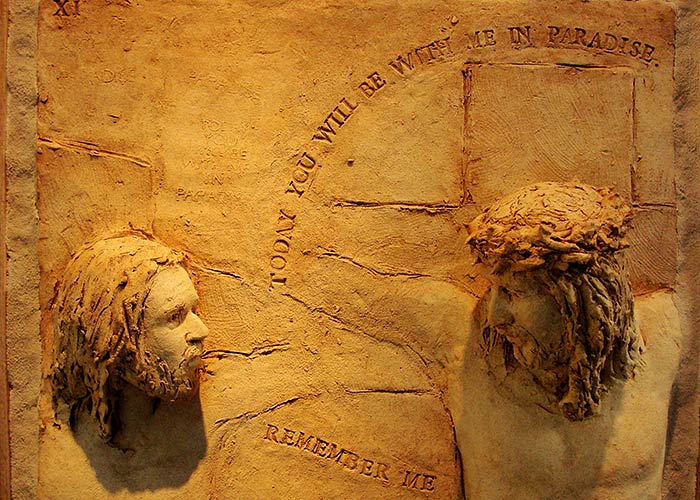
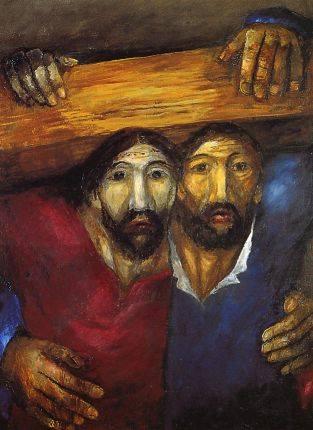
One way to approach Holy Week to live it like no other of the year is to unite yourself with one of the holy people who accompany Jesus in his Passion.  So perhaps you might identify with one of the disciples sent to prepare the Upper Room, looking at everything in your life in the light of the Eucharist . . . or the woman who anoints Jesus in Bethany, begging for the grace of special compassion . . . or Simon Peter, weeping with true repentance over your sins . . . or Simon of Cyrene, eager to take up Christ’s cross no matter how it may appear . . . or the Good Thief, bursting with hope that Jesus wants us to be with him in paradise . . . or John, daring to remain with Jesus on Calvary and accepting the gift of Mary to be our Mother . . . or the centurion, letting our profession of faith transform our life for ever: This man is the Son of God!

And for those of you who are walking your own way of the Cross, my advice is that you approach Holy Week pondering how Jesus is accompanying you in your passion, helping you to carry your cross, washing your feet and kissing them . . .

10906383_10153007438452420_7820168988650214860_n

What really matters

Is Lent about reaching a greater level of perfection?  Read on.

It does not matter what level of perfection you reach.  What others think or don’t think of how much you does not matter, not does your judgment of yourself.  All that matters if that mercy has taken you for ever, for the very origin of your existence.  Mercy called you to love, because mercy loved you.

Holiness means always affirming–before everything else, in everything else–the embrace of the Father, the merciful, pitying movement of Christ, his gesture, that is he himself, independent of everything that stirs and has the appearance of life in us. . . .

We must become more and more aware of God’s covenant with us, of life as God’s involvement with us, and therefore of the absolute and unmistakable importance of the irrational influence of our outbursts, of our projects.

Nothingness, destruction, exile is the life proper to the world, especially our life, without this covenant, which remains in me even in the destruction and in the desolation caused by my wicked heart.  Grace holds fast because God leads me to discover what he is and to understand that from my destruction he makes something new bud forth–an identification with him and the Father.

(Servant of God Luigi Giussani)

The first goal of spiritual combat?

If you’re like me, one of the things that you battle–especially during a season like Lent–is discouragement.  You just keep failing at whatever.  Fr. Jacques Philippe, as always, has something encouraging to say, something doable.

The real spiritual battle, rather than the pursuit of invincibility or some other absolute infallibility beyond our capacity, consists principally in learning, without becoming too discouraged, to accept falling occasionally and not to lose our peace of heart if we should happen to do so lamentably, not to become excessively sad regarding our defeats and to know how to rebound from our falls to an even higher level.  This is always possible, but on the condition that we not panic and that we continue to maintain our peace.

One could, then, with reason, enunciate this principle: The first goal of spiritual combat, that toward which our efforts must above all else be directed, is not to always obtain a victory (over our temptations, our weaknesses, etc.), rather it is to learn to maintain peace of heart under all circumstances, even in the case of defeat.  It is only in this way that we can pursue the other goal, which is the elimination of our failures, our faults, our imperfections and sins.  This is ultimately the victory that we must want and desire, knowing, however, that it is not by our own strength that we will obtain it and, therefore, not pretending that we can obtain it immediately.  It is uniquely the grace of God that will obtain the victory for us, whose grace will be the more efficacious and rapid, the more we place maintaining our interior peace and sense of confident abandonment in the hands of our Father in heaven.

His Love Did Burn

PALM SUNDAY

Alone I weep, and lost, in hurt and pain.
My dreams seem shattered; mind’s lamp flickers low.
I blame myself, but how am I to blame?
No grand design to build, nowhere to go.
The world turns its uncaring eye away.
I live or die: ’twill not be written much;
And as the sleepless night brings troubled day,
I long for crumbs of comfort, human touch.
Yet soon is Easter, and my thoughts now turn
To One Who, palm-applauded, still rode on:
His face set flint, as all His love did burn:
A cross awaiting, for God’s only Son.
And as my tears descend, as winter rain,
I know Love lives, and I shall love again.

David John, Oxford, England.

A good way to start

Sometimes we just get fixated on the wrong things during Lent.  Or perhaps a better way to say it is: distracted by things different than God wants us to focus on.  Or we just get discouraged.  I found this advice by Marge Fenelon to be excellent and very helpful for me.  Hopefully for you as well.

Relaxing into Lent

As a little girl, I was extremely melancholic, to the point of finding myself every so often sinking into bouts of sadness or loneliness. Sometimes, I’d just feel “lost” for seemingly no reason at all. Nothing was ever truly wrong but at the same time, nothing was ever truly right, either.

Sure, there were things that could have had me down – my dad’s heart condition, the occasions of family discord, or the solitariness of being the youngest child who trails her siblings by several years. Our house certainly could get quiet and lonely at times. Yet, there was never anything I could directly relate it to. In fact, all these years later, I still can’t figure out the cause of those sensations. They were sudden, and they were strong. That’s all I know.

Read the rest here.


Jesus, help me!

Is it just me, or do temptations increase during Lent?  And what to do with them?  I think we all can be afraid of temptations.  Our Pope Emeritus suggests a simple way to deal with them:

“. . . to a disciple who expressed the desire to discover ‘the causes of the different temptations that had assailed him’, Barsanufius replied: ‘Brother John, do not be afraid of the temptations that arise against you to put you to the test, do not be determined in trying to understand what it is about; rather cry out the name of Jesus: “Jesus, help me!”  And he will hear you because ‘the Lord is near to all who call upon him.’ Do not be discouraged, run with ardor and you will reach your end in Christ Jesus, our Lord!”

And these words of the ancient Father are also valid for us.  In our difficulties, problems, temptations, we must not simply engage in a theoretical reflection from whence do they come? — but must react positively, invoking the Lord, maintaining a living contact with the Lord.  Beyond that, we must cry out the name of Jesus: ‘Jesus, help me!’  ANd we may be sure that he listens to us, as he is near to those who seek him.  Let us not be discouraged; rather let us run with ardor–as this Father says–and we too will reach life, Jesus, the Lord.”  (Benedict XVI)