Loving my littleness

I have a flip-top collection of quotes of St. Thérèse in the room where I pray, and I have had it flipped to this quote for a few weeks now: “What pleases Him is that He sees me loving my littleness and my poverty.”  This morning as I read it, I was struck by the word “loving.”  She doesn’t say “accepting” or “living with” or “bearing”, but “loving”.   Loving?

And then it struck me: that is exactly where I meet Christ in my life–in my littleness and poverty.  He favors the poor.  He came to us as the poor Man. So, of course, I should love that place and love dwelling there with Him.

Thank you, St. Thérèse.  Pray for me that my love for my littleness and poverty will increase.

A Better Resurrection

A Sunday poem from Christina Rossetti:

A Better Resurrection

I have no wit, no words, no tears;
My heart within me like a stone
Is numbed too much for hopes or fears.
Look right, look left, I dwell alone;
I lift mine eyes, but dimmed with grief
No everlasting hills I see;
My life is in the falling leaf:
O Jesus, quicken me.

My life is like a faded leaf,
My harvest dwindled to a husk:
Truly my life is void and brief
And tedious in the barren dusk;
My life is like a frozen thing,
No bud nor greenness can I see:
Yet rise it shall–the sap of spring;
O Jesus, rise in me.

My life is like a broken bowl,
A broken bowl that cannot hold
One drop of water for my soul
Or cordial in the searching cold;
Cast in the fire the perished thing;
Melt and remould it, till it be
A royal cup for Him, my King:
O Jesus, drink of me.

~Christina Georgina Rossetti

Friday: from the archives

When you feel that you have nothing left to give . . . 
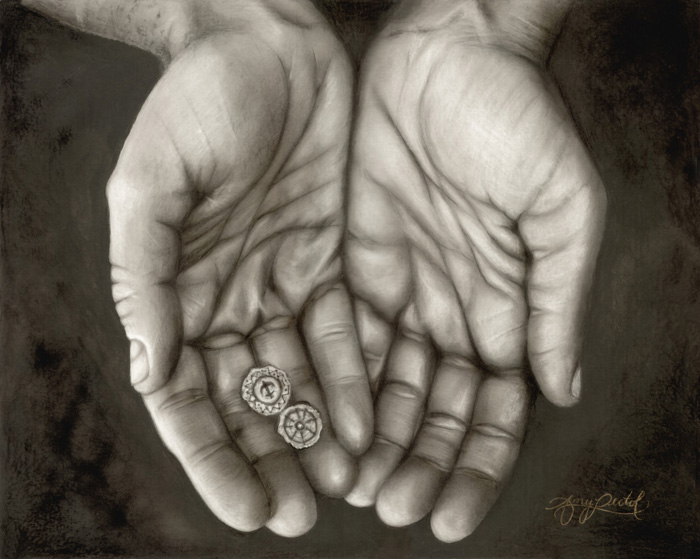
In my position as superior of our community, there are many days when I feel like I don’t have anything to give my sisters–not that I don’t want to–I just feel very poor.  I also feel that way pretty much all the time in prayer these days.  I have always experienced great encouragement from the story of the widow’s mite.  Some words on this topic from Andre Louf, abbot emeritus of the Cistercian monastery of Mont-des-Cats, France:

Jesus was elated over the poor widow who offered two copper coins.  She gave from her poverty and in so doing offered up everything she had to live on (Mk 12:42-44).  The others had also given money, a lot of it even, but “from their surplus wealth” . . . Jesus, however, preferred the two miserable coins of the widow to these substantial gifts even though the coins were of no significance in the sum total of the collection.    Why did he rate this gift more highly?  Jesus’ answer was very simple: “She, from her poverty, put in everything she had, all she had to live on.”  Does this mean the others should have been more generous?  Should they have given larger sums?  Of course not.  They were naturally free to do this and a higher contribution would certainly have been appreciated.  But that was not what was important to Jesus; the issue was not so much one of quantity.  Even if the rich were to give more, they would still only be giving from their abundance.  For them it would always remain immensely difficult to give from their poverty.  It is the same for us: whatever we may give of all the things that belong to us–our money, our time, our magnanimity, our health, our thousand good qualities–even if we put all this at Jesus’ disposal, still we are only giving from our abundance.  And it will always remain hard and even painful for us to give from our poverty.  To give everything to Jesus always means to give from our poverty and that is not an easy thing to do.  But it is precisely this gift that Jesus expects from us all . . . To give from our poverty means, first of all, to know that we are poor, that we have discovered in ourselves the wound for which (for that matter) no one is responsible but which for ever makes us utterly poor indeed, poor to a degree we would not dare to admit to ourselves. . . [The widow] accepts the fact that she just wants to give what she has because Jesus looked at her and accepted her as she was.  Happy are they who dare to give from their poverty: in the eyes of Jesus they have given everything they had.   (from Mercy in Weakness)
“The Blessing of Poverty”

A very honest and inspiring personal testimony from one of the priests of Madonna House about his own personal poverty and weakness:

The Blessing of Poverty

by Fr. Denis Lemieux.

Blessed are you poor, for the kingdom of heaven is yours (Lk 6:20).

I have learned that there is only one place where I grow in faith, one place where I encounter the living God. That is the place of my own personal poverty.

I am going to reflect on my spiritual journey and on different ways in which I have encountered my own poverty, at least a little bit. At least enough that I am beginning, I hope, to know the blessedness of poverty.

I’m 45 years old now, and I’ve been a staff worker of Madonna House for twenty years and a priest for seven. I was nineteen the first time I came to Madonna House and twenty-five when I made my first promises.

When I arrived at Madonna House in 1986, for various personal and familial reasons, I was fairly “bruised and broken.” I don’t mean physically.

You can read the rest here.