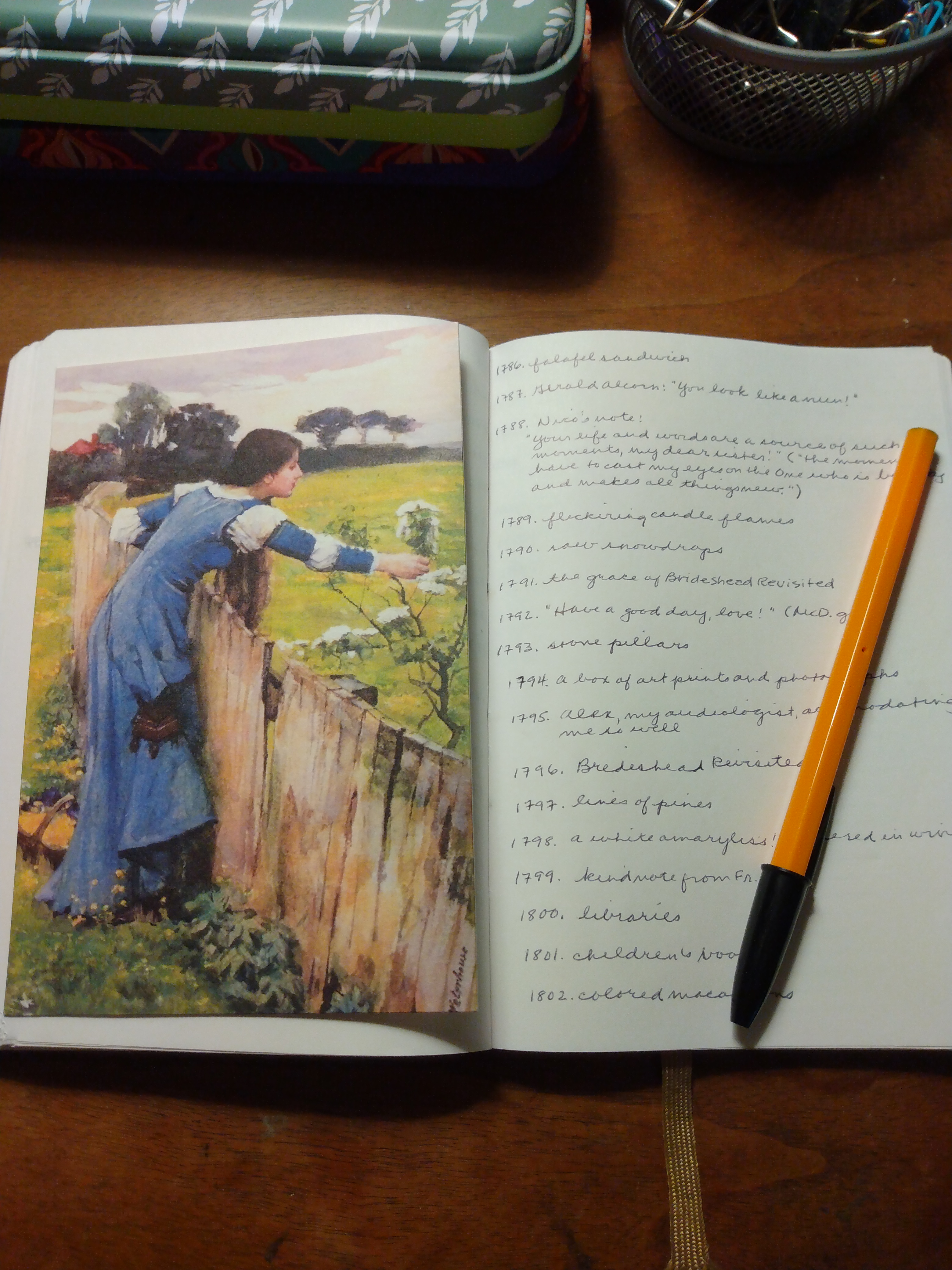
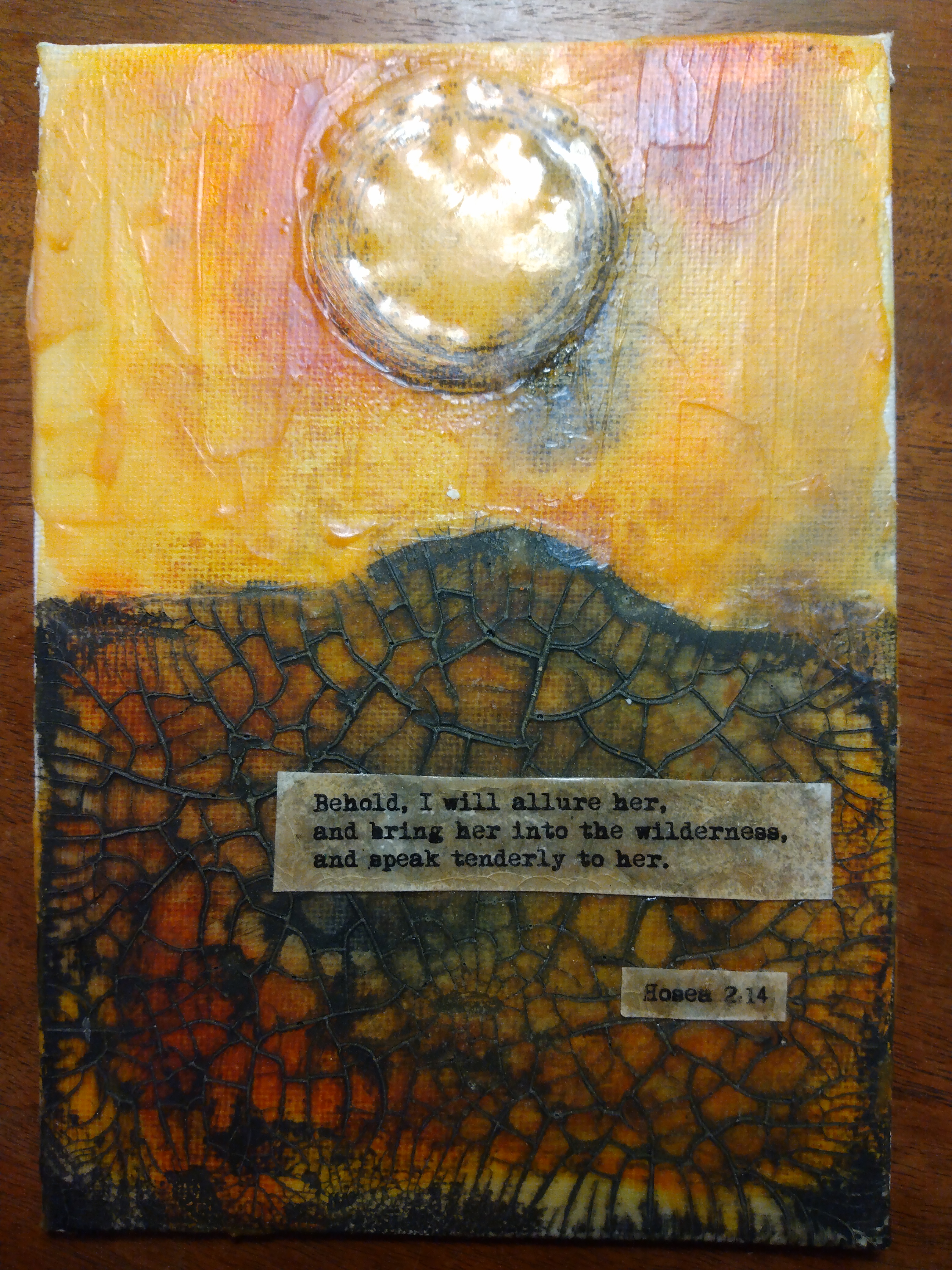
Just thought I’d introduce you to Heather King if you haven’t discovered her yet. I love the suggestion she passes on that we stop seven times a day to stop and think of God for one minute.
A shy yet solemn glory
A Sunday poem.
Music
When I was a child
I once sat sobbing on the floor
Beside my mother’s piano
As she played and sang
For there was in her singing
A shy yet solemn glory
My smallness could not hold
And when I was asked
Why I was crying
I had no words for it
I only shook my head
And went on crying
Why is it that music
At its most beautiful
Opens a wound in us
An ache a desolation
Deep as a homesickness
For some far-off
And half-forgotten country
I’ve never understood
Why this is so
But there’s an ancient legend
From the other side of the world
That gives away the secret
Of this mysterious sorrow
For centuries on centuries
We have been wandering
But we were made for Paradise
As deer for the forest
And when music comes to us
With its heavenly beauty
It brings us desolation
For when we hear it
We half remember
That lost native country
We dimly remember the fields
Their fragrant windswept clover
The birdsongs in the orchards
The wild white violets in the moss
By the transparent streams
And shining at the heart of it
Is the longed-for beauty
Of the One who waits for us
Who will always wait for us
In those radiant meadows
Yet also came to live with us
And wanders where we wander.
Anne Porter
Fill in the blank
The second antiphon for morning prayer this morning (Feast of the Conversion of St. Paul) reads: “Paul, my grace is sufficient for you; my power is made perfect in weakness.” I felt the Holy Spirit nudging me to put my own name in place of Paul’s and pray it again: “Dorcee, my grace is sufficient for you; my power is made perfect in weakness.” I would like to suggest that you do the same. Place your name in the blank and then pray it slowly a few times. For it is truth for your soul as well as Paul’s.
_____________________________, my grace is sufficient for you; my power is made perfect in your weakness.
Let God come to you first
I recently recommended a few of Joshua Elzner’s books. Today I would like to post an excerpt from another of his books. It speaks to me deeply–as I assume it will also to you–because he addresses the times when we feel like we just cannot pray the way that we desire. May it bring you hope, as it did for me this very day.
“I have no desire to forsake prayer, to live it behind and to busy myself instead with superficial things. But I cannot pray in the way that I am accustomed, in the way that I would desire. But how can I go beyond this dilemma: to pray when I am incapable of praying, to rest when I am incapable of resting, to gaze upon God when I am incapable of gazing? The only answer lies in letting God come to me first, in letting him draw near to meet me in the very place where I feel my poverty and incapacity so deeply. I will not find him in the flight from my weakness to the periphery, where I occupy myself with things to distract my attention from the pain, things with which I try to pass the time that I once spent in prayer and recollection and filial play in his presence. But neither will I find him in the forceful effort by which, with the vigorous activity of my will or my intellect, I try to break through my limitations and to achieve what he is not giving. Rather, I will find him only when I sink down into the very heart of my littleness and incapacity, when I let him approach me, touch me, and cradle me at the heart of my deepest weakness, poverty, and greed.
“And when this happens . . . ah, when this happens! Then the very pain and incapacity and weakness that hemmed me in before become a living sacrament of his presence! The very difficulty and suffering that I experience become a living space of his compassionate love, which sensitizes my heart both to his own goodness as well as to the suffering of my brothers and sisters, which, in him and with him, I tenderly take up into my heart and hold in his presence. My suffering, in other words, becomes a living space of yet deeper encounter and get more profound intimacy. Yes, my poverty becomes but the flip side of his abundant fullness; my incapacity becomes a living space of receptivity to the ceaseless activity of his love; my pain and restlessness in the suffering of my body and my spirit, touched by him and surrendered to him, becomes pervaded by a deeper peace and rest and serenity.
“The pain and incapacity do not disappear, as God does not somehow dissolve my limitations and make possible what, in my very suffering, is now impossible. Rather, he permeates the living space of my consciousness with his presence, such that he meets me in my very littleness and limitation, and makes this something radiant and expansive and beautiful. For, after all, what makes something truly great is not what it looks like on the outside, How much it sparkles in the eyes of the world, but simply how much God there is in it, and how totally and intimately it is held by him, permeated by his presence, and filled with the sweetness of his love and tenderness.”
(Joshua Elzner, The Prayer of the Heart)
Wring the Changes
A Sunday poem.
Wring the Changes
I have known the breathless feeling of a sponge that has been wrung
thoroughly and roughly above my life’s chipped sink,
squeezed to the point of tearing by the chapped hands of God
until my shape was nothing. Until I could not think.
I have known the way one squishes at the crushing of one’s foam,
have felt the curious balling of a thing without a spine.
But all of it led to a hope I do not hold alone:
that when my water’s all pressed out, I might soak in his wine.
Paul J. Pastor
Awe & Wonder

The Dignity of All Things
Wednesday, December 6, 2023
I prayed for wonders instead of happiness, and You gave them to me.
—Abraham Joshua Heschel, The Ineffable Name of God: Man
Rabbi Abraham Joshua Heschel (1907–1972) is known for his prophetic action and commitment to “radical amazement.” Theologian Bruce Epperly explains:
Heschel lived out a holistic balance of delight and awe, radical amazement, and prophetic challenge.
At the heart of Heschel’s mystical vision is the experience of radical amazement…. Wonder is essential to both spirituality and theology: “Awe is a sense for the transcendence.… It enables us to perceive in the world intimations of the divine.” [1]
Wonder leads to the experience of radical amazement at God’s world. Created in the image of God, each of us is amazing. Wonder leads to spirituality and ethics. As Heschel noted, “Just to be is a blessing, just to live is holy. The moment is the marvel.” [2]
Heschel considers the significance of a worldview of radical amazement:
The world presents itself in two ways to me. The world as a thing I own, the world as a mystery I face. What I own is a trifle, what I face is sublime. I am careful not to waste what I own; I must learn not to miss what I face.
We manipulate what is available on the surface of the world; we must also stand in awe before the mystery of the world. We objectify Being but we also are present at Being in wonder, in radical amazement.
All we have is a sense of awe and radical amazement in the face of a mystery that staggers our ability to sense it….
Awe is more than an emotion; it is a way of understanding, insight into a meaning greater than ourselves. The beginning of awe is wonder, and the beginning of wisdom is awe.
Awe is an intuition for the dignity of all things, a realization that things not only are what they are but also stand, however remotely, for something supreme. Awe is a sense for the … mystery beyond all things. It enables us … to sense in small things the beginning of infinite significance, to sense the ultimate in the common and the simple; to feel in the rush of the passing the stillness of the eternal. What we cannot comprehend by analysis, we become aware of in awe.
Faith is not belief, an assent to a proposition; faith is attachment to transcendence, to the meaning beyond the mystery.
Knowledge is fostered by curiosity; wisdom is fostered by awe. Awe precedes faith; it is the root of faith. We must be guided by awe to be worthy of faith.
Forfeit your sense of awe, let your conceit diminish your ability to revere, and the universe becomes a market place for you. The loss of awe is the avoidance of insight. A return to reverence is the first prerequisite for a revival of wisdom, for the discovery of the world as an allusion to God. [3]
References:
[1] Bruce G. Epperly, Mystics in Action: Twelve Saints for Today (Maryknoll, NY: Orbis Books, 2020), 81; Abraham Joshua Heschel, I Asked for Wonder, ed. Samuel H. Dresner (New York: Crossroad Publishing, 1983, 2022), 21.
[2] Epperly, Mystics in Action, 81; Abraham Joshua Heschel, “To Grow in Wisdom,” in The Insecurity of Freedom (New York: Schocken Books, 1972), 82.
[3] Abraham J. Heschel, Who Is Man? (Stanford, CA: Stanford University Press, 1965), 88–89.
Image credit: A path from one week to the next—Madison Frambes, Untitled 4, 1, and 7 (detail), 2023, naturally dyed paper and ink, Mexico, used with permission. Click here to enlarge image.
When we are in awe, there are no deeds to be done or words to be said; a simple, ecstatic surrender.
Be of good heart
Book recommendations
I have recommended numerous books on this blog–many are listed under the “Books to read” tab. I realize that not every book that speaks to me personally will necessarily do the same for others, but I would like to at least mention a few books by Joshua Elzner that have greatly impacted my spiritual life over the last couple of years. I would even say that my relationship with the Lord has been significantly transformed as a result of reading his writings. So I offer them here knowing that there might be the possibility of them impacting your spiritual lives as well.

This first book is set up to be read over the span of 40 days. It begins with a short autobiography written by Joshua in order to situate his writings within his own spiritual development. The chapters are short, just enough to chew on for a day. So many things from this book have impacted me. Here’s just a snippet from what I read a couple of days ago:
“All that I am, all that I have ever felt, known, had, or desired–all shame and fear, all desire and effort, all failure and guilt, all capacities and incapacities, all experience and expectation–everything, absolutely everything, is to be laid before him in trusting nakedness, and to be opened wide, in unconditional poverty, to receive his gift as he wishes to give it. And this gift is ultimately his very Self . . . ”

This next book is, as the cover indicates, a commentary on the Song of Songs. I have read many books on the Song of Songs, but this one by far opened up the Song in a way that no other had. If you are longing for intimacy with God, this is the book for you.

These next two have just been recently released and are the first two in the Dawnbringer series. They are written in the style of Tolkien and other great myth creators. This is an incredibly beautiful, well written story that has moved me to tears numerous times by its beauty and goodness.

They can be purchased here.
I would love to know if you read him.
“God loves to light little lights”
When I found out that St. Peter’s keeps their Christmas tree and crèche up in the square until February 2, I decided (as our Superior) that we would keep our crèche in the chapel and all our Christmas lights up until then as well. I always felt gypped that there were not 40 days to celebrate after Christmas as there are after Easter. Then I discovered that February 2, the Presentation of the Lord (Candlemas), is indeed 40 days after Christmas. So, to me, it makes total sense to keep those Christmas lights lit. If you drive past our house right now, you will still see our candle lights in the windows. I personally love clusters of little white lights. When we begin the Salve Regina at the end of night prayer, the guitarist dims all the lights in our chapel. During this season, that leaves only the Christmas lights and the sole candle lit before the icon of the Mother of God. Yet the chapel still seems bright.
In the beginning of his 1999 Christmas message, Pope Benedict spoke of how God “loves to light little lights.” I found that particularly encouraging as I thought of all of us who are desiring to be God’s witnesses to hope. May it encourage you as well, and may you call it to mind whenever you see Christmas lights and candles:

The liturgy of the Mass at Dawn reminded us that the night is now past, the day has begun; the light radiating from the cave of Bethlehem shines upon us. . . .
At first, beside the manger in Bethlehem, that “us” was almost imperceptible to human eyes. As the Gospel of St. Luke recounts, it included, in addition to Mary and Joseph, a few lowly shepherds who came to the cave after hearing the message of the Angels. The light of that first Christmas was like a fire kindled in the night. All about there was darkness, while in the cave there shone the true light “that enlightens every man” (Jn 1.9). And yet all this took place in simplicity and hiddenness, in the way that God works in all of salvation history. God loves to light little lights, so as then to illuminate vast spaces.
May we allow God to light each of us, little lights in this darkened world.
Epiphany
They have brought gold and spices to my King,
Incense and precious stuffs and ivory;
O holy Mother mine, what can I bring
That so my Lord may deign to look on me?
They sing a sweeter song than I can sing,
All crowned and glorified exceedingly:
I, bound on earth, weep for my trespassing,–
They sing the song of love in heaven, set free.
Then answered me my Mother, and her voice
Spake to my heart, yea answered in my heart:
‘Sing, saith He to the heavens, to earth, Rejoice:
Thou also lift thy heart to Him above:
He seeks not thine, but thee such as thou art,
For lo His banner over thee is Love.’
Christina Rossetti
20 January 1852