Where is Christ today?

[A repost from the past]

This is the day when everything is silent.  We can go about the day not giving much of a thought to it–just seeing it as the day between Good Friday and Easter Sunday. Yet monumental things were happening in the spiritual realm.  Christ descended to hell to set captives free.

This still has meaning for us.  So often we think nothing is happening in our own spiritual lives, yet God is about monumental things.  Have hope in the Unseen.

Christ descended into “Hell” and is therefore close to those cast into it, transforming their darkness into light.  Suffering and torment is still terrible and well-nigh unbearable.  Yet the star of hope has risen–the anchor of the heart reaches the very throne of God.  Instead of evil becoming unleashed within man, the light shines victorious: suffering–without ceasing to be suffering–becomes, despite everything, a hymn of praise. (Pope Benedict XVI, Spe Salvi)
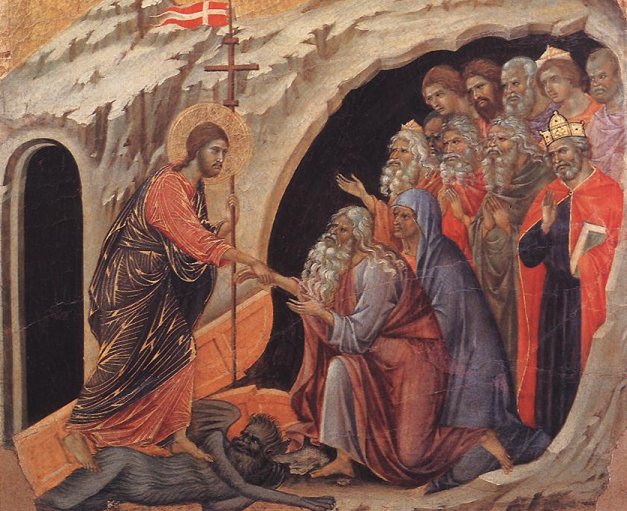
And for those of you who feel that you are living “in darkness and in the shadow of death”, take heart, for you are exactly who he desires to visit.  From an ancient homily on Holy Saturday:

Greatly desiring to visit those who live in darkness and in the shadow of death, he has gone to free from sorrow the captives . . .

How can we ever comfort Him?

Today we remember the depths of Christ’s love for us.  But how can we ever love Him in return, how can we comfort Him in His suffering?  His suffering is too huge and our love is so small.  As I was pondering that question last night, the Holy Spirit called to mind something I read a year or too ago about this.  The author advised that we be like little children who try to comfort a suffering parent.  About all we can do as a child is hold our parent’s hand or kiss him or her.  Yet that provides great comfort for the parent.  All Christ asks of us is to be with Him today in His suffering, to hold His hand or kiss His feet, each in our own way.

This all reminds me of a painting by Giotto of Christ’s descent from the cross.  In it we see the women caressing Christ’s body: Mary, His dear Mother, and the women who followed Him.  Giotto places a figure square in the middle of the painting with its back to us.  He does that to prompt us to think about where we would be in the picture.  Take his prompting and let yourself enter into this mystery and hold Him and kiss Him today.

“Return to the most sorrowful woman the body, even if only lifeless, so that, although so diminished the crucified man may grow with kisses, with embraces.”

But if we find grace

This slideshow requires JavaScript.

Judas, Peter

because we are all
betrayers, taking
silver and eating
body and blood and asking
(guilty) is it I and hearing
him say yes
it would be simple for us all
to rush out
and hang ourselves
but if we find grace
to weep and wait
after the voice of morning
has crowed in our ears
clearly enough
to break our hearts
he will be there
to ask us each again
do you love me

Luci Shaw

Loving with Mary

This morning as I woke up, I began thinking again about contemplating our Lord’s Passion with Mary.  I was immediately struck by the thought of how much of her time and love was spent through these difficult days in loving those that Christ loved.  Peter would surely have flown to her after his denial.  How lost John must have felt after his flight in the garden.  Mary Magdalen and Mary and Martha (and Lazarus) of Bethany would have faced their own devastation.  There was the bitter anger at Judas that pervaded them all.  And so on with all of them. But just as Jesus gave her to us through John at the Cross, so He would have been urging her in the same way (by His Spirit) to go out to those He loved so much.

Perhaps your Triduum will be filled with the demands of others and you would rather be focusing more “directly” upon our Lord.  Perhaps it is His Spirit urging you to go where His Mother is going.  In following her and loving whomever she is loving, you will in fact be loving our Lord who loves them more than you do.

Contemplating with Mary

There were two options for the Opening Prayer for Mass last Thursday–something I hadn’t seen yet in the new missal.  Our priest chose the second option, and I will be forever grateful.  The prayer reads:

O God, who in this season give your Church the grace to imitate devoutly the Blessed Virgin Mary in contemplating the passion of Christ, grant, we pray, through her intercession, that we may cling more firmly each day to your Only Begotten Son and come at last to the fullness of his grace.  Who lives and reigns with you in the unity of the Holy Spirit, one God for ever and ever.  Amen.

I was caught by the beginning: “to imitate devoutly the Blessed Virgin Mary in contemplating the passion of Christ.”  My whole prayer became one of asking Mary to help me walk through this Holy Week close to her, perceiving her Son with her eyes and loving Him with her heart.   This, of course, can totally change one’s experience of the Passion.  Wouldn’t Mary have walked in great faith though in great darkness?  Wouldn’t she have strengthened her Son as much as she could?  Would she not have stood at the Cross in adoration, willing that He would draw from her everything that could encourage Him in doing His Father’s will completely?

May we each learn greatly from her this week.

Entering Holy Week

Entering Holy Week

by Catherine Doherty.

This is the hour of faith. We are going to need faith, because Holy Week, in a manner of speaking, will show us the reign of the prince of darkness, who rejoiced on Good Friday because he killed God, or so he thought.

One picture has haunted me throughout the years. It is Christ hanging on the cross while many who have benefited by his goodness—the halt, the lame, and the blind—are saying to him, “If you are who you say you are, come down from that cross and we shall believe you.”

How many miracles have happened to us, individually?

This is the week for meditating on how much we are loved. If there is anyone who thinks that he or she is not loved, let him follow the Holy Week liturgies, and he will know with what love we are all loved.

For those of us who do know a little of that love, let this week be a week of loving others, for no one can receive the infinite love of God without passing it on. God meant it to be that way. If we kept it for ourselves, it would break us.

It seems that each of us is always to have empty hands—to have our sinner’s heart with all its hostility, pain, and sin—yet a heart that is always turned to God. He who loves sinners has to come into our hearts again and again and constantly give us the mercy of his love.

Let us acknowledge this and let us share this love, emptying it onto the other, whoever he might be. It is immaterial who, for when one is loved by God, one loves everybody, because God lets the rain fall on the just and the unjust.

God’s love pouring into us is poured out to the other, and then another Niagara of his love comes in. It never stops.

When I think I have nothing to give, lo and behold, the cascade of God’s love passes through me and I am renewed. I can give again, because God became man, dispossessing himself.

When you fall in love with God, the desire for dispossession becomes like a fire in your heart, because when one falls in love, one wants to identify with the beloved. It has always been thus and still is.

The Gift of Tears

Russians say that this is the week of the gift of tears. We believe that there is a gift of tears that comes from the Holy Spirit. We say that it washes away our sins and the sins of mankind. Silence and tears and a contrite heart God will not reject.

This is the week of confession and also the week of overcoming sins, because it is one week in the year when we know that, while we can’t overcome our sins, Christ can.

As one of our MH priests has said, “During most of this holy season of Lent, you have to work at living Lent, but then comes the time when you no longer have to carry Lent. The liturgy is so strong, so powerful, that it just carries you. The strength and power at work in the Church carries us all through Holy Week.”

When you think of this holy week, it’s like a shiver passing through you. It is the mercy of God and his love for you. And because you are caught up in it, held by it, immersed in it, your soul opens up and you cease to be afraid. The God-man has erased your fear.

In this Holy Week, let us join hands in deep forgiveness of one another. Let us reconcile ourselves to whomever we are not reconciled. Let us each enlarge the circle of love in our hearts so that it can encompass the humanity that flows near us. Such is the love of God: mercy flows from it. Forgiveness is part of it. Humility sings a song to it. This truly is a week that is holy!

Let all of this sink into you, for God is with us every moment. He is present right now. Let his love, his simplicity, his ordinariness, and his extraordinariness—all of him—enter your heart, and then you will know why this week is called holy.

— Adapted from Season of Mercy, pp. 79-81, available from MH Publications.

“The Blessing of Poverty”

A very honest and inspiring personal testimony from one of the priests of Madonna House about his own personal poverty and weakness:

The Blessing of Poverty

by Fr. Denis Lemieux.

Blessed are you poor, for the kingdom of heaven is yours (Lk 6:20).

I have learned that there is only one place where I grow in faith, one place where I encounter the living God. That is the place of my own personal poverty.

I am going to reflect on my spiritual journey and on different ways in which I have encountered my own poverty, at least a little bit. At least enough that I am beginning, I hope, to know the blessedness of poverty.

I’m 45 years old now, and I’ve been a staff worker of Madonna House for twenty years and a priest for seven. I was nineteen the first time I came to Madonna House and twenty-five when I made my first promises.

When I arrived at Madonna House in 1986, for various personal and familial reasons, I was fairly “bruised and broken.” I don’t mean physically.

You can read the rest here.

If today

“If today you hear His voice, harden not your hearts.”

We have been praying that verse several times every morning during Lent.  In essence, it is a plea to not turn away when the Lord convicts us of sin.  But yesterday morning, the Lord broke into my thoughts as if to say: “What I most speak to you is My love.  Don’t harden your heart to it.”  When we think of the true meaning of sin, it is a breaking of our relationship with God–which, in fact, weakens our ability to know His love.  He only convicts in order to restore the relationship.  He so longs for full union with us, for each of us to know His love in its fullness.

So today, when the Lord nudges you with His love, don’t harden your heart.  Open it wide.

When God is silent

What sense can we make of those times when God is silent?  Does that mean that He is absenting Himself from our lives?  Pope Benedict profoundly reflected on this a couple of weeks ago during his Wednesday audience:

“Often in our prayer, we find ourselves before the silence of God; we experience a sense of abandonment; it seems to us that God is not listening and that He does not respond.  But this silence of God–as Jesus also experienced–is not a sign of His absence.  The Christian knows well that the Lord is present and that he is listening, even in the darkness of suffering, rejection and solitude.  . . . God knows us intimately, more deeply than we know ourselves, and He loves us: and knowing this should suffice.  In the Bible, Job’s experience is particularly significant in this regard.  This man quickly loses everything: family, wealth, friends, health; it seems that God’s attitude towards him is precisely one of abandonment, of total silence.  And yet Job, in his relationship with God, speaks with God, cries out to God; in his prayer, despite everything, he preserves his faith intact and, in the end, he discovers the value of his experience and of God’s silence.  And thus, in the end, turning to his Creator, he is able to conclude: ‘I had heard of thee by the hearing of the ear, but now my eye sees thee’ (Job 42.5): nearly all of us know God only through hearsay, and the more we are open to His silence and to our silence, the more we begin to know Him truly.  This supreme confidence, which opens way to a profound encounter with God, matures in silence.  St. Francis Severio prayed, saying to the Lord: I love you, not because you can give me heaven or condemn me to hell, but because You are my God.  I love You because You are You.”

And God says in turn to each of us: “I love you because you are you.”

Gold on glass

Makoto Fujimura is a Christian contemporary artist.  He studied under Matazo Kayama.  One of Kayama-sensei’s lessons teach us a lot about the spiritual life, about God’s wonderful work in our souls.  Fujimura reflects on one lesson:

“When he gathered us students to teach us how to use gold, he had one of his assistants bring a clear piece of glass.  He then proceeded to glue the gold right onto the glass.  Lifting the glass, he showed us that the most pure gold is nearly transparent as it casts a bluish light and halo.  I mentally pictured the new Jerusalem ‘coming down out of heaven from God, prepared as a bride beautifully dressed for her husband’ (Rev. 21.2).  The transparency of gold that Kayama-sensei was displaying overlapped with John’s vision.  For the new Jerusalem is a ‘city of pure gold, as pure as glass’ (Rev. 21.18).”  (Makoto Fujimura, Refractions)