His love has no end

I have been meditating on Ps 136 this past weekend.  The RSV begins: O give thanks to the Lord, for he is good, for his steadfast love endures for ever–or as Derek Kidner points out, the better translation is: for his love has no end. This phrase repeats itself after every verse of the psalm–for his love has no end, for his love has no end, for his love has no end. Fr. Patrick Henry Reardon, an Orthodox pastor,  has a wonderful commentary on this phrase:

Psalm 136 insists, literally in every verse, that the root of all God’s activity in this world, beginning even with the world’s creation, is mercy–hesed.  This mercy is eternal–le’olam–“forever.”  Mercy is the cause and reason of all that God does. He does nothing, except as an expression of His mercy.  his mercy stretches out to both extremes of infinity.  “For His mercy endures forever” is the palimpsest that lies under each line of Holy Scripture.  Thus, too, from beginning to end of any Orthodox service, the word “mercy” appears more than any other word.  The encounter with God’s mercy is the root of all Christian worship.  Everything else that can be said of God is but an aspect of His mercy.  Mercy is the defining explanation of everything that God has revealed of Himself.  Every Orthodox service of worship, from Nocturnes to Compline, is a polyeleion, a celebration of God’s sustained and abundant mercy.  What we touch, or see, or hear, or taste–from the flames that flicker before the icons and the prayers our voices pour forth, to the billowing incense and the mystic contents of the Chalice–all is mercy.  Mercy is the explanation of every single thought that God has with respect to us.  When we deal with God, everything is mercy; all we will every discover of God will be the deepening levels of His great, abundant, overflowing, rich and endless mercy.  “For His mercy endures forever” is the eternal song of the saints.  (Christ in the Psalms, p. 272)

Even there

Written by a missionary in Communist China in the early 1950’s, with only 15 cents left in his pocket, a terrible toothache, no fuel and a tiny daughter with scarlet fever.  The beginning reference is to Acts 27:27-32.

In Adria’s tempest-tossed wastes,
My barque through the dark deeps is driv’n;
The canvas all torn from my masts,
My timbers by stormy waves riv’n.
Yet there faith’s assurance rings clear,
E’en there will I trust, EVEN THERE.

All hope for deliverance had gone,
Despair’s chilly gloom shrouded all;
No sun’s ray through threat’ning cloud shone
To brighten the future’s dark pall.
Yet there should my heart quake with fear,
E’en there will I trust, EVEN THERE.

My brook’s daily waters had dried,
All replenishing springs scorched bare;
Resourceless in sore need I cried
To a God who seemed not to care.
Though trembling, triumphant I bow
E’en now will I trust, EVEN NOW.

The barrel of meal empties fast,
The tempter crowds close with his lies;
“Can God?” Ah! He’s failed you at last,
“In wilderness find fresh supplies.”
Perish doubts!  Though I know not how,
E’en now will I trust, EVEN NOW.

~Arthur Mathews

Safely Through the Storm

I just got a copy of a little gem of a book, Safely Through the Storm, compiled by Deb Herbeck.  Debbie compiled 120 wonderful quotes guaranteed to help you to “lift up your hearts.”  I already have post-its marking many of them. I have to share at least a couple with you:

All things fail, but You, O Lord of them all, never fail. . . . You seem, O Lord, to give extreme tests to those who love You, but only that, in the extremity of their trials, they learn the greater extremity of Your love.  (St. Teresa of Avila)

Today, O Lord, I felt intense fear. My whole being seemed to be invaded by fear.  No peace, no rest; just plain fear: fear of mental breakdown, fear of living the wrong life, fear of rejection and condemnation, and fear of you . . . .

You, O Lord, have also known fear.  You have been deeply troubled; you sweat and tears were the signs of your fear.  Make my fear, O Lord, part of yours, so that it will lead me not to darkness but to the light, and will give me a new understanding of the hope of your cross.  (Fr. Henri Nouwen)

“I found myself . . .”

When you find yourself in a trial or difficult situation, do you see it as the hand of God.  Here’s another excerpt from the book I was talking about last time, Green Leaf in Drought, by Isobel Kuhn.  It’s  from one of Arthur Mathews’ letters home:

John says, I FOUND myself in the isle which is called Patmos–not one jot of credit does he give to the might of Rome.  A not one mention escapes him of what he must have endured before eventually “finding” himself there.

He was “found” there just as Philip was “found” at Azotus, and the Mathews’ family is “found” here.  The means, circumstances, decisions that led to his finding himself there are unimportant.  Faith discerns even behind the Beast the hand of God–for second causes make good disguises and baffle any eyes but the eyes of faith.  So to enlarge on the why and the wherefore; to blame himself or his charges; to weigh past decisions for or against . . . is not on John’s mind; nor does he allow any wishful sightings to occupy his thoughts.  A more ideal field for just such thoughts could hardly be found.  So there is a great deal of comfort for us in John’s early verses of the Revelation.   (Green Leaf in Drought, p. 55)

If

I have been reading quite a bit of the writings of Isobel Kuhn, a protestant missionary to China right before Communism took over.  The excerpt below is from a book about a married couple and child who were trapped in China at the onset of Communism and not allowed to leave for quite awhile.  Isobel focuses in on the question that can tempt us all at various times in our lives: “If only . . .”  The woman she is writing about is the wife and mother in the family.

“If only that letter had not come, inviting us here.”  What about the “if”?  She got them [a tract she had on “If”] and read:

Lord, if you had been here, my brother would not have died” [Jn 11.32b]”  And He could have been there; He was not far away.  He knew all about it, and He let him die.  I think it was very hard for that woman . . . It is something God could  have made different, if He had chosen, because He has all power; and He has allowed that “if” to be there.

I do not discount the “if” in your life.  No matter what it is . . . Come to the Lord with your “if” and let Him say to you what He said to Martha.  He met her “if” with His “if”!  “Did I not tell you that IF you would believe you would see the glory of God” [Jn 11.40]” The glory of God is to come out of the “if” in your life. . .

Do not be thinking of your “if.”  Make a power out of your “if” for God. . .

Do you know that  light is to fall on your “if” some day?  Then take in the possibilities and say, “Nothing has ever come to me, nothing has ever gone from me, that I shall be better for God by it . . .”

Face the “if” in your life and say, For this I have Jesus.

But there is nothing to be ashamed of if you experience those “ifs” plaguing you, as Isobel Kuhn goes on to write:

[O]ur Lord never scolded Martha for her “if”; nor Mary (who accompanied the same “if” with mute worship, prostrating herself at His feet), but with her, He wept.  Wept at the sorrow which must accompany spiritual growth in our lives: for by suffering He also learned obedience.  (Green Leaf in Drought, p. 36)

“When You Can’t Say Your Prayers”

I am going to be “off the air” for a little over a week.  All of The Servants of God’s Love will be on retreat this coming week.  I’m going to leave you with an article by one of my favorites, Fr. Pat McNulty from Madonna House.  He starts out:

When You Can’t Say Prayers

by Fr. Pat McNulty.

What do you say when you think you have just written a significant, deep, wonderful, life-giving, fantastic, momentous, world-changing article and your editor says, “I read it carefully several times and could not get a handle on what you are saying”?  to read more, click here.

One of those days

I’m continuing to read and be inspired by the lives of protestant missionaries.  My current favorite is a book by Isobel Kuhn, a missionary to the Lisu people in China in the 1940’s.  The book is entitled In the Arena and basically recounts the challenges she faced in her daily life as a married woman and mother living in, in all reality, the outskirts of the world, high in the mountains.  Here is her account of  “one of those days.”  A little background: she was about to start a Bible School for some of the natives, her husband was out of town, the missionary, Charles, who came to help her came down with rheumatic fever, and it was the rainy season.

It was a Sunday, Eva [her helper] had gone to church.  I was going to go to bed early but had a feeling that I should go down to Charles’ cabin first and see if he needed any help.  He did.  The rheumatic fever was getting under way now, and he was in such pain that he needed a shot of morphine.  So back up the slippery path I went to sterilize the hypodermic needle.  Behold, the charcoal fire in the kitchen was almost out.  With much blowing and coaxing I got a few coals hot enough to boil it the ten minutes required.  Then down the mountainside I went again with the pot and needle.  But I had never given an injection before this as John [her husband] had always done it for me.  Charles was suffering yet I hated to experiment on him.  I felt I must confess my inexperience to him.

“Oh, it’s easy,” said Charles, picking up the needle and fitting it on the syringe.  “You just want to make sure there is no bubble,” and to show me how, he held the syringe up, pressed the plunger and shot my carefully sterilized needle through the open window into the wet mud of the dark mountainside!  I had no other needle so had to take a lantern and search for that one.  Then I trudged up the mountain to our kitchen only to find that the fire was out!  I forget what happened after that.  Probably church was dismissed and Eva came to my rescue, for lighting charcoal fires was never where I shone!  My first lesson in giving an injection!

She and Charles would joke later: “Oh, it’s easy.  All you do is–shoot it out the window!”

Isobel goes on to say:

Small harassments; they come to everyone.  What are we to do with them or in them?  Seek a promise from the Lord.  Nothing is too small but that He will respond to comfort or to guide . . . .

“When did I licht ma auld lantern?” asked a Scottish deacon.  “Was it no when I was comin’ frae the lict o’ ma ain hoose along the dark road tae the licht o’ yours?  That is where tae use the promises–in the dark places between the lichts.”  Stumbling down the mountainside in the rain with a tray for a sick fellow worker–from ma hoose tae your hoose–that is where to use your light.

Believing God’s goodness

I have been thinking a bit these past couple of weeks about a number of things.  First: about living selflessly, living for others, living for the Other, Christ, who lived His entire life only for others, and praying for that grace to be released more and more in my own life.  Along with that, I have been pondering the lives of those who, like all those mentioned in Hebrews, did not obtain in this life what was promised.  (Cf. Heb 11)  The priest who said Mass for us this past Saturday–whose homily I hope to soon post–spoke about the European cathedral dwellers who labored on churches whose completion they would never see, cathedrals which would not be finished for hundreds of years.  Their lives were certainly lived in hope, in living for others–the others who would contemplate and be moved by the beauty of the buildings they themselves would never see.

There come times in all our lives where we can’t even see the beginnings of the building, but only see its ruins.  What then?  My friend, Debbie Herbeck, has just written a book called Safely Through the Storm (Servant) in which she collected 120 quotes on hope.  Being a quote “collector” myself, I did not hesitate to get a copy.  The following quote from Fr. Benedict Groeschel (#8 in her book) brings together, I think, all my little threads of reflection:

When things fall apart and all seems to be ruined and when the terrible question “What do you do when nothing makes sense?” comes right home, the answer is that it is the time to believe.  It is the time for faith . . . . One must grab onto God . . . . One must be able to say, “I believe that God’s goodness is going to bring about some greater good by this horror.  It may not be a great good for me in this world, but it will be a great good someplace, somewhere, perhaps for those I love in the next world.” (Arise from Darkness, When Life Doesn’t Make Sense, p. 132)

“And elsewhere many other saints . . .”

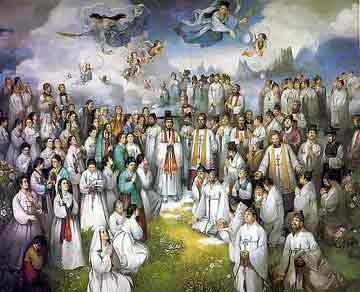
Today is the feast of St. Teresa Benedicta of the Cross (Edith Stein), a Jewish Catholic martyr of the 2oth century.  I am currently reading a book called Edith Stein and Companions on the Way to Auschwitz. I have hardly gotten past the first few pages, actually the first few paragraphs of the Foreward by Fr. Ralph McInerny who died this past January.  I will simply quote them for you to ponder:

Once, in monasteries, religious houses, and seminaries, the Roman Martyrology was read in the refectory before meals.  Each day some of those who had given their lives in witness to the faith were commemorated by name, and often the tortures they underwent were described.  Each day’s entry ended with a sentence beginning “et alibi aliorum plurimorum sanctorum . . . .” And elsewhere many other saints . . . . This tradition continues in some monasteries.

We may feel sad for all the anonymous martyrs gathered into that commodious final sentence, but that would be a mistake.  They are all entered into the Book of Life, and the names of each are known to God.  For all that, it is important for us, not them, that the names and sufferings of some be explicitly known by us.  The saints are put before us as models of the Christian life, and martyrs are the ultimate models.  We need to know more about some of them.

“For all that, it is important for us, not them, that the names and sufferings of some be explicitly known by us.”  A good friend of mine recently came over to our house to borrow some books on martyrs, so that she and her husband could read aloud from them once a week to their children.  She perceives–as did Fr. McInerny–the importance of familiarizing ourselves with those, not much different from us, who have gone before us, braving death for the sake of Christ. Reading their lives can give us courage as well.  One finds that they are pretty much ordinary folks like the rest of us who were simply willing to rely on Christ for what is humanly impossible.  One of my favorite stories is of one of the Ugandan martyrs,I believe.  He was too afraid to face death, but another held out his hand to him and said something to the effect that he would hold his hand and help him.  That scene is, for me, such a visible playing out of the desire of the Holy Spirit, our Helper, who holds out His hand to each of us.  “Be not afraid.”

The pass of suffering

In reading the book by Richard Wurmbrand this past week, it is hard not to think of all those who have gone before us to Christ by the path of martyrdom and the many who tread that path today.  This poem by Emily Dickenson succinctly sums up their secret and is an encouragement to all of us.

Through the straight pass of suffering
The martyrs even trod,
Their feet upon temptation
Their faces upon God.