“Mary-darkness, faith’s walled place”

This Sunday’s poem is one by Jessica Powers, written in 1948:

Advent

I live my Advent in the womb of Mary.
And on one night when a great star swings free
from its high mooring and walks down the sky
to be the dot above the Christus i,
I shall be born of her by blessed grace.
I wait in Mary-darkness, faith’s walled place,
with hope’s expectance of nativity.

I knew for long she carried me and fed me,
guarded and loved me, though I could not see.
But only now, with inward jubilee,
I come upon earth’s most amazing knowledge:
someone is hidden in this dark with me.

               ~Jessica Powers, The Selected Poetry of Jessica Powers, p. 81.

A pure transparent pool

I’ve been thinking about how I would answer my own query at the end of yesterday’s post, and one thing that immediately came to mind that brings beauty into my own life is a little photo album of art prints and such that I have collected.  For many of them I have an accompanying quote on the facing page.  Often I use it as an accompaniment in prayer, a source of meditation.  One example of this can be found here.  And here is another example:

I find this image of Mary quite beautiful.  Its title is Mary, the Mother and Consolation of the Grieving.   The following is the poem I have placed opposite it:

THE POOL OF GOD

There was nothing in the Virgin’s soul
that belonged to the Virgin–
no word, no thought, no image, no intent.
She was a pure, transparent pool reflecting
God, only God.
She held His burnished day; she held His night
of planet-glow or shade inscrutable.
God was her sky and she who mirrored Him
became His firmament.

When I so much as turn my thoughts toward her
my spirit is enisled in her repose.
And when I gaze into her selfless depths
an anguish in me grows
to hold such blueness and to hold such fire.
I pray to hollow out my earth and be
filled with these waters of transparency.
I think that one could die of this desire,
seeing oneself dry earth or stubborn sod.
Oh, to become a pure soul like the Virgin,
water that lost the semblances of water
and was a sky like God.
~Jessica Powers

“You are the Custodians of Beauty”

A couple of months ago, I began a series of posts on beauty.  Pope Benedict XVI just last week addressed a group of some 250 artists gathered in the Sistine chapel on this very theme. What particularly struck me in his address was the link he made between beauty and hope.

Unfortunately, the present time is marked, not only by negative elements in the social and economic sphere, but also by a weakening of hope, by a certain lack of confidence in human relationships, which gives rise to increasing signs of resignation, aggression and despair.  . .  . What is capable of restoring enthusiasm and confidence, what can encourage the human spirit to rediscover its path, to raise its eyes to the horizon, to dream a life worthy of its vocation–if not beauty? . . . the experience of beauty, beauty that is authentic, not merely transient or artificial, is by no means a supplementary or secondary factor in our search for meaning and happiness; the experience of beauty does not remove us from reality, on the contrary, it leads to a direct encounter with the daily reality of our lives, liberating it form darkness, transfiguring it, making it radiant and beautiful. [You can read the rest of the address here.]

Though this was addressed particularly to artists, I am convinced of the importance of all of us having this mind in the living of our daily lives.  We can all be “custodians of beauty” (Paul VI) wherever we are.  Even if all we do–and by no means of little importance–if all we do is constantly invite the Holy Spirit to make of our souls a thing of beauty, we will be a worthy custodian of beauty.  We each need contact with beauty ourselves, true beauty, that is–art, music, poetry, literature, nature, people–and we each need to be purveyors of beauty to those around us.  And, as we do this, I think we will discover that link that Pope Benedict spoke of between beauty and hope.

Need I say that most of all we need to long for the beauty of God, a longing that will not be fulfilled until we see Him face to face.    “The sweetest thing in all my life has been the longing . . .to find the place where all the beauty came from.” (C.S. Lewis, Till We Have Faces)And isn’t that what Advent is all about?

I would be interested in where you find beauty: what books you’ve read, how you bring beauty into your homes, etc.  Please feel free to comment.

Bless the Lord, O my soul

Bless the Lord, O my soul, and forget not all his benefits,
who forgives all your iniquity,
    who heals all your diseases,
who redeems your life from the Pit,
    who crowns you with steadfast love and mercy,
who satisfies you with good as long as you live . . .    (Ps 103.2-5a)

O give thanks to the Lord, for he is good;
for his steadfast love endures forever!  (Ps 106.1b)

Bless the Lord, all our souls!   A blessed Thanksgiving to each of you.

The Homecoming

Still thinking a lot about our Homeland, and, of course, about my aunt’s journey there.  I was thumbing through my collection of Jessica Power’s poetry and found this most apt poem.  (Poetry is one of the solaces in my life.)

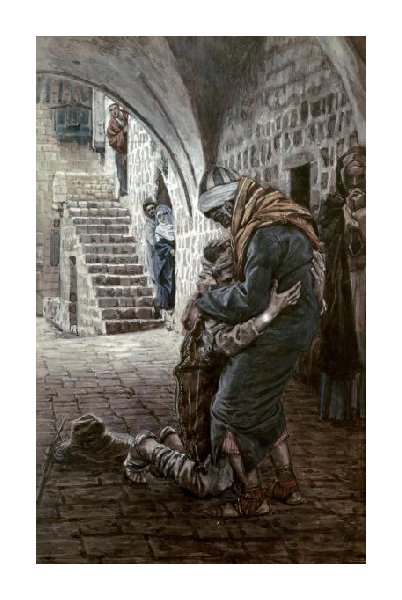
Return of the prodigal son (Tissot)

The Homecoming

The spirit, newly freed from earth,
is all amazed at the surprise
of her belonging: suddenly
as native to eternity
to see herself, to realize
the heritage that lets her be
at home where all this glory lies.

By naught foretold could she have guessed
such welcome home: the robe, the ring,
music and endless banqueting,
these people hers; this place of rest
known, as of long remembering
herself a child of God and pressed
with warm endearments to His breast.

            ~Jessica Powers, The Selected Poetry of Jessica Powers, p. 53

The same will be true for us: the robe, the ring, the banqueting, and best of all, the warm endearments as we are pressed to His breast.

Carry your homeland in your heart

For obvious reasons (my aunt’s death and it being the end of the liturgical year), I’ve been thinking about our Homeland.  As Christians, it can be all too easy to forget that we are citizens of heaven first and of our country second.  This quote from what looks like will be a great novel, emphasizes this point.  (Read “Christian” instead of “Jew”.)  The conversation is between a young German and his teacher, a Jew, in the early 1900’s.

    “Does it make any difference, being a Jew?”
     Dr. Mendel looked down at the tablecloth, the plush tablecloth that had been there all of Max’s life, and smoothed it with his familiar hand.  He did not answer for some time.  
     “Ah”, he said.  “At last we come to it.  Yes, Max, it does.  It makes a great deal of difference.  A Jew does not ever quite belong to the country in which he lives.  I have been a French Jew, and I have been a German Jew, but I have never been a Frenchman or a German.  The Jews are a people who carry their homeland with them wherever they go because it is in their souls and not in the streets of cities or in the villages and fields and woods where other people allow them to live.”
     “Is their homeland where God lives?”
     Dr. Mendel raised his head and looked searchingly at Max.
     “It should be, Max, it should always be, perhaps for everyone.  But it is not always so, even with Jews.  They also, as other people do, often make another homeland for their souls.  Perhaps it is France, or Germany, or science, or music, or the making of much money.  Then, because they have lost God, they have lost the distance that should be precious to them, the distance from which it should be easier to look calmly at all these passions, the loves and hatreds and fears, which drive wars and draw frontiers and arm people to fight over them.”   (Lucy Beckett, A Postcard from the Volcano, p. 57)

Come soon

My mom had only one sibling, a younger sister, my Aunt Dorothy.  After my mom died ten years ago, my aunt became my other mother.  I would tell her: “You’re the closest thing to my mother that I have, and I’m the closest thing to my mother that you have.”  I could go visit her and feel like I was at my mom’s.  I could find the same unconditional love there as I did at my mom’s.  She’s been sick the last couple of months with recurrence of cancer, and I was able to spend some good times with her.  My cousin, Matt, called yesterday and said that she had taken a turn for the worse, so I drove up immediately to see her.  She was unresponsive, but I was able to tell her I loved her and God loved her and thank her for everything.  This morning I found out that she died peacefully a half hour after I left, with her two youngest children holding her, one of them with her hand on my aunt’s heart. 

I can’t help but think that I’m starting Advent early.  Advent is all about Christ’s coming, His first coming and His second coming, and these kinds of comings at the moment of death.  Of course, I’m mourning her loss.  I’ve lost my other mother.   I’m now the oldest on that side of the family.  But she’s with the One who loves her the most.  The One we all long to be with.  This poem has been going through my mind the past few hours. 

Come Soon

I set my candle where the shadows loom,
A flame of faith between the eyes of fate,
And I am waiting in the windy gloom;
O come, my Love, for it is growing late.
Small doubts on darkling wings flit here and there
Uncertainly in the grey, lingering light;
Mysterious music haunts the troubled air,
And none but you can comfort me tonight.

I wait upon the moment’s hazard now;
Is there no power can hold the darkness back
Until you come?  O do not disavow
Your promised love–the one thing I most lack.
The hour is late, dear Love, come soon, come soon;
Then shall the night be lovelier than noon.

               ~Hazel Littlefied Smith

My aunt now knows the one thing she most lacked, for her Love has come for her.  May He come soon for all of us “waiting in the windy gloom.”

King’s Council

Today is the Feast of Christ the King.  “The King of love my shepherd is  . . . ” 

The poem for this Sunday speaks of a personal response to this King of ours:

King’s Council

From the four zones of my universe
They come, the rulers of my dioceses:
Fine-featured dreams and hawk-nosed fears,
Shabby compromises with scrawny necks.

Ageing hopes pull back their rounded shoulders.
Love comes in borrowed crimson, having spent
Her robes on the unbeautiful.  And, last
That patriarch, old faith, comes shuffling in.

Here is the council of me, God.  Look!  see,
Them all cast down their mitres at Your feet!

      ~Mother Mary Francis, P.C.C. (Summon Spirit’s Cry, p. 125)

New every morning

Some mornings it’s just hard.  It’s hard to get up.  It’s hard to pray.  It’s hard to face another day of living for others rather than yourself.   That’s where my thinking was going this morning.  So I did as I usually do when I wake up early, I reached for my Amy Carmichael devotional, Edges of His Ways.  (One of the main reasons I like to read her is because she always draws me deeper into Scripture.  I don’t end up with reading just some nice words, but I end up reading God’s word.)  Today’s entry is entitled “Ps 22.  Title LXX [in the Septuagint] Concerning the Morning Aid”  Well, that obviously struck home.   I stopped reading and grabbed my RSV.  The RSV reads “According to the Hind of the Dawn.”  So I then pulled out my Kidner commentary, in which he said that indeed the more faithful translation according to the Greek is “On the help at daybreak”.   Psalm 22, as you know–and as Amy reminds us–makes us think of the darkness and suffering of Calvary.  I’ll let you read the rest of what she wrote, and may you experience it as I did this morning, as the prophet writes in the Book of Lamentations: “His mercies are new every morning.” 

When we think of Psalm 22, we think most of the darkness and suffering of Calvary.  We know that it was in our Savior’s mind through those most awful hours; He quoted the first verse, He fulfilled all the verses.  Even though there is a burst of triumphant joy in that psalm of pain, it is chiefly the pain that comes to mind when we think of it.  But its title is not about pain, it is a word of beautiful joy: Concerning the Morning Aid. As I pondered this, my thoughts were led on to a familiar New Testament story: “It was now dark and Jesus was not come to them . . . They see Jesus walking on the sea”.  Looking back on that night the most vivid memory must have been, not the darkness or the weariness, not the great wind and the rough sea, but the blessed Morning Aid that came before the morning.
     So let us not make too much of the storm of the night.  “Even the darkness is not dark to Thee” [Ps 139.12]; “And He saw that they were distressed in rowing” [Mk 6.48].  The wind was contrary unto them then, perhaps it is contrary to us now.  But just when things were hardest in that tiredest of all times (between 2 a.m. and 6 a.m.), just then, He came.
      “I will not leave you comfortless: I will come to you” [Jn 14.18], He said, and He does come.  He always will come.  “His coming is as certain as the morning” [Hosea 6.3].  His Morning Aid comes before the morning.  If we do not see Him coming, even so, He is on His way to us.  More truly, He is with us.  “I am with you all the days, and all the day long” [Mt 28.20 Moule].

As I say in my sidebar, I started this blog to share things that have increased my hope during challenging times–those challenging times are not just in the past, but also in my present.  My prayer is that you, especially any of you who are so aware of your need for Him this morning, may know His help at daybreak, and to know that He is coming, and is indeed already with you.

Why set aside time to pray?

In one of her meditations Amy Carmichael answers this question: “There is so much to do.  Why set aside so much time just to pray?”   This is a question we all deal with.  We can have so many demands on our time, some very urgent.  Sometimes we find ourselves not praying because we have so much to do.  Amy’s answer gives pause for thought, and remember this comes from a woman who was a “mother” to many orphans–not exactly a woman with time on her hands:

The certain knowledge that the suggestion that prayer is waste of time is Satan’s lie; he is much more afraid of our prayer than of our work.  (This is proved by the immense difficulties we always find when we set ourselves to pray.  They are much greater than those we meet when we set ourselves to work.)