“When he was in the cave”

I have just recently been paying more attention to the subtitles of the psalm, and this one caught my eye today regarding Psalm 142: “A Maskil of David, when he was in the cave.  A prayer.”  When he was in the cave.  I feel that way often–do any of you as well?  That you’re in some kind of cave?  So I took some time to read Derek Kidner’s commentary on this psalm.  I can’t go into all of what he had to say in this brief post, but there are a few things I’d like to pass on.  But, first, the psalm:

Psalm 142 [141]

A Maskil of David, when he was in the cave. A Prayer. 1 I cry with my voice to the LORD, with my voice I make supplication to the LORD, 2 I pour out my complaint before him, I tell my trouble before him. 3 When my spirit is faint, thou knowest my way! In the path where I walk they have hidden a trap for me. 4 I look to the right and watch, * but there is none who takes notice of me; no refuge remains to me, no man cares for me. 5 I cry to thee, O LORD; I say, Thou art my refuge, my portion in the land of the living. 6 Give heed to my cry; for I am brought very low! Deliver me from my persecutors; for they are too strong for me! 7 Bring me out of prison, that I may give thanks to thy name! The righteous will surround me; for thou wilt deal bountifully with me.

What I gleaned from Kidner’s comments:

  • Ps 57 is also a psalm David wrote while in a cave.  That one is more “bold and animated, almost enjoying the situation for the certainty of its triumphant outcome.  In the present psalm the strain of being hated and hunted is almost too much, and faith is at full stretch.  But this faith is undefeated, and in the final words it is at last joined by hope.”
  • v. 1: with my voice has the sense of “aloud”.  Made me consider the importance–and “okay-ness”–of calling out loud to the Lord in our distress.  “David, Like Bartimaeus in the gospels, knows the value of refusing to lapse into silence.  That way lies despair.”  That way, lies despair.  Even if all we can do is cry out loud to the Lord, that will save us from despair . . . 
  • v. 2: my complaint can be translated “my troubled thoughts”   Kidner also points out about this verse David’s frankness, indicated by the words pour out and tell. 
  • One last comment on v. 3: The TEV translates When my spirit is faint as “When I am ready to give up.”  But Kidner also points out, there is almost a double emphasis on the word Thou–and, here we find the first of three “modest summits” in the psalm: “Thou knowest my way.”  And doesn’t that–the fact that God knows your way–make all the difference?  Can you find the other two summits in the psalm?
I am the one Jesus loves

What if we could each come to the place where we saw our primary identity–as John did–as “the one Jesus loves”?

Rate this:

Yesterday I was looking through some quotes I had gathered for some small booklets that I have in the past put together to sell at our bazaar.  As I read them, I thought to myself: “I’ve got some good quotes here!”  Here’s a favorite from Philip Yancey:

Not long ago I received in the mail a postcard from a friend that had on it only six words, “I am the one Jesus loves.” . . . When I called him, he told me the slogan came from the author and speaker Brennan Manning.  At a seminar, Manning referred to Jesus’ closest friend on earth, the disciple named John, identified in the Gospels as “the one Jesus loved.”  Manning said, “If John were to be asked, ‘What is your primary identity in life?’ he would not reply, ‘I am a disciple, an apostle, an evangelist, an author of one of the four Gospels,’ but rather, ‘I am the one Jesus loves.’”  What would it mean, I ask myself, if I too came to the place where I saw my primary identity in life as “the one Jesus loves”?   (Philip Yancey)

The Doorkeeper

To keep God’s door—
I am not fit.
I would not ask more
Than this–
    To stand or sit
Upon the threshold of God’s House
Out of the reach of sin,
To open wide His door
To those who come,
To welcome Home
His children and His poor:
To wait and watch
The gladness on the face of those
That are within:
Sometimes to catch
A glimpse or trace of those
That are within
That all I failed to be,
And all I failed to do,
Has not sufficed
To bar them from the Tree
Of Life, the Paradise of God,
The Face of Christ.

                        John W. Taylor

When the doors were shut

Have you ever been in a funk–one of those times when you’ve been walking along fine, experiencing great hope in the Lord about something, but all of a sudden that hope just disappears?  (Rhetorical question) Your thoughts just swirl around you.  You’re not able to concentrate on the truth.  Your thinking at the moment is not helpful, to say the least?


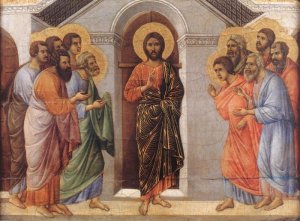
Christ Appears to the Apostles Behind Closed Doors (Duccio)

   Often our thoughts are like a crowd of people talking together in a room whose doors are shut, and because of the setting of some hope that had a bright sunrise, it is a sorrowful time.
     There may be love, understanding love, all around us, and yet we may be needing some word of life in our own soul, something that would do what only the Divine can do.  “Lord, to whom shall we go?  You have the words of eternal life” (Jn 6.68).
     One day lately, when feeling like this, I took my New Testament, and it opened of itself at John 20, and the first words I read were these: “The same day at evening . . . when the doors were shut . . . Jesus came and stood in their midst, and said . . . Peace be with you.  And when He had said this, he showed them His hands and His side.”  It is all there–the shut doors (for we cannot say aloud all that fills our mind), the dreary evening, then the risen Lord, and peace.   (Amy Carmichael, Edges of His Ways, pp. 131-2)

My prayer for you today is that the Lord may enter through any of your shut doors . . .

I can’t say God didn’t warn me

I can’t say God didn’t warn me.  This morning I woke up early and picked up a book I’m reading, Can God be Trusted?  The last section I read before Mass was all about our need for patience.  Then I heard that one of our sisters who works at one of our homes for the elderly had been at the ER since 1:00 a.m. with one of the residents.  After Mass I decided to run over to the ER and bring her some breakfast and a cup of coffee.  I got halfway there (without a cell phone, mind you) and realized I didn’t know the resident’s last name.  I called home when I arrived, found out the last name, but that didn’t turn up anyone on their list.  I called home again, which after some sleuthing, found out that that was her maiden name, not her married name.  Giving the correct last name didn’t turn up anyone either.  Come to find out they were at the ER at another hospital across town!.  I didn’t have time to run over there, so I came back home with an uneaten breakfast sandwich and the cup of coffee.  And don’t ask me God’s purpose in all that.  Maybe it was just an exercise in patience–which I definitely had the grace for today.  God’s ways are not our ways, but they are always the best.   At the least, I can ask your prayers for our resident, that God provide all she needs and that she may be at peace.  Thanks.  And may you all have the patience you need today to trust in God’s ways.

Little words (6)

Today I want to point out what is undoubtedly the most important little word that I have circled in my Bible.  To do that, I need to go back to the scripture I referred to in  “Little words (4)”:

“Behold, I go forward,  but he is not there;
     and backward, but I cannot perceive him;
on the left hand I seek him, but I cannot behold him;
     I turn to the right hand, but I cannot see him.
But he knows the way that I take:
     when he has tried me, I shall come forth as gold.”
                                           (Job 23:9-10)

As you can see, the word I’m referring to is “he”.  The fact that he knows the way I take–even though I cannot seem to find him or perceive him–makes all the difference.

Little words (5) “But if not . . .”

Three little words today: “But if not . . .”  And once again, it was Amy Carmichael who brought these to my attention.  The context is Daniel 3:16-18.  The three young men are threatened with the fiery furnace if they will not bow down the false god.  Nebuchadnezzar asks them: If I do this, who will snatch you from my hands? Their reply is: “O Nebuchadnezzar, we have no need to answer you in this matter.  If it be so, our God whom we serve is able to deliver us from the burning fiery furnace; and he will deliver us out of your hand, O king.  But if not, be it known to you, O king, that we will not serve your gods or worship the golden image which you have set up.”

Amy refers to this passage in this selection from her book, Thou Givest . . . They Gather:

Some years ago we were caught in the turmoil of Law Court trouble [Note: Amy rescued Indian children from temple prostitution]; it lasted for many months, and utterly exhausted those of us who were submerged in it.  During that time a friend came for a visit, and his (as it seemed to me) light faith was a trial, not a help.  Of course, we should win, he said–“Power over all the power of the enemy”–was not that our Lord’s own word?  What need for anxiety?  Everything would be all right.  I remember thanking God for the Psalms with their cries of depth.  This shallow sureness got me nowhere.  I could not forget “But if not . . .”

I do not think we should ever forget that “must” of our Lord Jesus, spoken just after the shining word about His coming: “So shall also the Son of Man be in His day.  but first He must suffer many things” (Lk 17.24-5).  They followed a suffering Savior, the warrior souls and heroes of faith all down the ages . . ..

Of course, this brings to mind that powerful eleventh chapter in Hebrews wherein is recounted all those who “by faith” “did not receive what was promised, since God had foreseen something better for us, that apart form us they should not be made perfect.”

May God give us the grace to be able always to say: “But if not . . .”

If It Were Not So.

       If It Were Not So

I thought I heard my Savior say to me,
My love will never weary, child, of thee.
Then in me, whispering doubtfully and low,
     How can that be?
     He answered me,
But if it were not so
I would have told thee.

I thought I heard my Savior say to me,
My strength encamps on weakness–so on thee.
And when a wind of fear did through me blow,
     How can that be?
     He answered me,
But if it were not so
I would have told thee.

     O most fine Gold
     That naught in me can dim,
     Eternal Love
     that hath her home in Him
     Whom seeing not I love,
     I worship Thee.

                        ~Amy Carmichael

Little words (4)

I’d like to point out another significant use of the little word, “but”, that I have circled in my bible:  Job 23:8-10.

“Behold, I go forward,  but he is not there;
     and backward, but I cannot perceive him;
on the left hand I seek him, but I cannot behold him;
     I turn to the right hand, but I cannot see him.
But he knows the way that I take:
     when he has tried me, I shall come forth as gold.”

Where would we be if we only had those first two verses and not the third beginning with that little word?  It makes all the difference.