Lord, have you forgotten me?

“Lord, have you forgotten me?”

Rate this:

Psalm 77 is another of the psalms that express pain and distress (see yesterday’s post for another).  “My soul refuses to be comforted . . . I am so troubled that I cannot speak. . . . Will the Lord spurn for ever, and never again be favorable?  Has his steadfast love for ever ceased?  Has God forgotten to be gracious?” 

I can recall being on retreat quite a few years ago at a Trappistine monastery in Dubuque.  Our Lady of the Mississippi Abbey is a wonderful and beautiful place to spend a retreat.  It is located on top of a bluff overlooking the Mississippi Valley.  Nonetheless, it had been a long season of dry, dry prayer in my life, and at one point that week I prayed my own version of Psalm 77: “Lord, have you forgotten me?”  (Short and to the point. 🙂  And I heard no answer at the time.

Psalm 77, with all its wonderful and clear expressions of anguish–yes, wonderful, because it is so important to find scriptures that actually express all the movements in our hearts–also includes a few lines of instruction for us when we find ourselves in those places of distress: “I will call to mind the deeds of the Lord; yea, I will remember thy wonders of old.  I will meditate on all thy work, and muse on thy mighty deeds” (vv. 11-12).  If we can only stop to remember at least one thing the Lord has done for us–and there are easily more than one, aren’t there?–then we may experience at least a slight lifting up of our hearts. 

Take time today to remember, to call to mind, at least one way the Lord has blessed you in your life, and let your heart be lifted up, at least a little.

The saddest prayer in the psalter

What do we make of Psalm 88, the saddest prayer in the psalter?

Rate this:

I have always found it a comfort that Night Prayer in the Liturgy of the Hours is primarily made up of psalms for the sick, the lonely, and the distressed.  The Church includes Ps 88 for Friday night, a psalm Derek Kidner refers to in these words: “There is no sadder prayer in the psalter.”  It is a psalm I have prayed myself in true earnest.  It begins: “O Lord, my God, I call for help by day; I cry out in the night before thee. . . . For my soul is full of troubles, and my life draws near to Sheol.  I am reckoned among those who go down to the Pit; I am a man who has no strength. . .” and ends with this verse, “You have turned my friends and neighbors against me, no darkness is my one companion left.” (JB) 
      I appreciate the honesty of the pray-er of this psalm, for we all have days or seasons during which we can identify with him.  What is most important is that it is a prayer.  It is always better to pray out of the honesty of our hearts than to feel that we cannot pray, that what we have to say is too sad or anguished or distressing and thus not acceptable to our God.  What father would not want to hear the anguish of his child? 
      Some final comments from Kidner:

With darkness as its final word, what is the role of this psalm in Scripture?  For the beginning of an answer we may note, first, its witness to the possibility of unrelieved suffering as a believer’s earthly lot.  The happy ending of most psalms of this kind is seen to be a bonus, not a due; its withholding is not a proof of either God’s displeasure or His defeat.  Secondly, the psalm adds its voice to the ‘groaning in travail’ which forbids us to accept the present order as final.  It is a sharp reminder that ‘we wait for adoption as sons, the redemption of our bodies’ (Rom 8.22f).  Thirdly, the author, like Job, does not give up.  He completes his prayer, still in the dark and totally unrewarded.

Kidner goes on to point out that, in fact, the author’s rejection was only apparent:

This supposedly God-forsaken author seems to have been one of the pioneers of the singing guilds set up by David, to which we owe the Korahite psalms (42-49; 84f.; 87f.), one of the richest veins in the Psalter.  Burdened and despondent as we was, his existence was far from pointless.  If it was a living death, in God’s hands it was to bear much fruit.

Let your anguish be a prayer.  In His hands it will bear much fruit.

Dying words

Give me your grace, good Lord . . . to think my greatest enemies my best friends.

Rate this:

I am currently reading a book by Paul Thigpen called Last Words, Final Thoughts of Catholic Saints & Sinners.  I would like to consider today a statement made by St. Thomas More while he was awaiting his execution.  He was reflecting on the life of Joseph of the Old Testament and Joseph’s response to his brothers who had sold him into slavery.  As we know, Joseph saw all that had happened to him in the Providence of God.  More wrote this just before he died:

Joseph greets his brothers

Give me your grace, good Lord . . . to think my greatest enemies my best friends; for the brothers of Joseph could never have done so much good with their love and favor as they did him with their malice and hatred.

His wounds that speak more loudly than words

Jesus “always lives to make intercession for us” (Heb 7.25).

Rate this:

Here is a major reason for you to have hope: Jesus “always lives to make intercession for us” (Heb 7.25).  He continually stands before the Father showing Him His wounds that speak more loudly than words, the wounds He gained by the passion of His love for you and that He chose to maintain in His flesh after His resurrection.  Think about that: He wanted to keep His wounds.  St. Bernard says: “Thy Heart has been wounded so that the visible wound should make us know the invisible wound of love.”  Another place he says: “The iron has pierced His soul and has touched His heart, so that He might know how to be compassionate to our infirmities.  The body’s wounds betray the secret of the heart and disclose a great mystery of love, the merciful goodness of God Who came from heaven to visit us.” That’s how much He loves us–how much He loves you.  And He continuously stands before the Father displaying His unfathomable love for you.

This ongoing prayer is the most important thing in the world, the only thing in the entire universe that carries real weight.  It is the prayer of a human being who is God, this God who became human but who returned to his Father to present the universe to him for all eternity. (Andre Louf, Mercy in Weakness)

So when you start thinking, “No one ever prays for me.  I’m all alone,” stop and remember “he always lives to make intercession for us” (Heb 7.25)–always lives to make intercession for you.

One drop less

What difference, really, can one person make?

Rate this:

One of our sisters is currently going into Detroit one day a week to work with the homeless.  As you can imagine, she can easily experience being overwhelmed by the greatness of the needs she encounters.  Any of us can have that same experience: e.g. what difference are we making in the fight against abortion or trying to amend the pending health care package so it will exclude provisions for assisted suicide . . . or “just” trying to instill the truth in a teenager’s mind.

A saying from Mother Teresa comes to mind: “The whole work is only a drop in the ocean.  But if we don’t put the drop in, the ocean would be one drop less.” 

Don’t cease to put your drops in, drop by drop.  Each one counts.

Two stones in your pocket

A man should carry two stones in his pocket.

Rate this:

A story from Rabbi Bunam:

A man should carry two stones in his pocket.  On one should be inscribed, “I am but dust and ashes.”  On the other, “For my sake was the world created.”  And he should use each stone as he needs it.

Which stone do you need to use today?

If you were to rewrite this story from a Christian perspective, what would you write on the second stone?

You are an icon of Jesus

“Nothing more closely resembles the face of Jesus and of God than the face of a human being, from the most famous to the most miserable.” (Andre Louf)

Rate this:

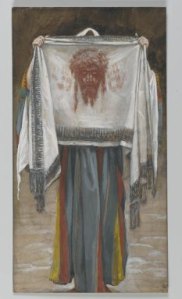
The Holy Face
The Holy Face (James Tissot)

Many of our sisters work with the poor and the marginalized.  Often I hear one or the other of them talking about seeing Jesus “in the distressing disguise of the poor” (Mother Teresa).  This morning I was reading a chapter from Andre Louf’s book, Mercy in Weakness, and came across this: “Nothing more closely resembles the face of Jesus and of God than the face of a human being, from the most famous to the most miserable.”   As I pondered that sentence,  I began to think about how, at the same time as looking for the face of Jesus in others, we need to look for His face in ourselves.  You are I are each an icon of Christ.  As I continued to read the chapter, I came across these confirming words:

The Holy Spirit, from the moment of our baptism, day after day, resculpts in our heart the features of Jesus’ face, not only his physical face but also his ‘spiritual’ face.  Every believer bears the glorious features of Jesus’ face, the holy face of our beloved Saviour, as though it were engraved in his or her heart, usually–sadly enough–without knowing it. 

As we strive to see Christ in others, let’s not miss His beauty in us.  You are an icon of Christ.

Desire to be thoroughly what you are

“Don’t long to be other than what you are, but desire to be thoroughly what you are.” (St. Francis de Sales)

Rate this:

For years I struggled with feeling that I just wasn’t good enough, that who I was wasn’t very likable.  I wasn’t content with just being “me” with the personality and temperament God gave me.  I have often gone back to these three quotes:

Perfection consists in doing His will, in being what He wills us to be.  (St. Therese)

Don’t long to be other than what you are, but desire to be thoroughly what you are.  (St. Francis de Sales)

Most people don’t achieve holiness because they’re fighting who they’re meant to be.  (attr. to Thomas Merton)

(emphasis added)

God made you to be you.  Don’t rob Him of the treasure that you are.  Be fully who He made you to be.

The Garments of God

“The Garments of God”, a poem by Jessica Powers.

Rate this:

The poem I have to share with you this Sunday is another by Jessica Powers:

The Garments of God

God sits on a chair of darkness in my soul.
He is God alone, supreme in His majesty.
I sit at His feet, a child in the dark beside Him;
my joy is aware of His glance and my sorrow is tempted
to nest on the thought that His face is turned from me.
He is clothed in the robes of His mercy, voluminous garments–
not velvet or silk and affable to the touch,
but fabric strong for a frantic hand to clutch,
and I hold to it fast with the fingers of my will.
Here is my cry of faith, my deep avowal
to the Divinity that I am but dust.
Here is the loud profession of my trust.
I need not go abroad
to the hills of speech or the hinterlands of music
for a crier to walk in my soul where all is still.
I have this potent prayer through good or ill:
here in the dark I clutch the garments of God.

Ancient prayer to Mary

Ancient Egyptian prayer to Mary.

Rate this:

On this, our Lady’s day, I thought I would share an ancient prayer to Mary, found on papyrus in Egypt.  (Theotokos means God-bearer.)

Under your
compassion
we take refuge,
Theotokos; do not
overlook our prayers
in the midst of tribulation,
but deliver us
from danger,
O only pure,
only blessed one.