I am nothing but obstacle

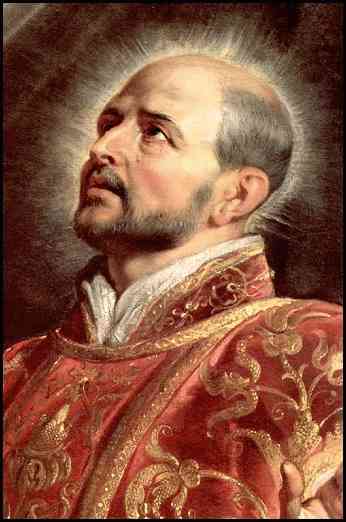
“For myself, I am convinced that I am nothing but obstacle.” (St. Ignatius of Loyola)

Rate this:

Ignatius of LoyolaLast year, on All Saints Day, our house began the custom of each sister drawing the name of a saint, one to get to know more and pray to during the year.  I prefaced our drawing of the slips on which were written the saints’ names with the comment that someone once made to me on a bus in Rome: “We often think that it’s our idea to learn more about a particular saint that then becomes our favorite, but in reality the saint is seeking us out and drawing us to him/herself.”  The saint’s name I drew was St. Ignatius of Loyola. 

Today being his feast day, I thought I would look through my two 600 page journals which are mostly made of quotes I have copied into them. (I have them indexed for obvious reasons. 🙂  The only quote I could find by St. Ignatius was:  “For myself, I am convinced that I am nothing but obstacle.”  (Must have struck home when I read it. 🙂  But what I have written next in my journal is this: “But does that put God off?  Absolutely not!  His love pursues me.  ‘The voice of my beloved!  Behold, he comes, leaping over the mountains, bounding over the hills‘ (Song of Songs 2:8).”  He can leap over any obstacle.  What can separate us from the love of Christ? “I am sure that neither death, nor life . . .” (Rom. 8.38).

Those whom He Himself wanted

Jesus calls each of us because He loves us.

Rate this:

Today is the anniversary of my final vows to our community, The Servants of God’s Love.  This morning before Mass I picked up a book I am reading–for the second or third time–Mercy in Weakness, by Andre Louf.  This is what I read: “Jesus called to him those whom he himself wanted” (Mk 3:13).  Of course, this refers to Jesus’ calling of the twelve apostles, but isn’t it just as true for us, each of us–for, yes, He called me to religious life, but it is just as true that He called you to whatever you said yes to in your own lives.  The RSV says: “those whom he desired”.  Think about that today: God called you, and me, out of desire for you.

A person was simply selected because Jesus preferred him, without any further motives.  Jesus chooses the rich and the poor, Jewish nationalists and collaborators, ordinary people and fishermen.  At the moment of selection what matters is not what these people are.  He simply prefers them because he loves them, each one individually.  Nothing other than Jesus’ love and preference explains this selection.

Calling of St. Peter and St. Andrew (James Tissot)

He prefers you because He loves you, short and simple.  And not just when He called you.  Even now.

The heart of God in the words of God

The Hand that holds the seven churches also is laid upon each one of us individually.

Rate this:

One of the things Amy Carmichael has taught me to do is to pay more attention to things like what verse follows a verse, or to the little words in scripture, like “but”.  Here’s an example of a verse following upon a verse:

In the Bible we have ‘the heart of God in the words of God’, as someone said hundreds of years ago; and now here is something for you from the heart of God in the words of God:

                    In His right hand were seven stars.  Rev. 1.16
                   But He laid His right hand upon me, saying, “Fear not.”  Rev. 1.17

Did you ever fear a little as you thought of difficulties ahead?  Did you ever think, ‘The Lord Jesus has so many to take care of, how will He have time to think of me”?  We have the answer to such thoughts here.  It is the Hand that holds the seven stars (the seven churches, all the worlds and the Heaven of heavens), it is that Hand that is laid upon each one of us, and to each one the word is the same, ‘Fear not’.”
     This does not mean that there will not be difficulties and hard fights, and (if we are real soldiers) battle-wounds.  Look at the next ‘Fear not’. ‘Do not fear what you are about to suffer’ (Rev. 2.10).  In the day when those words were written, the things that true Christians were about to suffer were terrific.  But even though we have not to go through torture of the body, we shall all have to endure something which is really suffering, and which God knows is suffering; and so we have the glorious word at the outset, ‘Fear none of these things . . .; be faithful unto death, and I will give you the crown of life.’

Loneliness

Loneliness, along with fear and weakness, is the greatest cause of human suffering.

Rate this:

All of us experience loneliness at different times, and sometimes we experience long seasons of loneliness: when someone we dearly love dies, when we’re going through an illness, when we take on a new responsibility, when we age and are facing death.  I’ve come across some good reflections on loneliness that I thought I would share with you:

I think that part of being human is being alone.  And being lonely.  I think that one of the stresses on a lot of our friendships is that we require the people we love to take away that loneliness.  And they really can’t.  And so, when we still feel lonely, even in the company of people we love, we become angry with them because they don’t do what we think they’re supposed to do.  Which is really something they can’t do for us.  (Rich Mullins)

The grace of loneliness is one of the most precious gifts that God gives to us in our path to sanctity.  (S.C. Biela)

Loneliness is the place of encounter with God.  At the same time, it is a difficult trial of faith.  Therefore, we should never face it by relying on our own strength.  (S.C. Biela)

The Holy Spirit is the answer to our loneliness, which along with fear and weakness, is the greatest cause of human suffering.  What really overcomes loneliness? . . . having a friend, someone to share thoughts with, a companion.  If we are open to him, this is what the Holy Spirit wants to be to us.  It is again St. Basil who says that the Holy Spirit was ‘the inseparable companion’ of Jesus during his life on earth, and that the Spirit wants to be the same for us . . . .
     If it is possible for weakness to provide an occasion for us to experience the strength of the Spirit, it is possible for loneliness to be the occasion and also the stimulus for us to experience the Spirit as ‘sweet guest.’ (Fr. R. Cantalamessa)

Comments?

Thousands of stars

Seeing the stars at night requires deep darkness.

Rate this:

I can across this piece by Fr. Garrigou-Lagrange when I was going through a very dark time of prayer.  What he has to say applies also, of course, to any times of darkness in our lives–times when we can’t see the ending, wondering if it will be good or bad.  (Of course, God works everything for the good, but sometimes it’s hard to even see that, isn’t it?)  Fr. Garrigou-Lagrange writes: “If we are saddened at the approach of twilight, God could well answer us by saying: How can I otherwise reveal to you all those thousands of stars which can only be seen at night?”  Isn’t that the truth–we can only see stars if there is darkness–and a deep darkness at that.  And we can only see certain spiritual things (of just as much beauty as the stars on a clear, clear night) if we walk through certain darknesses that God allows.  “To You I lift up my eyes, O You who are enthroned in the heavens!” (Ps 123.1)  Lift up your eyes!

Stars at night

We conquer by His song

Amy Carmichael’s poem, “We Conquer By His Song”.

Rate this:

My share-a-poem-with-you this Sunday is from Amy Carmichael.

We Conquer By His Song

We see not yet all things put under Thee,
We see not yet the glory that shall be,
We see not yet, and yet by faith we see,
     Alleluia, Alleluia.

We see the shadows gathering for flight,
The powers of dawn dispel the brooding night,
The stedfast march of the triumphant light,
     Alleluia.

Be we in East, or West, or North, or South,
By wells of water, or in land of drouth,
Lo, Thou hast put a new song in our mouth,
     Alleluia.

Therefore we triumph, therefore we are strong,
Thou vision tarry, and the night be long,
For lifted up, we conquer by Thy song,
     Alleluia.

For more on singing, see Never be afraid of singing too much and Come, Christians, Join to Sing.

You are my favorite

I used to tell all my students, each of them, “You’re my favorite.”

Rate this:

I taught sixth graders for around eleven years–hey, eleven years of teaching eleven-year-olds!  And I loved every minute of it.  One of the ways God graced me was by giving me a unique love for each child.  I could truthfully say–and often did–to each one, “You are my favorite student.”  Sometimes I would walk around the class while they were doing silent reading and whisper, in all sincerity, in each ear, “You are my favorite student.”  Of course, they would ask, “How can that be true? How can we all be your favorite students?!”  Then, I would pull out a pile of my favorite books.  I would pick each one up and say, “This is my favorite book”, and so on.    I’d talk about how each book was a favorite for a different reason from the others. Then I would ask them, “How many favorite movies do you have?”  And then I would go on to explain how each of them could be my favorite student–and how to God, we are all His favorites.  Even to this day, I’ll have former students say, “Hi, Sr. Dorcee, am I still your favorite student?” and, of course, I’ll say, “Yes!!”

One day, on a Feast of Our Lady–I can’t remember which one–I was at Mass, and I looked up and saw one of my former favorite students across the way, and started thinking about her.  And, out of the blue, a thought passed through my head–which I’m sure was from Our Lady–“You’re my favorite.”  All I could do was smile . . . because I know she says that to each one of us.

Mary Magdalene

A Jessica Powers’ poem on Mary Magdalen.

Rate this:

I’ve done a lot of meditating over the years on today’s gospel.  For many long seasons of my life, I have felt that I have been with Mary weeping outside the tomb, Jesus calling my name, but I keep failing to recognize Him.  Learning to trust Him when I think He’s gone and I can’t recognize Him. (See “While it was still dark”)

Two paintings here of Mary before and after her conversion:

The Magdalene before her conversion (Tissot)
The Magdalene before her conversion (James Tissot)
The repentant Mary Magdalen (James Tissot)


On another note, this poem by Jessica Powers came to mind today.  In this poem, she writes about Mary’s encounter with Christ on the Cross and then her later life, where she lived as a contemplative hermit:

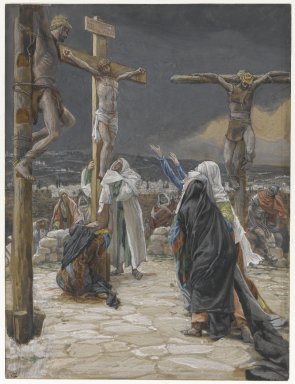
The death of Jesus (James Tissot)

The Blood’s Mystic

Grace guards that moment when the spirit halts
to watch the Magdalen
in the mad turbulence that was her love.
Light hallows those who think about her when
she broke through crowds to the Master’s feet
or ran on Easter morning,
her hair wind-tumbled and cloak awry.
What to her need were the restrictions of
earth’s vain formalities?
She sought, as love so often seeks and finds,
a Radiance that died or seemed to die.

One can surmise she went to Calvary
distraught and weeping, and with loud lament
clung to the cross and beat upon its wood
till Christ’s torn veins spread a soft covering
over her hair and face and colored gown.
She took her First Communion in His Blood.

O the tumultuous Magdalen!  But those
who come upon her in the hush of love
claim the last graces.  A wild parakeet
ceded its being to a mourning dove,
as Bethany had prophesied.  We give
to Old Provence that solitude’s location
where her love brooded, too contemplative
to lift the brief distraction of a wing.
There she became a living consecration
to one remembering.
Magdalen, first to drink the fountained Christ
Whose crimson-signing stills our creature stir,
is the Blood’s mystic.  Was it not the weight
of the warm Blood that slowed and silenced her?

The hands of love

The man born blind

Rate this:

Some things in life are hard to understand and to deal with–especially those terrible  things that happen to the innocent, especially when it’s our own children.  In his ninth chapter, John tells the story of the man born blind.  My brother, Rod, is legally blind as a result of his diabetes, and it has proved a great challenge to him.  I am currently reading the letters of Bede Jarrett, a provincial of the English Province of Dominicans from 1916-1932.  He has a thought-provoking reflection on John 9:

Think what it means to be born blind.  He could do nothing for himself, except what he had learned with great labour and trouble.  It must have seemed the worst possible thing to him.  Think of him as a child, a boy with all his strength for, as far as we know, he was otherwise perfectly healthy, his pent-up energy, and he couldn’t walk, ride or swim without someone coming to help and guide him, and tell him which way to go.  If you described the beauty of a flower, or the bloom of a fruit, to him, it meant nothing; he was born blind.  Horrible, hideous–and yet, what does our Lord say?  The apostles, seeing him, said, ‘Lord, who has sinned, this man or his parents that he should be born blind?’ Of course they put it down to sin (the Pharisees had a doctrine that a man could sin even in his mother’s womb), and our Lord said, ‘Neither hath this man sinned, nor his parents, but that the works of God should be made manifest in him.’ It was just the fact of his being born blind that made the glory of God so manifest.  ‘It has never been heard of since the world began that  man born blind hath received his sight.’ Others, yes, but never one born blind.  So just what seemed so cruel to him turned out to be this wonderful miracle, making manifest the glory of God.
     So we see that all circumstances, however adverse they seem to be to us, are always favorable to God’s plan, always, always, as to the blind man, the best thing for us.
     His hands are strong and powerful hands and we can confidently rest there.  Can we not sometimes see in the hands of a clever artist, or surgeon, the strength and deftness expressive of the mind that directs their action?  But with God, they are not only the hands of power, and not only the hands of wisdom, but of love, and it is only when we leave all things in his hands that we find complete serenity; and then a great peace shall come into our souls.

The blind man washes in the pool of Siloam (James Tissot)