The context of holiness

Digging into my 600 page journal last night and I found some gems from Fr. Marc Foley’s book, The Context of Holiness.  I’ll share them over the next few posts.  Hope they encourage you as they do me.

Becoming an adult does not mean that the deep emotional wounds of childhood disappear. Rather, being an adult means  choosing to make courageous decisions in the face of powerful emotions.

———–

When she [Thérèse] was assigned a job [as novice mistress] that she thought was too much for her to handle, she felt overwhelmed, incompetent, unqualified, and inadequate . . .

However, Thérèse does not apologize for her fears.  She does not berate herself for feeling like a child; rather her fears and insecurities are the context within which she places her trust in God.  It is as if Thérèse is saying to all of us: ‘There are many situations in life that trigger the deep-seated fears of childhood.  I have come to see that this is a normal part of daily life.  I have also come to see that our childhood wounds are not obstacles to our spiritual growth but are in some mysterious manner the path on which we find our way back to God.  The deep-seated fears of my life have forced me to abandon my self-sufficiency and to rely upon the grace of God.’

Is it time to sit down for lunch?

Each tiny act is an extraordinary event, in which heaven is given to us, in which we are able to give heaven to others.

It makes no difference what we do, whether we take in hand a broom or a pen.  Whether we speak or keep silent.  Whether we are sewing or holding a meeting, caring for a sick person or tapping away at a typewriter.

Whatever it is, it’s just the outer shell of an amazing inner reality: the soul’s encounter, renewed at each moment, in which, at each moment, the soul grows in grace and becomes ever more beautiful for her God.

Is the doorbell ringing?  Quick, open the door!  It’s God coming to love us.  Is someone asking us to do something?  Here you are!  . . . it’s God coming to love us.  Is it time to sit down for lunch?  Let’s go–it’s God coming to love us!

(Madeleine Delbrêl)

Praying for laughter

“I was close to giving up on prayer altogether. Instead, I started to pray for laughter.”   These words of Amy Julia Becker remind us that sometimes that is the perfect prayer to pray.  Read her guest post on Ann Voskamp’s blog here.  Good to read even if you don’t feel like giving up on prayer . . . ’cause some day you surely could.

This photo will make you laugh–if nothing else.  Me as a child. 🙂

Dbig mouth

“You don’t see Him, but He is there.”

Friday . . . from the archives

Sr. Dorcee, beloved's avatarWitnesses to Hope

You know, most of the time–as I freely admit in the sidebar–I am writing these posts mainly for myself.  This is a post I actually wrote quite awhile ago, but somehow never posted.  Again, we hear from Amy Carmichael.  This seems to be taken from a letter she wrote in response to someone else’s, someone who was experiencing dryness in prayer, and someone who had sent her some dried myrtle.

You are sitting on the well-side with your Lord who once was weary and sat thus on the well.  You don’t see Him, but He is there.  You are His honoured one: “Blessed are they that have not seen and yet have believed.”

The bog myrtle you gave me is in my Daily Light, and every day its sweetness is a special little joy to me.  It knows nothing of that.  It only knows it is dried up, a…

View original post 121 more words

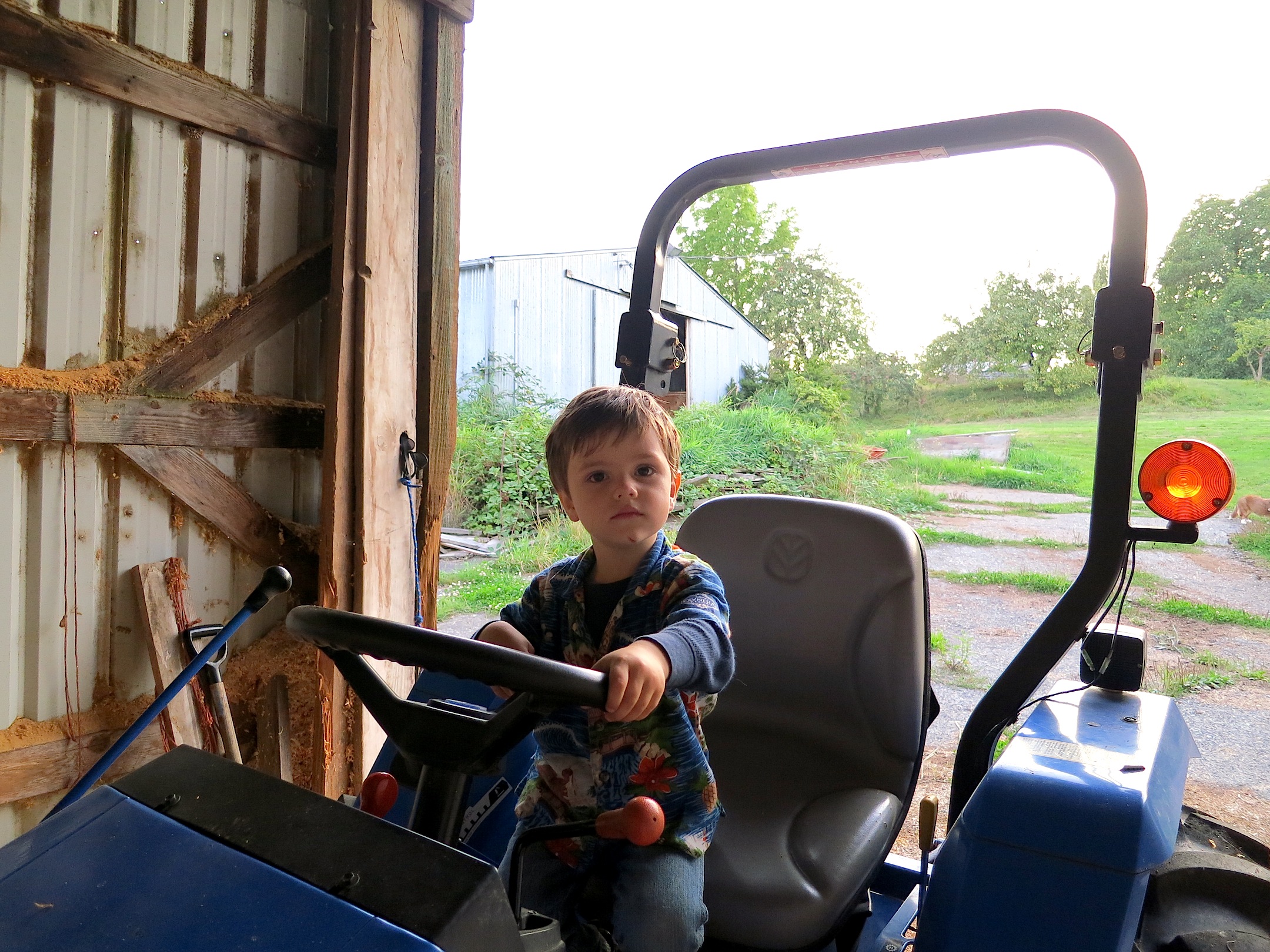
The Real Driver

So important to remember . . .

barnstormingblog's avatarBarnstorming

farmertheo4

farmertheo1

I heard an old man speak once, someone who had been sober for fifty years, a very prominent doctor.
He said that he’d finally figured out a few years ago that his profound sense of control,
in the world and over his life,
is another addiction and a total illusion.
He said that when he sees little kids sitting in the back seat of cars,
in those car seats that have steering wheels,
with grim expressions of concentration on their faces,
clearly convinced that their efforts are causing the car to do whatever it is doing,
he thinks of himself and his relationship with God:
God who drives along silently, gently amused, in the real driver’s seat.

~Anne Lamott from Operating Instructions

mantractor

View original post

When you get out of your cave

The psalm for tomorrow’s Liturgy is Psalm 18, written by David when God saved him from the hand of Saul.  It begins “I love thee, O Lord, my strength.”  Here is Amy Carmichael’s commentary on this and the next verse.

Let us pray for one another that we may not go into caves. [cf. Ps 142]  Any one of us might do it at any moment, but for the grace of God.  The heading of this Psalm says that it is the Song which David spoke to the Lord . . . when he was delivered from his enemies—those enemies who had driven him into the cave.

There are many caves besides the cave of selfishness and self-love . . .; but whatever our cave is, the moment we get out, the devil is sure to tell us we shall soon be back again, and so the second verse in the LXX is delightful: ‘The Lord is my firm support’.

Is that not just what we want?  We know our weakness, we have proved it many a time; but we need not fall, for ‘the Lord is our firm support’.  I have noticed that some of the happiest people are not by nature the strongest, but they are those who love the Lord their Strength with a confident, joyful love; and they are not constantly thinking of themselves and their weakness, nor do they ever dream of not enjoying what He gives them to do, for ‘the joy of the Lord is [their] strength’, and their Lord is their firm support.”

He sits by the door

“Just as human affection, when it abounds, overpowers those who love and causes them to be beside themselves, so God’s love for men emptied God (Phil 2.7).  He does not stay in His own place and call the slave, He seeks him in person by coming down to him.  He who is rich reaches the pauper’s hovel, and He displays His love by approaching in person.  He seeks love in return and does not withdraw when He is treated with disdain.  He is not angry over ill treatment, but even when He has been repulsed He sits by the door (cf. Rev 3.20) and does everything to show us that He loves, even enduring suffering and death to prove it.”  (Nicholas Cabasilas)